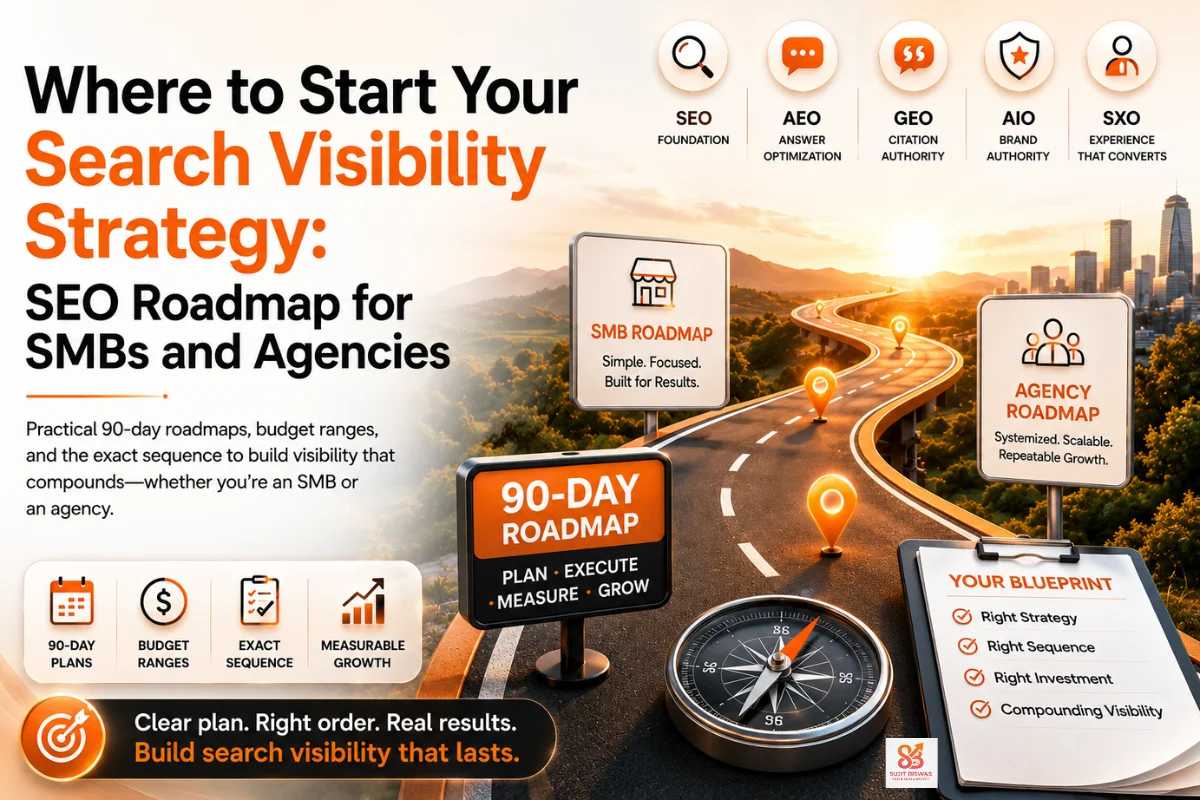

A search visibility strategy roadmap is more than a list of SEO tasks—it’s the sequence that determines whether your efforts compound or stall. The biggest mistake most businesses make isn’t choosing the wrong tactics; it’s applying the right tactics at the wrong time. Publishing content before fixing technical issues, building authority before establishing topical relevance, or investing in AI search before building a solid SEO foundation all lead to wasted effort.
Throughout this series, we’ve explored the five layers of the Search Visibility Stack, the evolution of search, AI optimisation, platform-specific citation strategies, and the maturity model. The final question—and the most practical one—is simple: where should you actually start?
The answer depends on your business. A small business owner and an agency may follow the same framework, but their priorities, budgets, and execution sequence are very different. This guide brings everything together into two practical 90-day search visibility strategy roadmaps, showing exactly what to do first, what to prioritise next, and how to build sustainable visibility across both traditional and AI-powered search.
The most common SEO mistake — at any budget level — is not a tactical error. It is a sequencing error: investing in content before the site can be properly crawled, or building links before there is anything worth linking to.
Before You Start: Assess Your Current Position
Every effective search visibility strategy roadmap begins with an honest assessment of your current position. Before deciding what to prioritise—or whether to follow the SMB or agency roadmap—you need to understand your current level of search maturity. Starting with advanced tactics before you’ve built the fundamentals leads to wasted time, budget, and effort.
Regardless of which track applies to you, start with the 18-question maturity diagnostic from Post 07 before spending a single dollar on execution. It takes fifteen minutes and tells you which of the five stages you are actually at — not which stage your ambition says you should be at. The single most expensive mistake covered throughout this series is stage-jumping: investing in GEO and AI citation tactics while the underlying SEO and AEO foundation cannot support them.
TRACK A — FOR SMALL BUSINESSES
Small businesses operate under a specific constraint that shapes everything else: limited time, limited budget, and the owner is frequently the one doing the work alongside running the actual business. The roadmap below is built for that reality — sequenced so that early wins are visible quickly, building the confidence and cash flow to invest further.
Realistic budget expectations
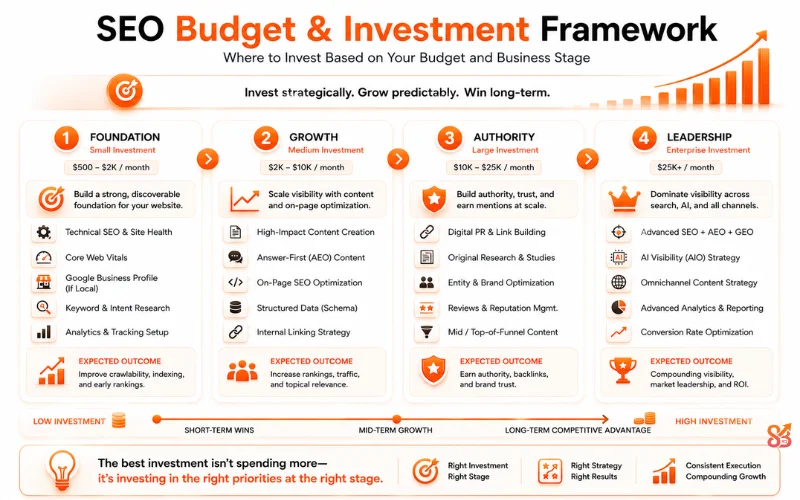
Most small businesses fall into one of three practical tiers. DIY with free tools costs time rather than cash — Google Business Profile, Google Search Console, and basic on-page work cost nothing but require four to six hours per week of consistent effort. A focused freelancer or boutique agency typically runs $500–$2,000 per month and delivers a reduced but coherent scope. A full-service agency with technical, content, and authority-building work integrated runs $1,500–$5,000 per month, with $1,497/month as the reported 2025 median retainer for SMB SEO clients.
The decision between DIY and hiring is fundamentally an opportunity cost calculation, not a capability question. Most owners are capable of learning the basics. The real question is whether the time spent learning and executing SEO is worth more than the agency fee, given what that same time could generate elsewhere in the business.
The 90-day SMB roadmap
Days 1–30
Foundation: get the basics correctly in place
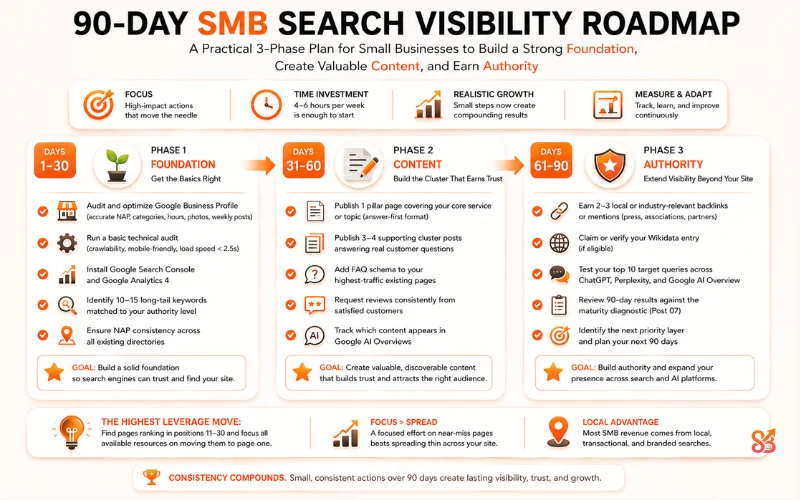
- Audit and complete Google Business Profile — accurate NAP, categories, hours, photos, and weekly posting cadence
- Run a basic technical audit — confirm the site is crawlable, mobile-friendly, and loads in under 2.5 seconds (use free PageSpeed Insights)
- Install Google Search Console and Google Analytics 4 if not already active
- Identify 10–15 long-tail, realistic keywords matched to your actual authority level — not competing against national brands for broad terms
Clean up NAP consistency across any existing directory listings
Days 31–60
Content: build the cluster that earns trust
- Publish 1 pillar page covering your core service or topic comprehensively, answer-first formatted per the AEO principles in Post 03
- Publish 3–4 supporting cluster posts answering specific, real customer questions sourced from actual conversations and search queries
- Add FAQ schema to your highest-traffic existing pages
- Request reviews systematically from recent satisfied customers — aim for a steady trickle, not a single batch
Begin tracking which content pieces appear in Google AI Overviews when you manually search your target queries
Days 61–90
Authority: extend visibility beyond your own site
- Pursue 2–3 local or industry-relevant backlink or mention opportunities — local press, industry associations, supplier or partner cross-links
- Claim or verify your Wikidata entry if your business has any press history or notable local presence
- Manually test your top 10 target queries across ChatGPT, Perplexity, and Google AI Overview — record which appear and which do not
Review the 90-day results against the maturity diagnostic from Post 07 — re-score and identify the next priority layer
The single highest-leverage move for resource-constrained SMBs
If you can only do one thing from this entire 11-post series with a limited budget, it is this: identify your pages currently ranking in positions 11–30 — page two or three of Google — and concentrate all available resource on moving them to page one, rather than spreading effort across your entire site. This is sometimes called a Micro-SEO approach, and the logic is sound: a focused budget targeting near-miss pages frequently outperforms a much larger budget spread thin across an entire site, because those pages already have partial relevance and authority signals — they need a push, not a foundation.
Most SMB revenue comes from transactional, local, and branded queries — the categories least affected by AI Overview zero-click behaviour. The panic about AI search killing SEO traffic applies disproportionately to broad informational content. A well-run local service business has less to fear here than the headlines suggest.
TRACK B — FOR AGENCIES
Agencies face a different constraint: the need for a repeatable, documented system that produces consistent results across multiple clients with different starting points, different budgets, and different stakeholder expectations. The roadmap below is built around building that system once and applying it client by client.
The six-pillar framework
A coherent 2026 agency strategy needs to plan for six pillars in parallel rather than treating SEO as a single linear checklist: technical foundations, content architecture, on-page optimisation, link and entity authority, AI search visibility (the AEO/GEO work covered in Posts 03–04), and measurement. Each pillar needs a named owner and ships on a 90-day tactical cadence within a 12-month strategic envelope — the SERP moves too fast for purely annual planning.
The 90-day agency client onboarding roadmap
Days 1–30
Audit and diagnose — clear the blockers
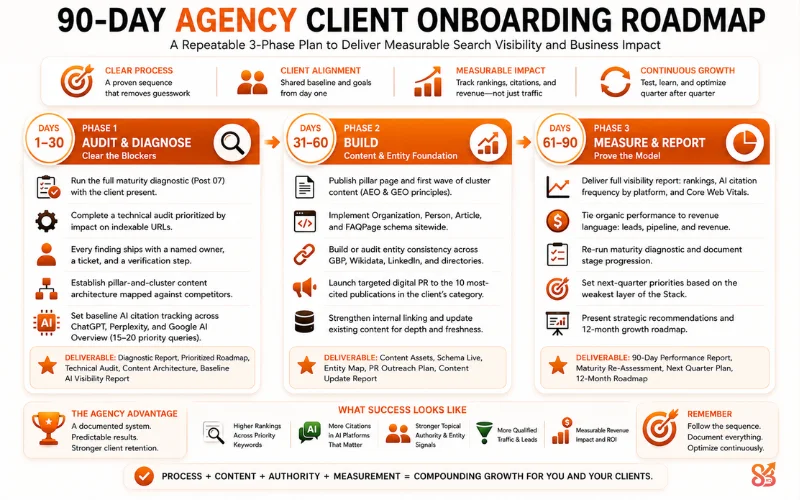
- Run the full maturity diagnostic from Post 07 with the client present — this becomes the shared baseline for the entire engagement
- Complete a documented technical audit prioritised by impact on indexable URLs, not alphabetical checklist order
- Every audit finding ships with a named owner, a ticket, and a verification step — technical recommendations with no implementation path are worthless
- Establish the pillar-and-cluster content architecture for the client’s primary topic area, mapped against competitor coverage
Set baseline AI citation tracking — manually test 15–20 priority queries across ChatGPT, Perplexity, and Google AI Overview per the framework in Post 09
Days 31–60
Build — content and entity foundation
- Publish the pillar page and first wave of cluster content, structured per the AEO and GEO principles from Posts 03–04
- Implement Organisation, Person, Article, and FAQPage schema sitewide — described in Post 09 as the single signal that moves citation rates across every AI platform
- Build or audit the client’s entity consistency across GBP, Wikidata, LinkedIn, and any industry directories — using the before/after framework from Post 05
Begin a targeted digital PR push toward the 10 publications most frequently cited in the client’s category across AI platform responses
Days 61–90
Measure and report — prove the model
- Deliver the first full visibility report covering traditional rankings, AI citation frequency by platform, and Core Web Vitals — not rankings alone
- Tie organic performance explicitly to revenue language stakeholders can act on — pipeline stages, not just sessions and impressions
- Re-run the maturity diagnostic and document stage progression as concrete proof of engagement value
Set the next-quarter priority based on which layer of the Stack scored weakest in the re-assessment
Pricing the work to match the sequence
| Client size | Typical monthly retainer | What it should include | Common failure mode |
| Micro / solo SMB | $500–$1,500 | Done-for-you content + basic technical monitoring, limited scope by design | Promising enterprise-scope deliverables at SMB pricing |
| SMB / local business | $1,500–$3,000 | Full technical, content, GBP management, basic GEO/AEO included as standard | Treating GEO as a paid add-on rather than how modern SEO is done |
| Mid-market / multi-location | $3,000–$8,000 | Comprehensive content velocity, structured link building, AI citation tracking across platforms | Spreading budget thin across too many pages instead of prioritising by impact |
| Enterprise | $8,000–$20,000+ | Full six-pillar execution, dedicated reporting, schema at scale, dedicated digital PR | Annual planning cadence in a market moving on a quarterly or faster basis |
The reported median 2025–2026 SMB SEO retainer sits around $1,497/month, and the median reported organic search ROI across First Page Sage’s 2026 data is 748% — roughly $22 returned for every $1 invested when the budget is allocated against a coherent plan rather than scattered tactics. The number that should anchor every agency pricing conversation is not the retainer figure — it is whether the sequencing matches the framework in this series. A correctly sequenced $1,500/month engagement consistently outperforms a poorly sequenced $5,000/month one.
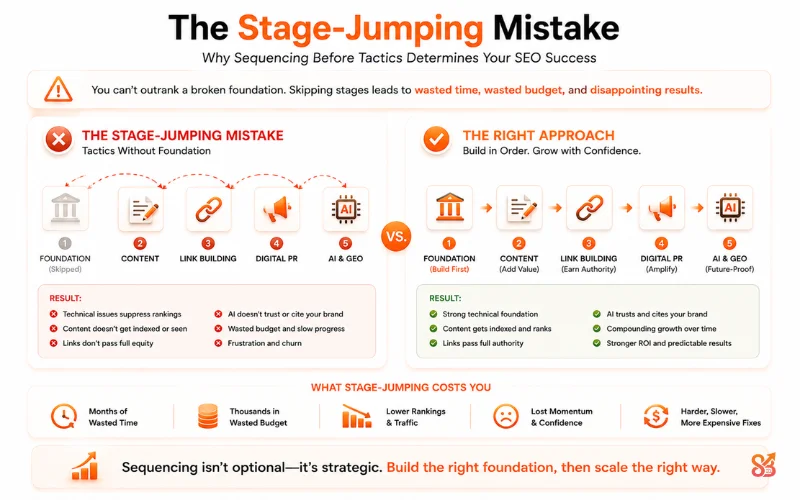
The mistake both tracks need to avoid
Whether you are a solo SMB owner or an agency managing forty client accounts, the single most common and most expensive error — repeated throughout this series since Post 07’s maturity model — is treating GEO and AI optimisation as separate, optional add-ons rather than how modern SEO is now done. Quality execution in 2026 integrates GEO into standard practice — structured content, FAQ schema, entity signals, AI-parseable formatting — at no separate cost, because these are not optional enhancements layered on top of SEO. They are what current SEO consists of.
If a proposal, a plan, or your own internal roadmap treats ‘AI search optimisation’ as a future phase rather than something woven through every phase from day one, that proposal is already operating on an outdated model.
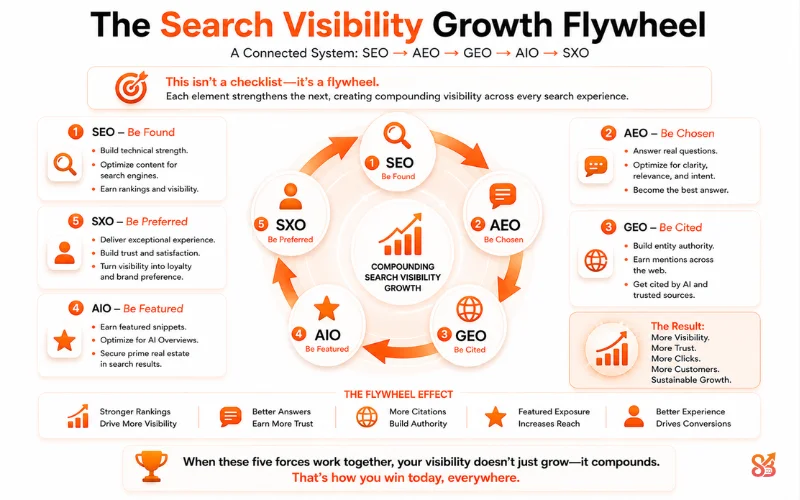
Closing the series: the argument this entire framework has been making
Eleven posts ago, this series opened with a single observation: ranking first is no longer the same thing as being visible. That gap — between rankings and genuine multi-surface visibility — is the reason the Search Visibility Stack exists as a five-layer framework rather than a single discipline.
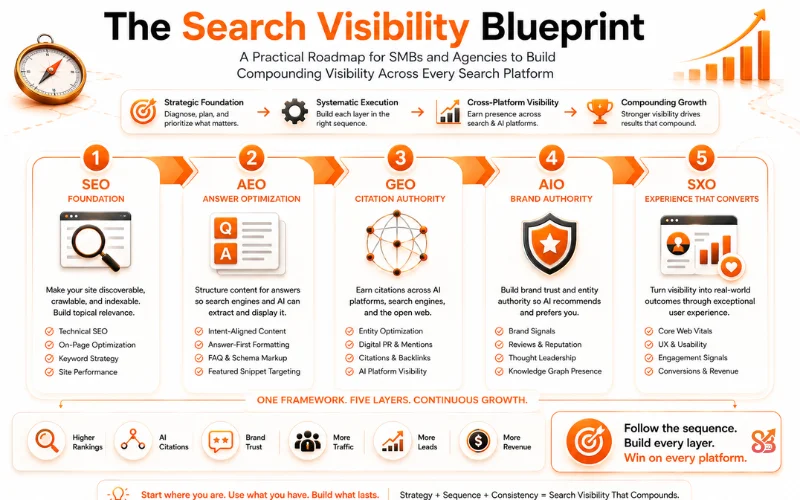
SEO builds the foundation that makes content discoverable. AEO structures it for extraction. GEO earns it citation. AIO builds the brand-level authority that makes citation automatic. SXO converts the visits that result into actual outcomes. Each layer depends on the one below it, and skipping ahead never produces the compounding results that working the full sequence does.
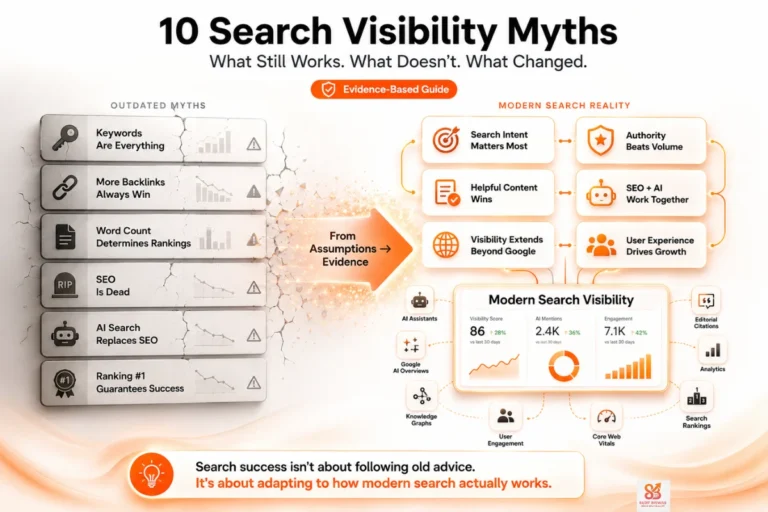
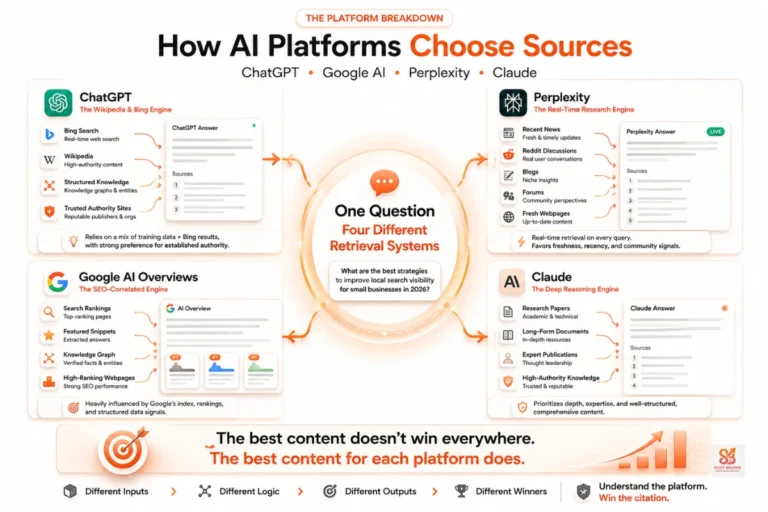
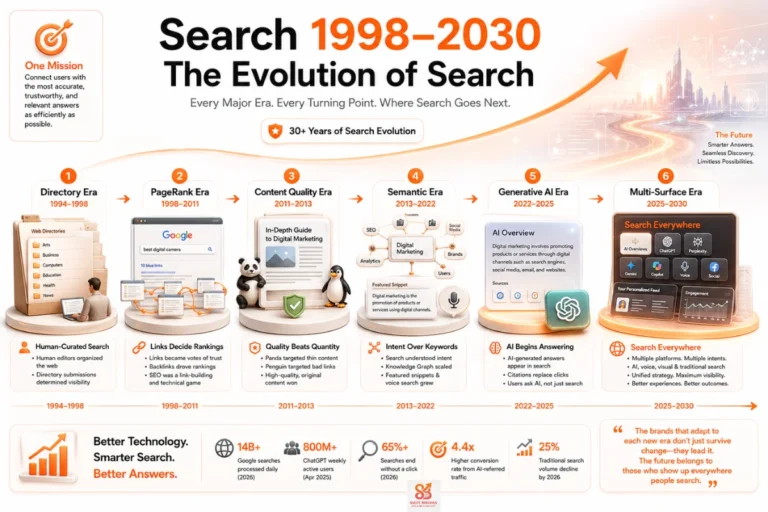
The maturity model in Post 07 gives you the diagnostic. The historical timeline in Post 08 shows why this pattern — each era’s tactics becoming the next era’s table stakes — has held for 28 years and shows no sign of stopping. The platform breakdown in Post 09 shows that even within the GEO and AIO layers, the work is not uniform across every AI surface. The myths in Post 10 clear away the outdated and overcorrected beliefs that waste the budget this closing post just helped you allocate properly.
What remains constant, across every layer, every platform, and every budget level covered in this series, is the principle stated at the very start: serve users genuinely, and the search systems — however they continue to evolve — will follow.
THE SEARCH VISIBILITY STACK — FULL SERIES INDEX
01. The Search Visibility Stack
02. SEO In AI Era
03. AEO: Writing for Answer Extraction
05. AIO: Building Brand Authority AI Recommends
06. SXO: Converting Visibility Into Outcomes
07. The Search Visibility Maturity Model
08. Search 1998–2030: The Full Timeline
09. How AI Platforms Choose Sources
10. Search Visibility Myths, Debunked
11. The Blueprint
← Back to pillar: The Search Visibility Stack
← Previous: The Platform Breakdown — How ChatGPT, Perplexity, Gemini, Claude, and Copilot Select Sources Differently
References and citations
- FastStrat. (2026, April). SEO for Small Business: The 2026 No-BS Guide. 90-day roadmap; AI Overviews affect informational queries disproportionately, transactional/local less so; GEO basics overlapping with classic SEO. https://faststrat.ai/seo-for-small-business-2026/
- theStacc. (2026, March). SEO Budget: The Complete Planning Guide. 63% of companies spend $500–$5,000/month; median ROI 748% per First Page Sage; budget tier breakdown by business size. https://thestacc.com/blog/seo-budget-guide/
- Boulder SEO Marketing. (2025, November). SEO Costs in 2026 | Pricing Guide for Local Businesses. GEO integrated into standard SEO at no extra cost; Micro-SEO Strategies for page 2–3 to page 1 movement; $2,000–$4,000/month typical SMB range. https://boulderseomarketing.com/seo-costs-guide-understand-seo-pricing-models/
- Digital Applied. (2026, April). SEO Strategy Template 2026: Complete Planning Guide. Six-pillar framework; pillar-and-cluster as canonical content model; quarterly tactical cadence within 12-month strategic envelope. https://www.digitalapplied.com/blog/seo-strategy-template-2026-complete-planning-guide
- Elescend Marketing. (2026, March). Smart SEO Strategies for Small Businesses 2026. Month-by-month SMB roadmap; local SEO results within 7–90 days; free-tool-first approach for limited budgets. https://www.elescendmarketing.com/blog/seo-strategies-small-business-limited-budgets
- Search Scale AI. (2026, April). SEO for Small Business: A Complete Strategy That Actually Works in 2026. DIY vs agency as opportunity-cost calculation; budget allocation shifts across campaign maturity phases. https://www.searchscaleai.com/blog/seo-for-small-business-complete-strategy-2026/
- FactoryJet. (2026, June). SEO Cost for Small Business in 2026: Real Monthly Pricing, Itemized. Budget tier breakdown; $1,497/month median SMB retainer per 2025 Search Engine Journal survey. https://factoryjet.com/blog/seo-cost-small-business-2026