
Every major shift in search technology produces the same headline. It appeared when social media took off. It appeared when mobile search overtook desktop. It appeared when voice assistants launched. It appeared when featured snippets started eating organic clicks. And it appeared again when ChatGPT demonstrated that users could get answers without visiting a search engine at all. Here is SEO in AI Era.
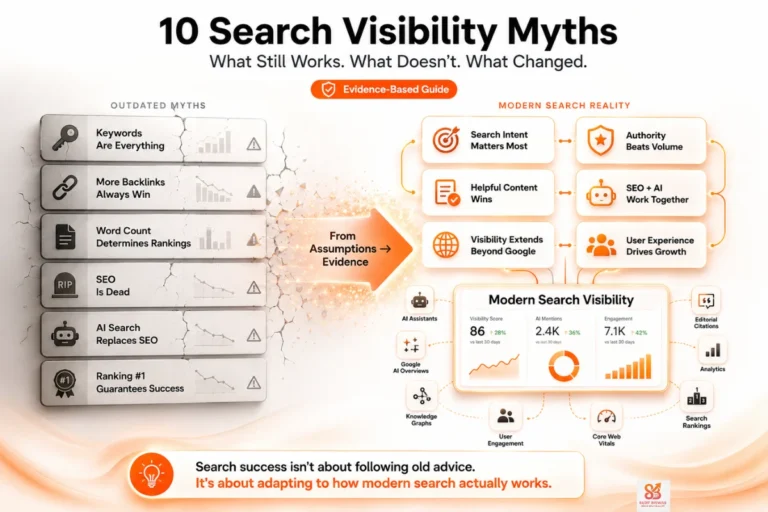
“SEO is dead.” It has been predicted so many times that the prediction itself has become a running joke in the industry. And yet, every time it gets made, real people — real marketing teams, real business owners — shift budget, pivot strategy, or abandon effective practices based on a claim that has never once been accurate.
Here is what is actually true: SEO has changed. Significantly. The version of SEO that worked in 2015 will not carry you through 2026. But the core discipline — helping search systems understand what your content is about and why it should be trusted — is as important as it has ever been. The difference is that the systems doing the evaluating have gotten dramatically more sophisticated.
SEO is not dead. SEO that stopped evolving after 2018 is dead. Those are very different statements with very different implications for your strategy.
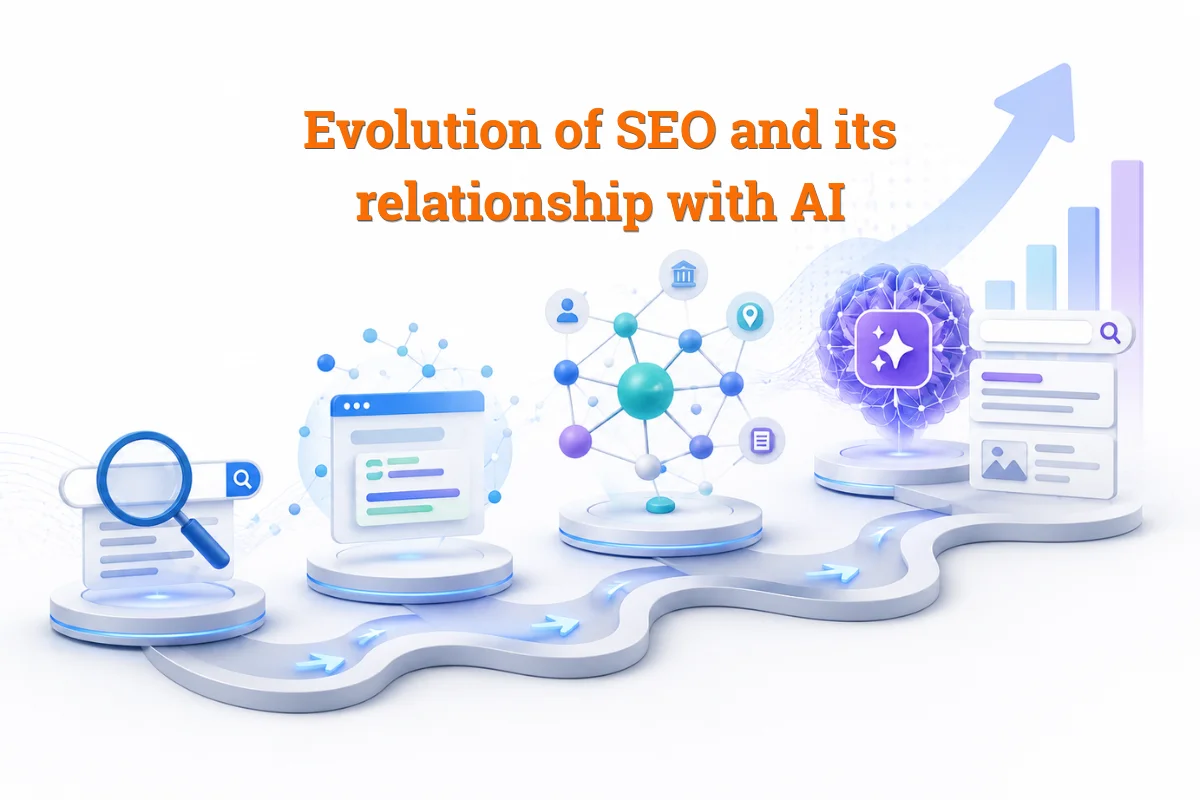
The four eras of SEO: why it keeps getting declared dead
To understand where SEO stands today, you need to understand the evolutionary pattern. Each major era introduced capabilities that made the previous era’s tactics obsolete — which is what generated the “SEO is dead” headlines each time.
Era 1: Keyword matching (pre-2013)
Early search engines were essentially keyword-counting machines. Relevance was determined by how often a term appeared on a page and in how many places — title, H1, body text, meta description. This rewarded exact-match optimization and created the conditions for keyword stuffing, invisible text, and content written for algorithms rather than humans. Tactics that look laughably obvious in retrospect worked because the systems were genuinely that simple.
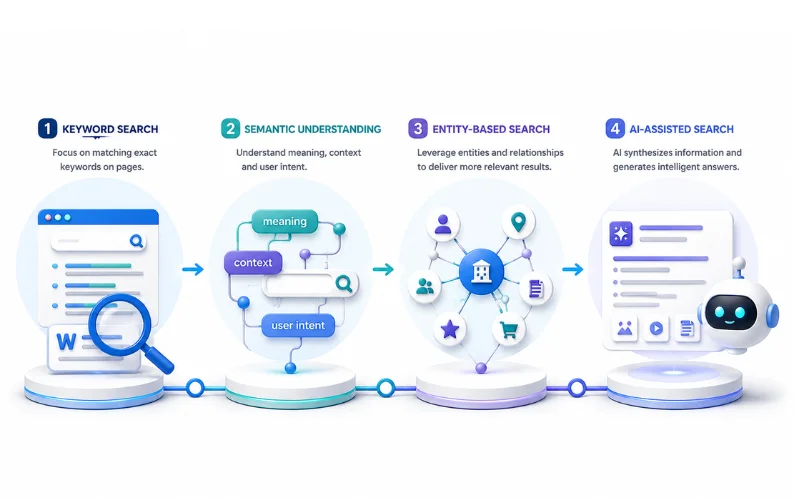
Era 2: Semantic understanding (2013–2019)
Google’s Hummingbird update (September 2013) was the first genuinely fundamental change to the search algorithm since 2001. For the first time, Google moved from analyzing individual keywords to understanding entire queries as coherent sentences — inferring intent, context, and meaning. Keyword stuffing stopped working not because Google penalized it more aggressively but because the underlying evaluation mechanism changed.
The follow-up was BERT (Devlin et al., Google AI Language, NAACL 2019), deployed in Google Search in October 2019 and affecting roughly one in ten English-language queries at launch. BERT introduced deep bidirectional transformer models that allowed Google to read a sentence in both directions simultaneously — understanding that the word “bank” in “I need to bank this money” means something completely different from “bank” in “the river bank.” This was the moment when SEO became, inescapably, a topic-first discipline rather than a keyword-first discipline.
Era 3: Entity-based search (2019–2024)
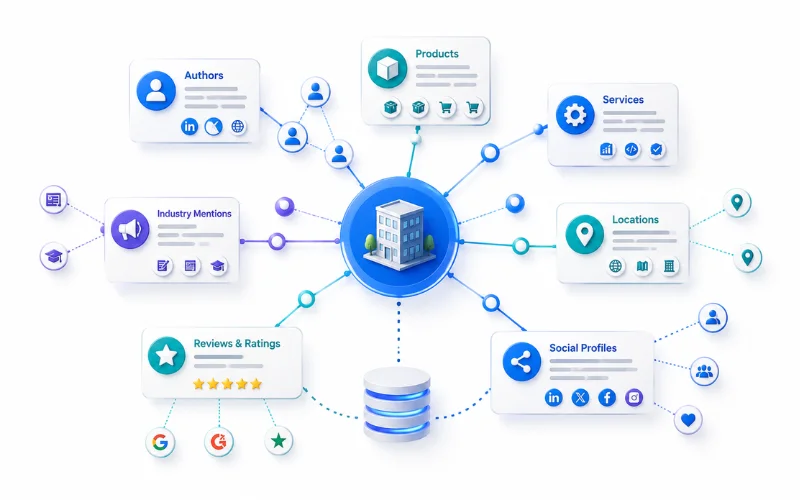
The semantic era laid the groundwork for entity-based search. Search systems increasingly began organizing their understanding of the web not as a collection of documents but as a connected network of entities — people, organizations, products, locations, concepts — and the relationships between them. Google’s Knowledge Graph, which stored over 500 billion facts about 5 billion entities by 2020, became the substrate on which relevance was evaluated. A site was no longer just a collection of keyword-matched pages — it was a representation of an entity with authority across specific topic areas.
Era 4: AI-augmented search (2024–present)
The current era is defined by the coexistence of traditional search with generative AI platforms. Google AI Overviews, ChatGPT Search, Perplexity, and Gemini don’t replace the web index — they sit on top of it, synthesizing content that the index has already surfaced, ranked, and validated. This is the crucial point that the “SEO is dead” argument misses: AI systems are built, in large part, on the foundation that traditional SEO created.
What has genuinely changed in 2026
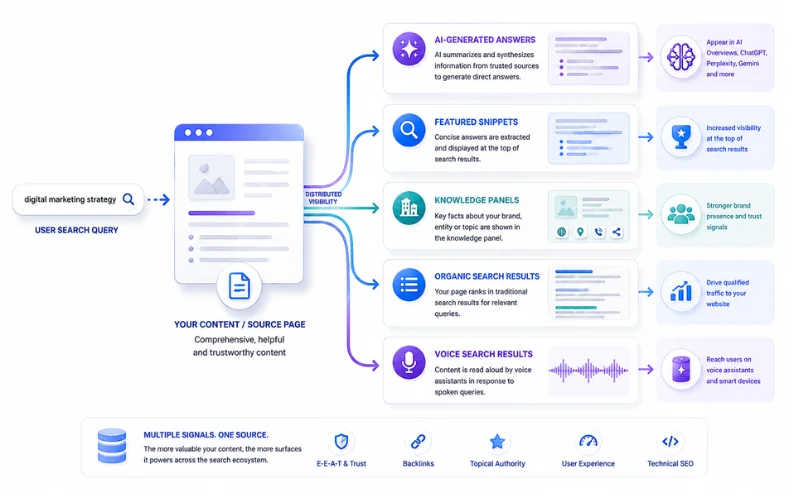
1. Rankings and clicks are no longer the same thing
This is the most significant structural shift. A page can rank in position one and still generate fewer clicks than it did three years ago, because the search interface now resolves the query before the user reaches the organic results. Google AI Overviews, featured snippets, knowledge panels, and People Also Ask boxes all extract value from your content without necessarily delivering a visit.
This does not mean rankings are irrelevant. It means rankings are now a necessary but no longer sufficient measure of SEO performance. A page at position one that earns zero citations from AI Overviews is delivering less total visibility than it used to. Measuring only rankings misses a growing portion of your content’s actual reach.
2. Topical authority outperforms isolated keyword targeting
The practice of creating single pages for single keywords — and treating each page as an independent ranking unit — has become significantly less effective. Modern search evaluation is site-wide and topic-wide. A website that covers a topic comprehensively, with multiple interconnected pieces that collectively signal deep expertise, is evaluated more favorably than a site with one strong page surrounded by thin content.
The practical implication: if you are still building pages around individual target keywords without mapping them to a broader topic architecture, you are optimizing for a version of SEO that no longer reflects how the algorithm actually works.
3. Entity signals matter as much as keyword signals
In keyword-era SEO, the primary question was: does this page contain the target keyword? In entity-era SEO, the questions are: what entity does this page represent? What entities does it discuss? What are the relationships between them? Are those entities consistently represented across the web?
This has direct practical implications. Author pages with verified credentials, consistent business information across platforms, structured data implementing Schema.org Organization and Person markup, and knowledge graph presence — these are not optional enhancements. They are foundational trust signals that influence how confidently AI systems and search algorithms can classify your content.
4. Technical SEO is now the floor, not the differentiator
In competitive niches, technical SEO excellence has become table stakes. Core Web Vitals, crawl efficiency, proper indexing, mobile performance — these matter enormously for getting into the game, but they are largely solved problems for well-maintained sites. The differentiation now happens at the content and authority layer.
The mistake many teams make is treating technical SEO as an ongoing priority at the expense of authority building and content depth. A technically perfect site with generic content will lose to a technically adequate site with genuine expertise every time.
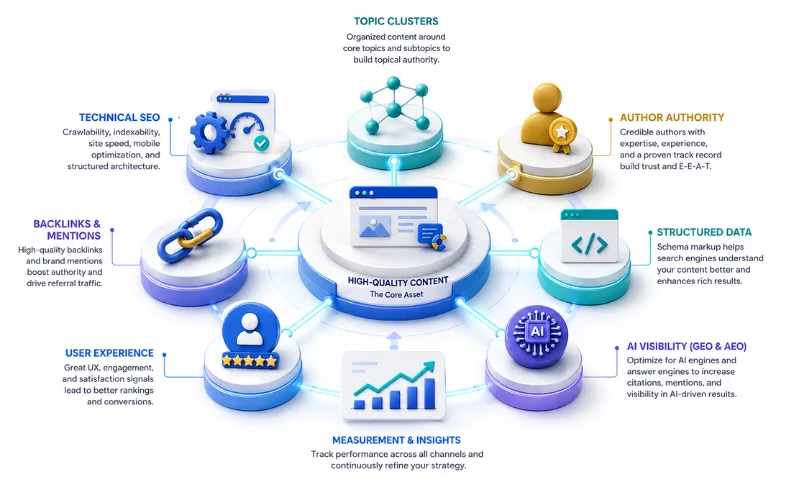
What has not changed in SEO
The noise around AI search makes it easy to assume everything needs to be rebuilt. Most of it does not. These fundamentals have remained consistent through every era:
- Backlinks still matter. High-quality editorial links remain one of the strongest authority signals in both traditional search and AI-powered systems. The difference is that AI systems are increasingly indifferent to link volume and highly attentive to link quality and editorial context.
- Content depth still wins. Thin content that exists primarily to target a keyword has never been rewarded by a sophisticated algorithm. Comprehensive content that genuinely addresses a topic has always outperformed it — this principle has not changed.
- User signals still feed ranking. Engagement, return visits, branded search, and time-on-page all continue to function as quality indicators. Satisfying users remains the most reliable proxy for satisfying search algorithms.
- Trust signals compound over time. Consistent, accurate, well-sourced content published under credible authorship continues to accumulate authority signals that are difficult for newer competitors to replicate quickly.
The mistakes practitioners are making right now
With so much noise about AI search, certain patterns of error have become extremely common. These are the ones worth naming explicitly:
Publishing AI-generated content at scale without genuine human expertise
The temptation is obvious. AI writing tools are fast, cheap, and capable of producing content that looks comprehensive. The problem is that search systems — and increasingly, AI citation systems — are evaluating content for evidence of actual expertise: original observations, specific data points, practitioner-level insights, things that require someone to have actually done the work. Generic synthesis of existing information, however fluently written, provides no citation advantage because it adds nothing to the information ecosystem.
Treating GEO and SEO as competing priorities
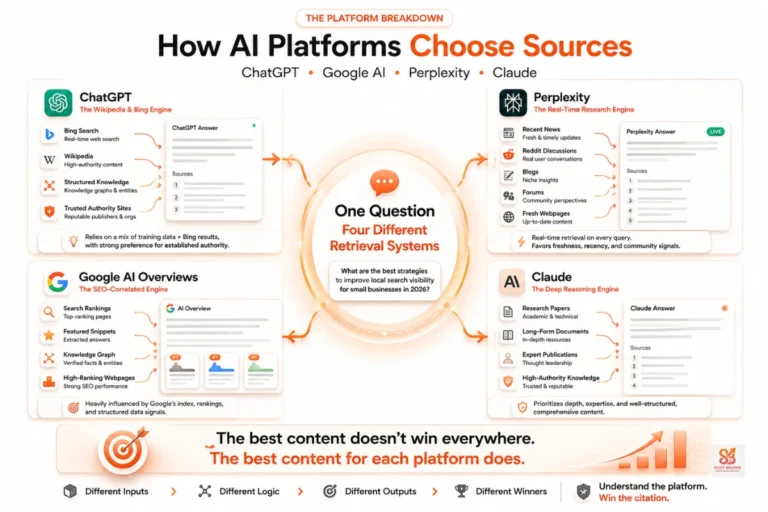
A significant number of SEO practitioners have pivoted away from traditional SEO entirely in favour of AI optimization strategies. This is a mistake. AI platforms — ChatGPT Search, Perplexity, Google AI Overviews — all draw heavily from web indexes that are themselves shaped by traditional SEO signals. Abandoning the foundation to chase AI visibility is like pulling the legs out from under the table and wondering why the surface is unstable.
Ignoring author entity development
Google’s E-E-A-T framework (Experience, Expertise, Authoritativeness, Trustworthiness) — detailed in the Search Quality Evaluator Guidelines — has made author identity a meaningful ranking and citation signal. Content attributed to a clearly established expert, with verifiable credentials and a consistent publication history, performs measurably better than identical content attributed to a faceless brand or published without authorship. Author entity development is not a nice-to-have. It is increasingly a prerequisite for competing in authoritative topic spaces.
Measuring rankings and ignoring everything else
Position tracking is still a useful input. But if it is the only metric you are reporting, you are missing AI citation frequency, featured snippet ownership, branded search volume trends, and direct traffic from AI referrals — all of which are growing as components of total visibility. The measurement framework needs to expand alongside the visibility ecosystem.
The SEO checklist that actually reflects 2026
Below are the areas that deserve ongoing investment. These are not revolutionary — they are the synthesis of what has consistently proven to work as the algorithm has evolved:
- Technical foundation: fast page speed, clean crawl architecture, correct indexing directives, structured data implementation
- Topic cluster architecture: every important topic covered at pillar + cluster level, with clear internal linking between them
- Entity consistency: brand name, URL, contact information, and descriptions identical across all platforms — website, Google Business Profile, social profiles, industry directories
- Author entity development: named authors with bio pages, credentials, social profiles, and a byline history that AI systems can trace
- Answer-first content structure: primary questions answered within the first 100 words of each section, before the elaboration
- Evidence and citations: statistics, studies, and external references included wherever claims are made — supporting both user trust and AI citation potential
- User experience: Core Web Vitals performance, mobile usability, clear conversion paths — because user satisfaction signals feed back into search quality evaluation
- Authority building beyond your own site: editorial backlinks, digital PR, expert appearances, community participation — signals that AI systems can find independently of your owned channels
Where SEO fits in the bigger picture
The argument of this series is that SEO is Layer 1 of a five-layer Search Visibility Stack. It is the foundation — not the ceiling. Without it, content cannot be discovered, indexed, or evaluated for authority. With it, you have the infrastructure on which AEO, GEO, AIO, and SXO can operate.
The organizations winning in 2026 are not the ones who chose between SEO and AI optimization. They are the ones who understood that AI optimization is built on top of SEO — and invested accordingly in both.
The next post in this series covers Layer 2: AEO — how to structure content so that answer engines and AI systems can extract and display your information directly, without requiring a click.
Quick reference: Old SEO vs. Modern SEO
| Practice | Pre-2019 Approach | 2026 Approach |
| Keyword targeting | Exact-match keywords, one page per term | Topic clusters with semantic keyword families |
| Content structure | Keyword density, thin articles | Comprehensive coverage, answer-first formatting |
| Author signals | Not a meaningful factor | Named experts with verifiable credentials |
| Backlinks | Volume-focused link building | Quality editorial links from authoritative sources |
| Technical SEO | Meta tags, sitemaps, basic on-page | Core Web Vitals, structured data, AI crawler access |
| Measurement | Rankings and organic traffic | Rankings + AI citations + branded search + referral traffic |
| Entity signals | Not typically considered | Consistent brand/author entities across all platforms |
References and citations
- Devlin, J., Chang, M.-W., Lee, K., & Toutanova, K. (2019). BERT: Pre-training of Deep Bidirectional Transformers for Language Understanding. Proceedings of NAACL-HLT 2019. Google AI Language. https://aclanthology.org/N19-1423
- Google. (2013). Hummingbird — Google’s Major Algorithm Update. Official announcement, September 2013. https://developers.google.com/search/blog/2013/09/google-hummingbird
- Aggarwal, P., et al. (2024). GEO: Generative Engine Optimization. KDD 2024. Princeton / IIT Delhi / Georgia Tech / Allen Institute for AI. https://doi.org/10.1145/3637528.3671900
- Google. (2024). Search Quality Evaluator Guidelines. Defines E-E-A-T (Experience, Expertise, Authoritativeness, Trustworthiness) as the core content quality framework. https://static.googleusercontent.com/media/guidelines.raterhub.com/en//searchqualityevaluatorguidelines.pdf
- Google. (2020). Knowledge Graph — 500 billion facts, 5 billion entities. Google Search On event. https://blog.google/products/search/search-on/
- Schema.org. (ongoing). Structured data vocabulary for Organization, Person, Article, FAQ, and related entity markup. https://schema.org
Related Post: