
The history of search engines is a story of continuous evolution. Since the late 1990s, search has transformed from manually curated web directories into intelligent AI systems capable of generating answers, recommending brands, and completing tasks on behalf of users. Each new era changed how information was discovered—and forced marketers, businesses, and SEO professionals to rethink how they earned online visibility.
Understanding this evolution is about more than looking back. Every major algorithm update, from PageRank and Panda to Hummingbird, BERT, and today’s AI-powered search experiences, solved a limitation of the previous generation. The tactics that worked in one era became ineffective—or even harmful—in the next. Recognizing these patterns helps explain why modern SEO extends beyond rankings to include concepts such as answer engine optimisation (AEO), generative engine optimisation (GEO), AI optimisation (AIO), and search experience optimisation (SXO).
This guide traces the complete history of search engines from 1998 through 2030, covering the six defining eras of search, the technologies and algorithm updates that shaped each one, and the evidence behind where search is heading next. Rather than presenting a simple timeline, it explains why each transition occurred, what practitioners had to change, and what those lessons mean for the future of search visibility.
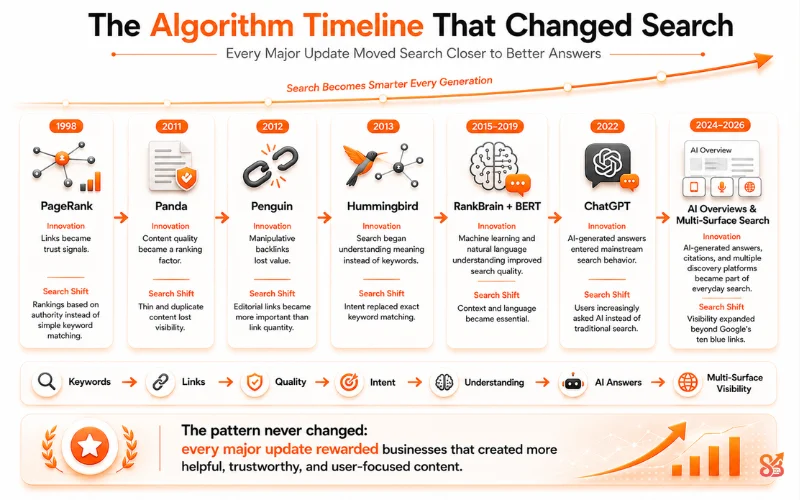
The pattern across 28 years is consistent: search rewards content that genuinely serves users, penalises tactics that game proxy metrics, and raises the floor of what ‘good’ means with each algorithm generation. Every era’s tactics become the next era’s spam.
Why the History of Search Engines Matters
Search isn’t just a sequence of algorithm updates—it reflects a continuous effort to deliver more relevant, trustworthy, and useful information. Understanding this evolution helps explain why modern SEO has expanded into AEO, GEO, AIO, and SXO, and why strategies that once worked no longer deliver sustainable results.
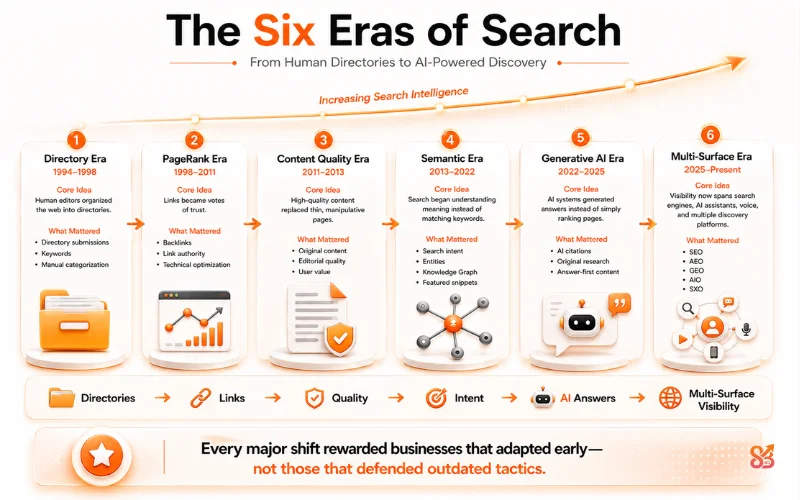
The Six Eras in the History of Search Engines
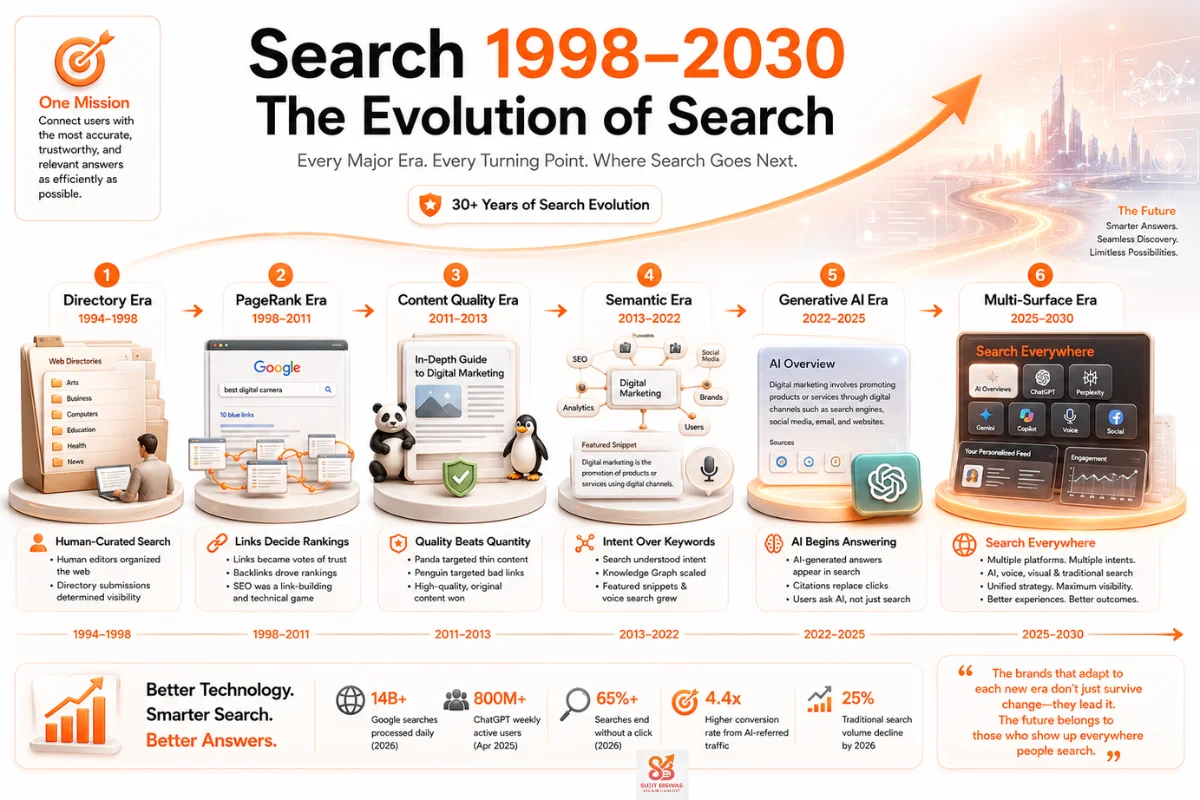
The history of search engines can be divided into six major eras. Each one introduced a new way of discovering, ranking, and presenting information—and each forced SEO practitioners to adapt. Together, these transitions explain how search evolved from manually curated directories to today’s AI-powered answer engines.
| Era | Years | Core Shift |
| Directory Era | 1994–1998 | Human editors organised the web. |
| PageRank Era | 1998–2011 | Links became the primary measure of authority. |
| Content Quality Era | 2011–2013 | Thin content and manipulative SEO were penalised. |
| Semantic Era | 2013–2019 | Search engines began understanding meaning, intent, and entities. |
| Generative AI Era | 2022–2025 | AI started generating answers instead of simply ranking pages. |
| Multi-Surface Era | 2025–Present | Visibility expanded beyond Google into AI assistants and multiple search surfaces. |
Era 1: The Directory Era (1994–1998)
1994–1998
Directory Era
Human editors decided what mattered. Algorithms were secondary.
What happened: Yahoo!, Excite, Lycos, and AltaVista dominated. Human editors curated web directories. Search was primarily categorisation — you browsed topics rather than queried them. Relevance was determined by inclusion in a directory and keyword frequency on the page. The entire indexed web in 1998 was estimated at around 26 million pages — a number Google would surpass within two years.
What SEO demanded: Submit your site to directories. Stuff keywords into page content, meta tags, and invisible text. Reciprocal link exchanges with other sites in your directory category. The barrier to manipulation was essentially zero.
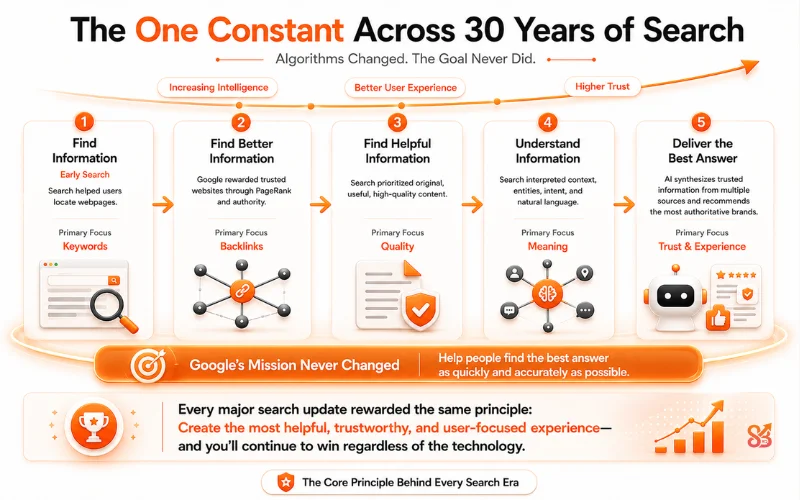
The pivot point: PageRank (1998) made human curation obsolete by using the link graph as a proxy for editorial judgment. A site linked to by many other sites was more trustworthy than a site that had simply submitted itself to a directory — a simple insight that would define search for the next 13 years.
Era 2: The PageRank Era (1998–2011)
1998–2011
PageRank Era
Links were votes. The site with the most votes won.
What happened: Larry Page and Sergey Brin incorporated Google on 4 September 1998. Their PageRank algorithm ranked pages by the quantity and quality of inbound links. Google rapidly displaced Yahoo! and AltaVista by delivering more relevant results. AdWords launched in October 2000, creating the revenue model that funded a decade of algorithm investment. By 2004, Google held dominant search market share and completed its IPO. The 2003 Florida update was the first signal that keyword manipulation was being targeted. The 2005 Jagger update targeted paid links specifically.
What SEO demanded: Build backlinks. More links meant higher rankings. Link farms, reciprocal link schemes, article directories, blog comment spam, paid link networks — all worked and were widely practised. Keyword density, exact-match anchor text, and meta keyword stuffing were standard practice. SEO was largely a technical and volume game.
The pivot point: Panda (February 2011) ended the PageRank era by introducing content quality as a primary ranking signal independent of link count. In its first rollout, Panda affected approximately 12% of all search queries — the largest single algorithm impact Google had ever reported. A site with thousands of backlinks but thin, duplicate, or low-quality content was no longer protected by its link profile.
Era 3: The Content Quality Era (2011–2013)
2011–2013
Content Quality Era
Thin content died. Depth was rewarded. Links required editorial judgment.
What happened: Google’s Panda update (February 2011) affected 12% of all queries on launch and devalued content farms, thin pages, and sites with high ad-to-content ratios. It introduced site-wide quality assessment — a domain with a high proportion of low-quality pages saw all its pages penalised, not just the thin ones. Demand Media, a content farm generating 2 million articles per year, lost 40% of its search visibility within weeks of Panda. eHow, Associated Content, and Mahalo suffered similar declines. The Penguin update (April 2012) targeted manipulative link building directly — penalising unnatural link profiles, anchor text manipulation, and participation in link networks. Penguin affected approximately 3.1% of English queries on launch. The 2012 Exact Match Domain update devalued keyword-stuffed domain names. The 2014 Pigeon update improved local search relevance. The 2015 Mobilegeddon update made mobile-friendliness a direct ranking signal — significant given that mobile search overtook desktop for the first time in 2015.
What SEO demanded: Write comprehensive, original content with genuine depth. Earn editorial backlinks from relevant, authoritative sources. Remove or disavow low-quality links. Eliminate duplicate content. The short, keyword-stuffed article that had worked in the PageRank era became a liability. Minimum viable content length increased substantially — the content marketing discipline was born directly from Panda’s quality requirements.
The pivot point: The Hummingbird update (September 2013) ended the content quality era by fundamentally changing how queries were interpreted. It was not a ranking update — it was a new core algorithm that understood queries as complete semantic units rather than collections of keywords. The question was no longer ‘does this page contain these words?’ but ‘does this page answer this question?’
Era 4: The Semantic Era (2013–2019)
2013–2019
Semantic Era
Intent replaced keywords. Topics replaced individual pages. Entities replaced strings.
What happened: Hummingbird introduced semantic understanding. The Knowledge Graph (launched 2012, expanded to over 500 billion facts about 5 billion entities by 2020) organised the web as a network of entities rather than a collection of documents. Featured snippets appeared in 2014 — the first time Google answered questions directly on the SERP rather than directing users to websites. RankBrain (2015) applied machine learning to query interpretation for the first time, initially processing around 15% of never-before-seen queries. Mobile-first indexing was announced in 2016 and rolled out through 2018–2019. The BERT update (October 2019) — based on Devlin et al.’s 2019 paper — applied deep bidirectional transformers to query understanding, affecting one in ten English-language searches at launch and eventually influencing nearly every query.
What SEO demanded: Build topical authority through comprehensive topic coverage rather than isolated keyword pages. Target intent, not just keywords. Optimise for featured snippets with answer-first formatting. Implement structured data. Develop entity signals — consistent brand information, author credentials, Schema.org markup. Voice search (Google Home launched 2016, Alexa 2014) required conversational query optimisation. Topic clusters replaced single-page keyword targeting.
The pivot point: The launch of ChatGPT in November 2022 and its 100-million-user adoption in two months — the fastest consumer product adoption in history — signalled that the semantic era’s assumption of a human using a search box was no longer the only model worth optimising for.
Era 5: The Generative AI Era (2022–2025)
2022–2025
Generative AI Era
Answer engines emerged. AI generated responses rather than ranking pages. Citations replaced clicks.
What happened: ChatGPT launched November 2022 and reached 100 million users in two months. By April 2025 it had 800 million weekly active users — an 8x increase in 18 months. Microsoft integrated GPT-4 into Bing (February 2023). Google launched Bard (March 2023), evolved into Gemini (2024). Google AI Overviews rolled out in the US in May 2024, reaching 1.5 billion users by October 2024. Pew Research (2026) found 31% of US adults now interact with AI multiple times daily; 38% of 18–29 year-olds use AI as their primary information access method. HubSpot — considered the gold standard of B2B content marketing — saw traffic decline 36% in a single month as users began answering questions through AI rather than clicking through to blog posts. Bain estimated 15–25% overall SEO traffic decline across the web.
What SEO demanded: GEO (Generative Engine Optimisation) emerged as a discipline, codified by the Aggarwal et al. KDD 2024 paper — the first peer-reviewed study of what content changes improve AI citation visibility. AEO structured content for extraction. AIO built brand-level authority for AI recommendation. The five-layer Search Visibility Stack replaced single-layer SEO thinking. Gartner predicted in February 2024 that traditional search volume would drop 25% by 2026 — a prediction that proved largely accurate by Q1 2026.
The pivot point: The August 2024 US federal antitrust ruling declaring Google an illegal monopolist — the most significant antitrust decision against a tech company since Microsoft in 2001 — combined with AI Overviews reaching 1.5 billion users simultaneously, marked the decisive end of single-surface search. No single system would again determine visibility for the majority of users.
800M
ChatGPT weekly active users by April 2025 — 8x growth in 18 months from launch Webflow AEO Maturity Model, 2025
36%
HubSpot organic traffic decline in a single month as AI search absorbed informational queriesWebflow / Bain, 2025
Era 6: The Multi-Surface Era (2025–present)
2025–Now
Multi-Surface Era
No single search surface dominates. Visibility requires all five layers simultaneously.
What happened: Search has fractured across surfaces: Google traditional SERPs, Google AI Overviews, ChatGPT Search, Perplexity, Gemini, Microsoft Copilot, Apple Intelligence, and voice assistants. Each surface has different citation behaviour, different content preferences, and different authority signals. A brand that ranks first on Google may be invisible on Perplexity. A brand with strong AI citation frequency may be unknown to voice search users. Google processes 14 billion queries daily in 2026 while ChatGPT handles approximately 1 billion per week — a ratio of 98:1 in Google’s favour, but AI search growing at exponential rates while traditional search growth has plateaued.
What SEO demanded: The Search Visibility Stack — all five layers operating simultaneously. SEO for discoverability. AEO for extractability. GEO for citation-worthiness. AIO for brand authority. SXO for user outcomes. Measurement must track visibility rate across all surfaces, not just Google rankings. Original research and genuine expertise are the only sustainable competitive advantages. AI-referred traffic converts at 4.4x the rate of standard organic visitors — making quality of visibility more important than quantity.
The pivot point: Agentic search — AI systems acting autonomously on behalf of users to complete tasks — is the emerging next paradigm. Gartner projects 90% of B2B buying will be AI agent-intermediated by 2028, with over $15 trillion of B2B spend flowing through AI agent exchanges. The question is not whether agentic search arrives but how quickly it becomes the dominant mode.
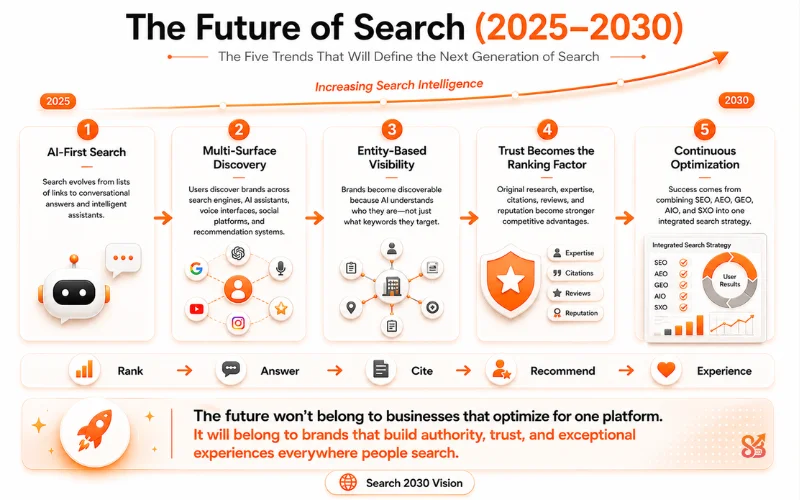
What the evidence says about 2025–2030
The table below distinguishes between what is already confirmed (2025–2026) and what is projected based on current research trajectories. The current-state row gives practitioners a concrete anchor before the forecasts begin.
| Period | Most likely development | Evidence basis | What practitioners should do |
| 2025–2026 (Now — confirmed) | 65% of searches end without a click. AI Overviews on 48%+ of queries. 4.4x conversion rate for AI-referred vs organic traffic. Traditional search volume down ~25% from peak. | Semrush zero-click study Q1 2026; Seer Interactive 25.1M impressions study; Gartner 25% prediction confirmed. | Build GEO and AIO foundations now. Measure AI citation frequency alongside rankings. Prioritise conversion rate over traffic volume. |
| 2026–2027 | AI search volume continues growing. Traditional search stabilises but does not collapse. Multi-surface measurement becomes standard practice. Apple AI search tool launch likely. | Google 14B/day vs ChatGPT 143M/day (98:1 ratio). SparkToro: visibility rate replaces position tracking. TTMS 2025 forecast. | Build AIO measurement framework. Track visibility rate across platforms monthly. Do not abandon SEO — the foundation remains essential. |
| 2027–2028 | AI-driven search traffic achieves equal economic value to traditional search despite lower volume — due to 4.4x–23x higher conversion rates. Economic parity reaches most verticals. | TTMS/Ahrefs 2025: economic value parity projected by late 2027. Gartner: 50% organic search traffic decline by 2028. | Invest in GEO and AIO now to build citation authority before parity arrives. Brands cited consistently today will compound advantages through 2028. |
| 2028–2029 | Agentic search becomes mainstream. AI agents complete purchases, bookings, and research tasks autonomously. Machine-to-machine trust becomes a primary visibility variable. | Gartner 2026: 90% of B2B buying AI agent-intermediated by 2028. $15T+ of B2B spend through AI agent exchanges. | Prepare SXO for machine-readable conversion paths. Implement comprehensive structured data. Ensure entity information is programmatically accessible. |
| 2029–2030 | AI search usage definitively surpasses traditional search in total queries globally. New measurement frameworks replace Google-centric SEO metrics entirely. | TTMS forecast: AI search surpasses traditional search globally 2029–2030. Gartner: 25% drop already achieved by 2026 with trajectory continuing. | Brands with full-stack Search Visibility Stack infrastructure will hold compounding advantages. Late movers face structural visibility deficits difficult to close. |
The pattern across every era is the same: the brands that invested in the next era’s requirements while still succeeding in the current era outperformed those who waited until the transition forced their hand. 2026 is that moment for AI search.
The lessons that have held across every era of Search Evolution
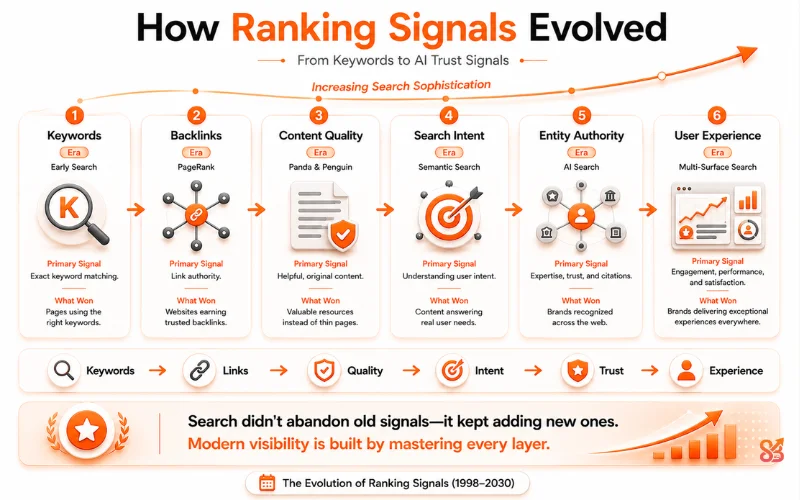
Six principles have remained constant across 28 years of search evolution. They are the closest thing the discipline has to universal laws.
- Serve users genuinely and search systems will follow. Every major algorithm update has moved closer to rewarding what actually helps users. Every tactic that worked by gaming proxy metrics eventually stopped working. The only consistently safe strategy is to do what users actually need.
- Sequence matters. Each era’s requirements built on the previous era’s foundation. Content quality required a crawlable site. Semantic optimisation required quality content. GEO requires AEO structure. AIO requires GEO authority. Skipping stages never produces compounding results.
- The floor keeps rising. What constitutes ‘good enough’ increases with each algorithm generation. Practices that were differentiating in 2015 — comprehensive content, structured data, mobile optimisation — are table stakes in 2026. The organisations differentiating today are building tomorrow’s table stakes.
- Early movers compound. The brands that built topical authority before Hummingbird, earned editorial links before Penguin, and structured content for extraction before AI Overviews all benefited disproportionately. The window to build AI citation authority at low competitive cost is closing now.
- Measurement must expand with the ecosystem. Practitioners who measured only rankings missed the featured snippet era. Those measuring only organic traffic are missing the AI citation era. Measurement frameworks that do not cover the full surface of user visibility will systematically undervalue the right investments.
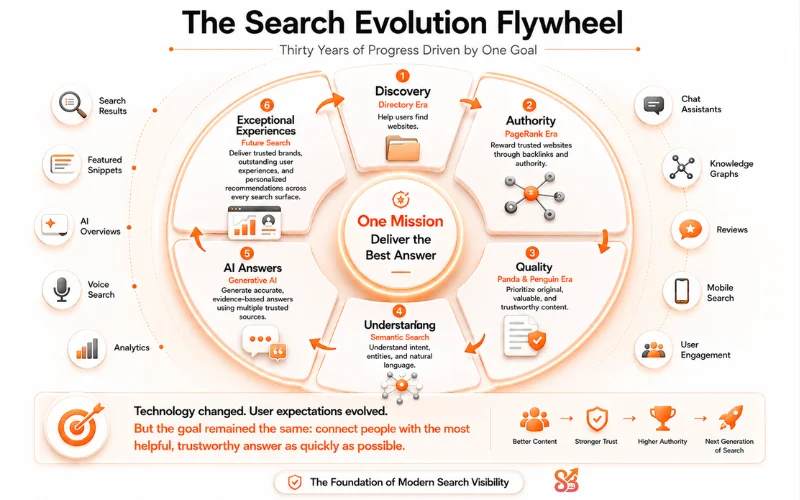
- The underlying goal never changed. Google in 1998 and Google AI Overviews in 2026 are both trying to connect users with the most trustworthy, accurate, and relevant answer to their question. Everything else — PageRank, Panda, BERT, GEO, AIO — is a progressively more sophisticated attempt to identify which content meets that standard.
→ Next: The Platform Breakdown — How ChatGPT, Perplexity, Gemini, Claude, and Copilot Select Sources Differently
→ Previous: The Search Visibility Maturity Model — Which Stage Is Your Strategy At?
References and citations:
- Page, L. & Brin, S. (1998). The Anatomy of a Large-Scale Hypertextual Web Search Engine. Stanford University. The foundational PageRank paper. Via Wikipedia Timeline of Google Search. https://en.wikipedia.org/wiki/Timeline_of_Google_Search
- Search Engine Journal. (2003–2026). Google Algorithm Updates: The Complete History. Panda (Feb 2011): 12% of queries affected. Penguin (Apr 2012): 3.1% of English queries affected. Comprehensive update log through May 2026. https://www.searchenginejournal.com/google-algorithm-history/
- Google. (2013). Hummingbird algorithm update. September 2013. New core algorithm introducing semantic query understanding. https://developers.google.com/search/blog/2013/09/google-hummingbird
- Devlin, J., Chang, M.-W., Lee, K., & Toutanova, K. (2019). BERT: Pre-training of Deep Bidirectional Transformers for Language Understanding. NAACL-HLT 2019. Deployed in Google Search October 2019; affected one in ten English queries at launch. https://aclanthology.org/N19-1423
- Aggarwal, P., et al. (2024). GEO: Generative Engine Optimization. KDD 2024. Princeton / IIT Delhi / Georgia Tech / Allen Institute for AI. https://doi.org/10.1145/3637528.3671900
- Webflow. (2025, July). Announcing Webflow’s AEO Maturity Model. ChatGPT 800M weekly active users by April 2025 (8x growth in 18 months). HubSpot traffic declined 36% in one month. Bain: 15–25% overall SEO traffic decline. https://webflow.com/blog/aeo-maturity-model
- Pew Research Center / Digital Agency Network. (2026). 31% of US adults interact with AI multiple times daily; 38% of 18–29 year-olds use AI as primary information source. https://digitalagencynetwork.com/aeo-vs-seo-vs-geo/
- Gartner. (2024, February). Predicts Search Engine Volume Will Drop 25% by 2026. https://www.gartner.com/en/newsroom/press-releases/2024-02-19-gartner-predicts-search-engine-volume-will-drop-25-percent-by-2026-due-to-ai-chatbots-and-other-virtual-agents
- Gartner. (2026, April). Strategic Predictions for 2026. 90% of B2B buying AI agent-intermediated by 2028; $15T+ through AI agent exchanges. https://www.gartner.com/en/articles/strategic-predictions-for-2026
- TTMS. (2025, October). When Will AI Search Beat Google? 2025–2030 Forecast. Economic value parity by late 2027; AI search surpasses traditional search globally 2029–2030. https://ttms.com/llm-powered-search-vs-traditional-search-2025-2030-forecast/
- Fishkin, R. & O’Donnell, P. (2026, January). SparkToro AI Brand Recommendation Consistency Research. 14B Google queries/day vs 143M ChatGPT queries/day. https://sparktoro.com/blog/new-research-ais-are-highly-inconsistent-when-recommending-brands-or-products-marketers-should-take-care-when-tracking-ai-visibility/