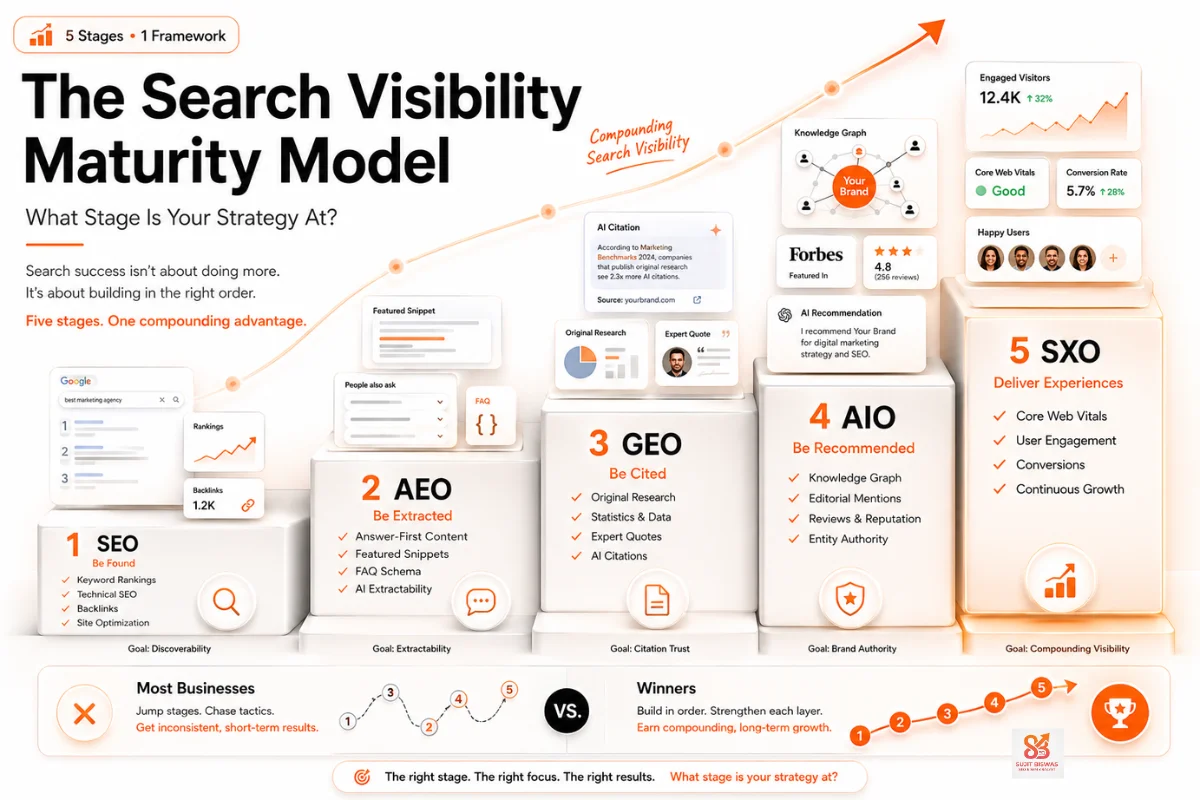

The Search Visibility Maturity Model is a strategic framework for assessing how prepared an organisation is for modern search. It evaluates every layer of the Search Visibility Stack—from traditional SEO to Answer Engine Optimization (AEO), Generative Engine Optimization (GEO), AI Optimization (AIO), and Search Experience Optimization (SXO)—to identify your current stage of maturity and the highest-impact actions to take next.
The most expensive mistake in search strategy is not investing too little. It is investing in the wrong layer for your current stage of maturity. Organisations that skip foundational SEO to chase AI citations. Agencies that pour budget into GEO content while their technical foundation cannot be crawled reliably. Brands investing in AIO authority building while their on-page content still cannot be extracted by a featured snippet.
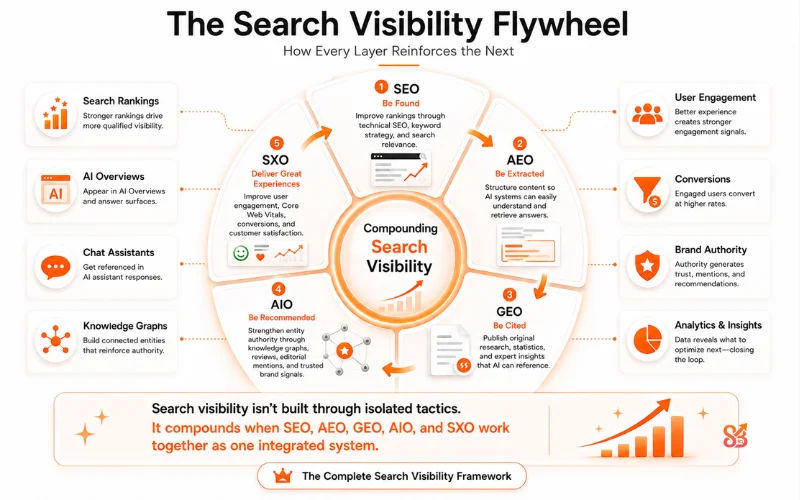
The Search Visibility Stack—SEO, AEO, GEO, AIO, and SXO—is a sequential architecture. Each layer depends on the one below it. Moving too fast through the sequence does not accelerate progress; it wastes resources on work that has no foundation to compound from.
You cannot earn AI citations for content that cannot be found. You cannot build brand authority on content that cannot be be extracted. You cannot convert AI-referred visitors on pages that fail Core Web Vitals. Sequence matters as much as tactics.
The five stages of search visibility maturity
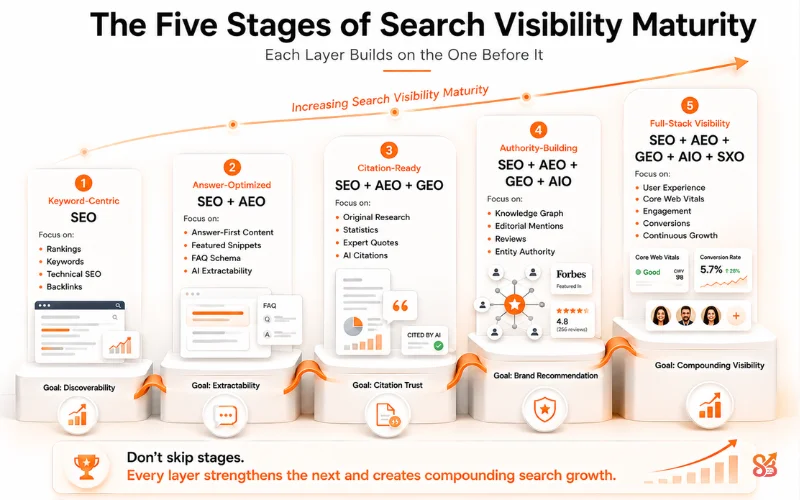
STAGE 1
Keyword-Centric
SEO only — rankings are the sole visibility metric
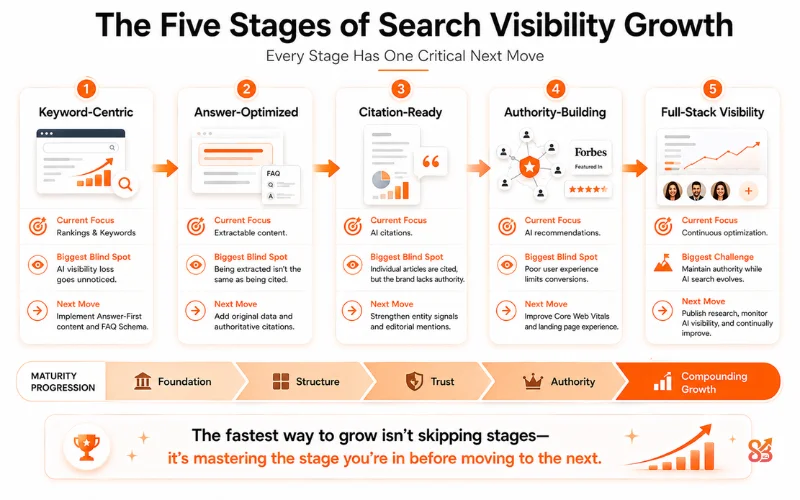
Stage 1 organisations treat search as a keyword problem. Strategy centres on target keyword lists, position tracking, and backlink volume. Content is written primarily to rank rather than to answer, extract, or earn citation. Technical SEO is understood as meta tags, title optimisation, and basic on-page structure.
The characteristic blind spot at Stage 1 is invisible visibility loss. Traffic from AI Overviews, featured snippets, and voice search is not captured in the measurement framework — so the organisation does not see it declining. Rankings hold steady while total search visibility contracts.
- Typical symptoms: Rankings stable but traffic declining. AI Overview appearances near zero. No structured data beyond basic meta tags. Author information absent or inconsistent. Featured snippet ownership low despite strong rankings.
- What Stage 1 gets right: Often strong technical fundamentals — fast sites, clean crawl architecture, solid on-page optimisation. These are genuinely valuable and do not need rebuilding.
- Highest-leverage next action: Move to Stage 2 by auditing top-10 ranking pages for AEO structure. Implement answer-first formatting and FAQ Schema on the five pages with the highest informational search volume.
STAGE 2
Answer-Optimised
SEO + AEO — extractability added to discoverability
Stage 2 organisations understand that ranking is not enough — content must also be structured for extraction. They have implemented answer-first writing on key pages, are seeing featured snippet ownership improve, and are beginning to appear in Google AI Overviews for some queries. Structured data is in place on content pages. FAQ sections are present and address real user questions.
The characteristic blind spot at Stage 2 is confusing extraction with citation. A page that appears in a featured snippet has been extracted. A page that is cited in a ChatGPT response has been deemed trustworthy enough to reference. These are different evaluations requiring different content characteristics — and most Stage 2 organisations have not yet made that distinction.
- Typical symptoms: Strong featured snippet performance. Beginning to appear in AI Overviews. But ChatGPT, Perplexity, and Gemini rarely cite the brand. Content is well-structured but generic — lacks original data, proprietary insight, or citable statistics.
- What Stage 2 gets right: Extractability. Content is clear, structured, and answer-first. This is a genuine competitive advantage over Stage 1 organisations and is increasingly difficult to replicate without deliberate effort.
- Highest-leverage next action: Move to Stage 3 by adding original data to the top five performing content pieces. Find three statistics unique to your client work or research and integrate them with proper attribution. This is the single highest-impact GEO move available at this stage.
STAGE 3
Citation-Ready
SEO + AEO + GEO — content earns AI citations
Stage 3 organisations have crossed the citation threshold. Their content appears not only in Google AI Overviews but in ChatGPT and Perplexity responses. They have original data, cite external sources within their content, write with declarative expert authority, and have clear entity signals throughout. The GEO paper (Aggarwal et al., KDD 2024) findings — statistics addition (+41% citation visibility), source citation within content (+115% for lower-ranked pages), expert quotations (+28%) — are being applied systematically.
The characteristic blind spot at Stage 3 is piece-by-piece optimisation without brand-level authority. Individual articles earn citations, but the brand is not consistently recommended as a category authority. When users ask AI systems who they should hire or which brand to trust, Stage 3 organisations may not appear — even though their individual pieces are being cited.
- Typical symptoms: Individual content pieces appear in AI responses. Citation tracking shows growing frequency. But brand recommendation queries (‘who is the best X in Y’) return competitors rather than this brand. Entity consistency issues across platforms. Author entities underdeveloped.
- What Stage 3 gets right: Content-level trustworthiness. This is the layer that most practitioners are currently trying to reach, and Stage 3 organisations hold a genuine competitive advantage in citation-rich categories.
- Highest-leverage next action: Move to Stage 4 by auditing entity consistency across all platforms. Build or claim Wikidata entry. Implement Organisation and Person schema with sameAs properties. Identify the top five publications most cited in AI responses for your category and begin targeted editorial outreach.
STAGE 4
Authority-Building
SEO + AEO + GEO + AIO — brand is consistently recommended
Stage 4 organisations are being recommended as category authorities, not just cited as content sources. Their brand appears consistently across AI recommendation queries — not just informational queries. They have built knowledge graph presence, maintain active review profiles, appear in authoritative third-party publications, and participate in community platforms. The SparkToro research (January 2026) finding — that visibility rate across many prompt runs, not position in any single response, is the only valid AI tracking metric — is part of their measurement framework.
The characteristic blind spot at Stage 4 is the user experience gap. Strong visibility and recommendation frequency are not translating to outcomes because the post-click experience disappoints or confuses visitors. AI-referred users — who convert at 4.4x the rate of standard organic visitors when satisfied — are being lost to poor page performance, unclear conversion paths, or intent mismatch.
- Typical symptoms: Strong AI visibility rate. Brand recommendation frequency growing. But AI-referred traffic shows lower-than-expected engagement and conversion. Core Web Vitals failing on mobile. Contact forms with too many fields. Above-fold content does not match the intent that drove the AI recommendation.
- What Stage 4 gets right: Brand authority architecture. Entity signals, third-party mentions, review presence, and community participation are all compounding. This is genuinely difficult for Stage 1–3 organisations to replicate quickly.
- Highest-leverage next action: Move to Stage 5 by running a full SXO audit on the top landing pages receiving AI-referred traffic. Fix Core Web Vitals failures on mobile first. Reduce friction at the conversion point. Ensure above-fold content satisfies the intent implied by the AI recommendation that drove the visit.
STAGE 5
Full-Stack Visibility
All five layers operating and compounding
Stage 5 organisations are running all five layers of the Search Visibility Stack simultaneously, with each layer feeding into the others. SEO ensures discoverability. AEO ensures extractability. GEO ensures citation-worthiness. AIO ensures consistent brand recommendation. SXO ensures that visits convert to outcomes and generate the positive user signals that feed back into every layer above.
Stage 5 is not a destination — it is a maintenance state. The characteristic challenge at Stage 5 is sustaining strategic coherence as the AI search landscape evolves. New platforms emerge with different citation behaviours. Algorithm changes shift the relative weight of different signals. Competitors advance through the maturity stages.
- Typical profile: Full topic cluster architecture. AI citation frequency tracked monthly across platforms. Brand recommendation visibility rate benchmarked against competitors. Core Web Vitals passing on mobile and desktop. Conversion paths tested and optimised. Original research published regularly. Author entities established and consistent.
- Highest-leverage ongoing action: Publish original research that earns third-party citations. Monitor AI citation frequency for signs of signal decay. Update content systematically as the information landscape evolves. Track competitor maturity advancement and identify emerging threats early.
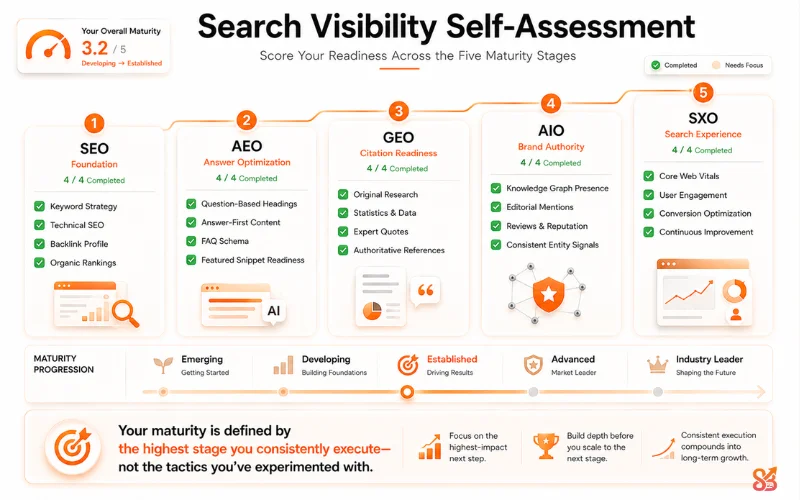
The self-diagnostic: which stage are you at?
Score each statement below based on your current state. 0 = not in place, 1 = partially in place, 2 = fully in place. Total your score and find your stage below.
| Signal | 0 Not in place | 1 Partial | 2 Fully in place |
| Technical SEO: site crawlable, fast, properly indexed, structured data implemented | |||
| Topical cluster architecture: pillar + supporting posts with internal linking | |||
| Answer-first content: primary question answered in first paragraph of each section | |||
| FAQ Schema implemented on key pages with real user questions | |||
| Featured snippet ownership on 3+ target queries | |||
| Original data or case study content published in the last 6 months | |||
| Inline source citations within content pieces | |||
| Named expert authors with bio pages and verifiable credentials | |||
| Content appearing in ChatGPT or Perplexity responses (tested manually) | |||
| Consistent entity signals across website, GBP, LinkedIn, directories | |||
| Knowledge graph presence (Wikidata entry or Google Knowledge Panel) | |||
| Editorial mentions in 3+ authoritative third-party publications | |||
| Active review profile on 2+ credible platforms | |||
| AI brand recommendation visibility rate tracked monthly | |||
| Core Web Vitals: Good rating on mobile for LCP, INP, and CLS | |||
| Above-fold content satisfies the implied intent of ranking/cited queries | |||
| Conversion rate by AI-referred traffic tracked in GA4 | |||
| Branded search volume tracked as a trend metric |
Score interpretation:
- 0–8: Stage 1 (Keyword-Centric). Foundation work is the priority. SEO infrastructure and AEO structure before anything else.
- 9–14: Stage 2 (Answer-Optimised). Extractability is your next leverage point. Add original data and inline citations to top-performing content.
- 15–20: Stage 3 (Citation-Ready). Brand-level authority is the gap. Focus on entity signals, third-party editorial, and review platform presence.
- 21–28: Stage 4 (Authority-Building). User experience is the missing layer. SXO audit your AI-referred traffic landing pages first.
- 29–36: Stage 5 (Full-Stack Visibility). Sustain and compound. Original research and systematic content updating are the highest-leverage investments.
The most common maturity trap: jumping stages
The pattern that produces the most wasted search investment in 2026 is stage-jumping — attempting to execute Layer 3 or Layer 4 tactics while the Layer 1 and 2 foundations are incomplete.
The most common version: an organisation reads about GEO and AI citation optimisation, produces a series of content pieces with statistics and expert quotes, and sees minimal citation improvement. The diagnosis is almost always one of three things: the site has crawl issues that prevent AI systems from reliably accessing the content; the content is not structured for extraction (AEO gap), so even if found, it cannot be cleanly cited; or the entity signals are inconsistent, reducing AI confidence in the source.
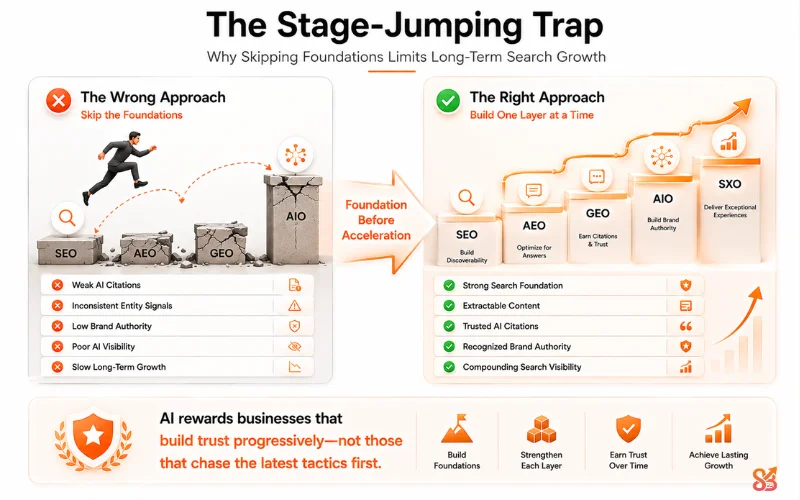
GEO tactics applied to a Stage 1 foundation produce Stage 1 results, regardless of how well the individual content pieces are optimised. The stage model exists precisely to prevent this — to ensure that investment is sequenced in the order that produces compounding returns rather than isolated improvements with no foundation to build on.
Do the diagnostic honestly. The most common error is self-assessing at Stage 3 while operating at Stage 1. The diagnostic is only useful if the scores reflect current reality, not strategic intent.
Maturity by organisation type: typical stage distributions
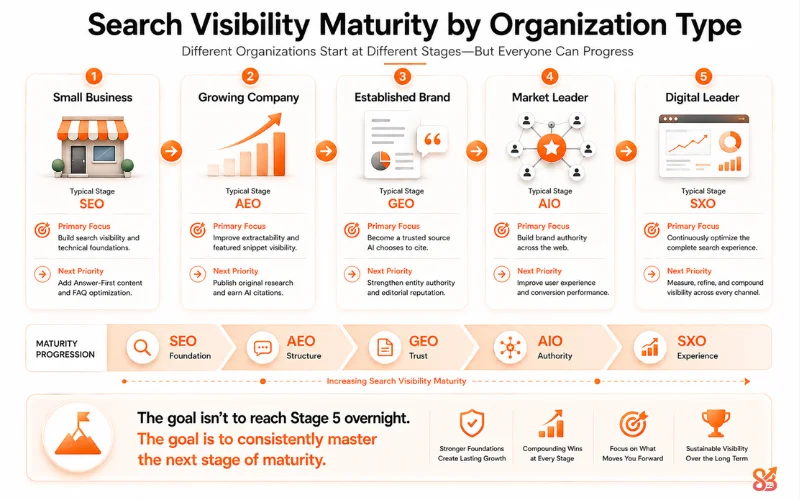
| Organisation type | Typical stage | Most common gap | Priority next action |
| Small business (<10 staff) | Stage 1–2 | AEO structure and entity signals | Answer-first content rewrite on top 5 pages + FAQ Schema |
| Mid-size agency client | Stage 2–3 | Original data and GEO citation signals | Add proprietary case data to core content + author entity setup |
| Established brand (in-house team) | Stage 3–4 | Brand-level AIO authority vs competitors | Editorial PR programme + review platform activation |
| Enterprise / large org | Stage 2–4 (inconsistent) | Inconsistent execution across layers | Maturity audit by business unit; standardise the weakest layer first |
| Personal brand / consultant | Stage 1–3 | AIO authority and third-party mentions | Original research publication + community platform presence |
Using the maturity model as a client diagnostic tool
For practitioners working with clients, the Search Visibility Maturity Model serves a second function beyond strategy sequencing: it is a client education tool that explains why certain investments must precede others.
The most common client expectation mismatch is a Stage 1 or Stage 2 organisation expecting GEO and AI citation results from a content programme that has not yet addressed AEO structure or entity signals. The maturity model gives you a framework for explaining, concretely and specifically, why the sequence matters — and what must be in place before the higher-layer work can produce returns.
Running the diagnostic with a client at the start of an engagement also surfaces the specific gaps faster than a traditional audit. Instead of reviewing hundreds of individual technical signals, the 18-question diagnostic identifies the layer where investment will produce the highest leverage — and builds the client relationship on shared understanding of what stage they are at and what Stage 5 looks like.
→ Next: The Historical Timeline — Search 1998–2030: Every Era and What It Demanded
Previous: Complete guide to Search experience optimisation
References and citations
- Aggarwal, P., et al. (2024). GEO: Generative Engine Optimization. KDD 2024. Princeton / IIT Delhi / Georgia Tech / Allen Institute for AI. Citation impact findings: statistics +41%, source citation +115% for lower-ranked pages, expert quotations +28%. https://doi.org/10.1145/3637528.3671900
- Fishkin, R. & O’Donnell, P. (2026, January). New Research: AIs are highly inconsistent when recommending brands or products. SparkToro / Gumshoe.ai. Visibility rate as the only valid AI recommendation metric. https://sparktoro.com/blog/new-research-ais-are-highly-inconsistent-when-recommending-brands-or-products-marketers-should-take-care-when-tracking-ai-visibility/
- Seer Interactive. (2025, November). AIO Impact on Google CTR. AI-referred visitors convert at 4.4x the rate of standard organic visitors. Reported via Search Engine Land. https://searchengineland.com/google-ai-overviews-drive-drop-organic-paid-ctr-464212
- SEO Hacker. (2025, November). The AEO Maturity Model for AI-Ready Search Visibility. Four-pillar maturity evaluation framework: keyword-centric through AI-ready. https://seo-hacker.com/aeo-maturity-model/
- Webflow. (2025, July). Announcing Webflow’s AEO Maturity Model. LLM visitors convert 4.4x–23x more than typical SEO traffic. HubSpot traffic declined 36% in one month. Bain estimates 15–25% overall SEO traffic decline. https://webflow.com/blog/aeo-maturity-model
- Wild Coffee Marketing. (2026, May). SEO, GEO, AEO, and AIO: The Four Layers of Search Visibility in 2026. https://wildcoffeemarketing.com/seo-geo-aeo-and-aio-the-four-layers-of-search-visibility-in-2026/