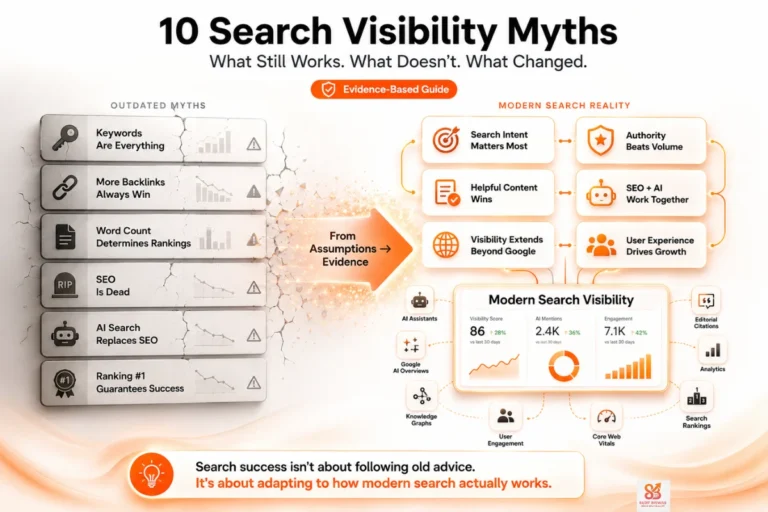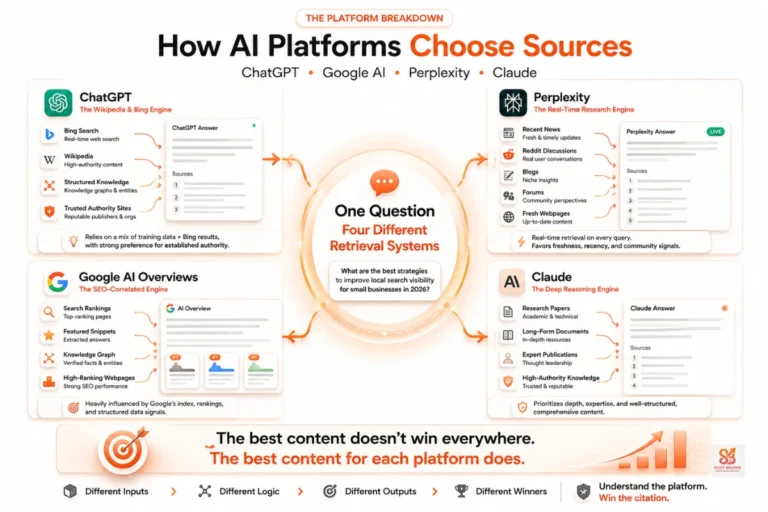

The question in 2026 is not how to rank. The question is how to be discoverable, answerable, citable, recognisable, and worth visiting — across every surface where users now search.
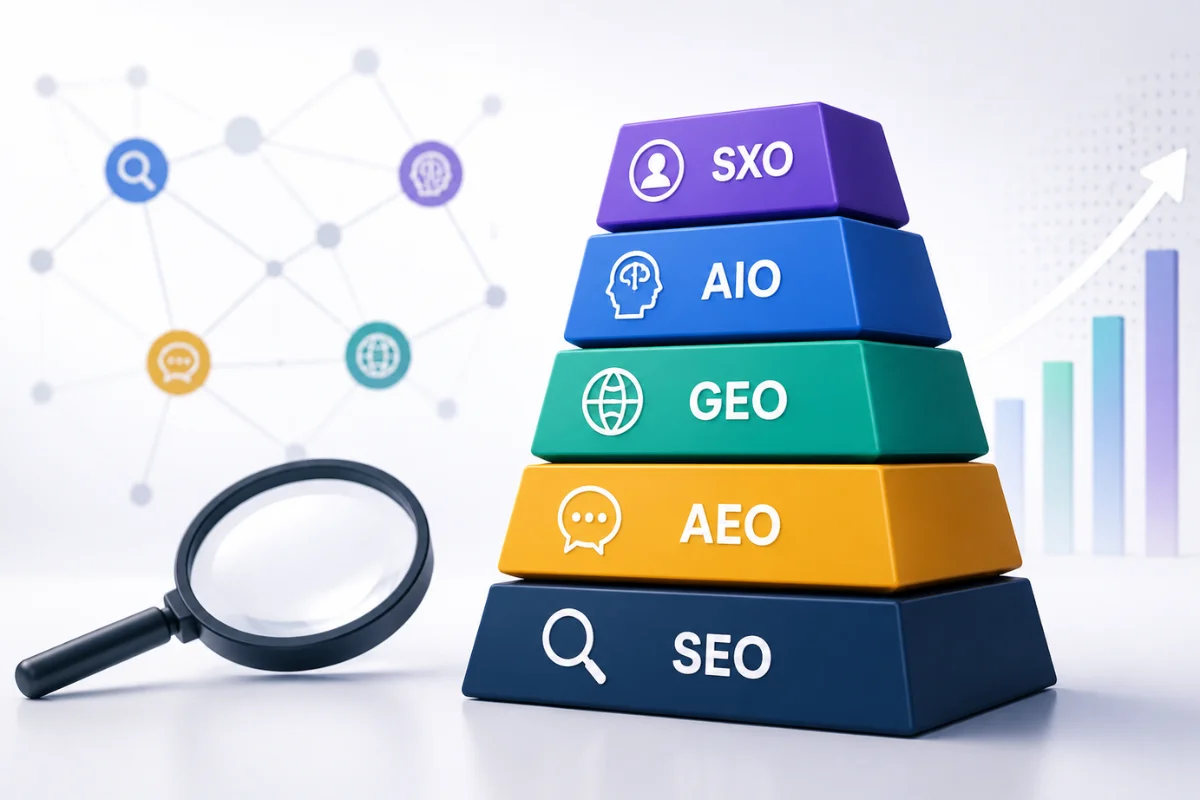
That five-part question maps to five distinct disciplines. Together, they form what I call the Search Visibility Stack: SEO, AEO, GEO, AIO, and SXO. Each layer does a specific job. None of them replaces the others. Missing one creates a gap that your competitors will quietly fill.
Why rankings are no longer the whole game
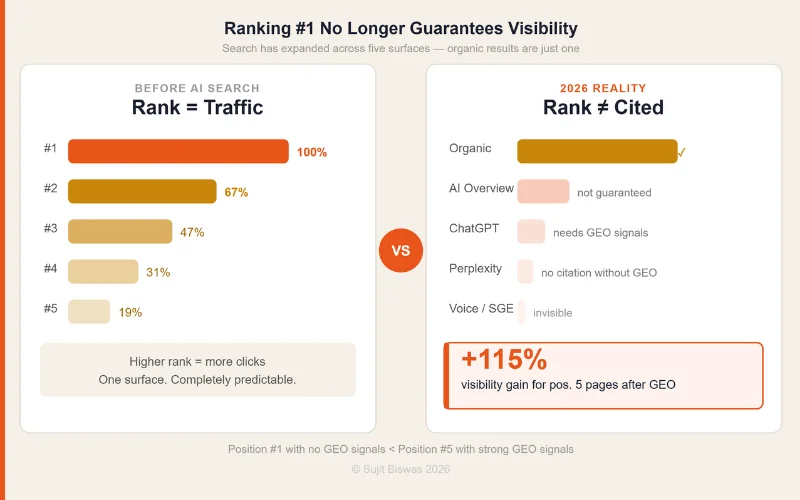
To understand why five layers now exist, you have to understand what changed. For roughly two decades, search was a retrieval problem. A user typed keywords, an algorithm ranked pages, the highest-ranking page got the click. Visibility meant ranking. Ranking meant traffic. Traffic meant business.
That model still operates — but it is no longer complete. The research makes this concrete: the landmark GEO: Generative Engine Optimization paper (Aggarwal et al., ACM SIGKDD 2024 — Princeton, IIT Delhi, Georgia Tech, Allen Institute for AI) was the first peer-reviewed study to demonstrate that content modifications specifically optimised for AI citation improve visibility inside generative engines by up to 40%. The study tested 10,000 queries across a system designed to mirror Bing Chat and validated results on Perplexity.
One finding is particularly striking for SEO practitioners: pages ranked around position five saw a 115% visibility improvement after GEO optimisation. Pages at position one saw minimal change. The implication is direct — ranking first gives you no protection if a mid-ranked competitor has content structured for AI citation and you do not.
This is not a warning that SEO no longer matters. It is a warning that SEO is now necessary but no longer sufficient. The organisations succeeding in 2026 are not choosing between SEO and AI optimisation. They are running both simultaneously, as part of a unified stack.
The Search Visibility Stack
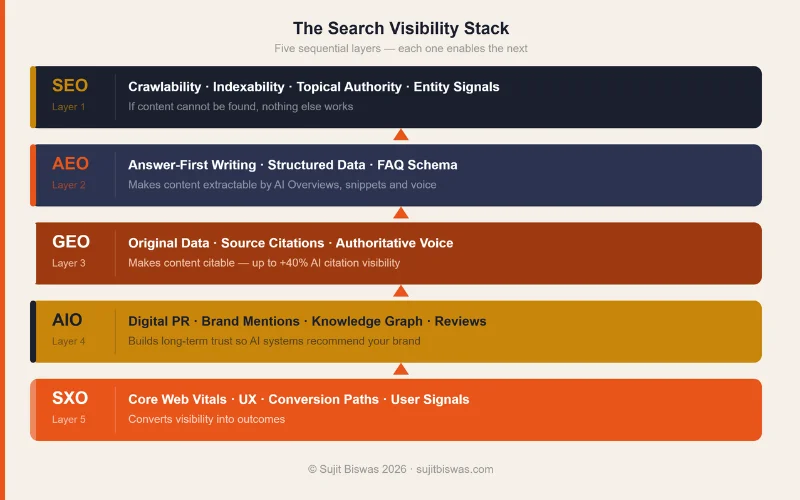
Each layer of the stack performs a specific function. Think of them as sequential filters a piece of content must pass through to achieve full modern visibility.
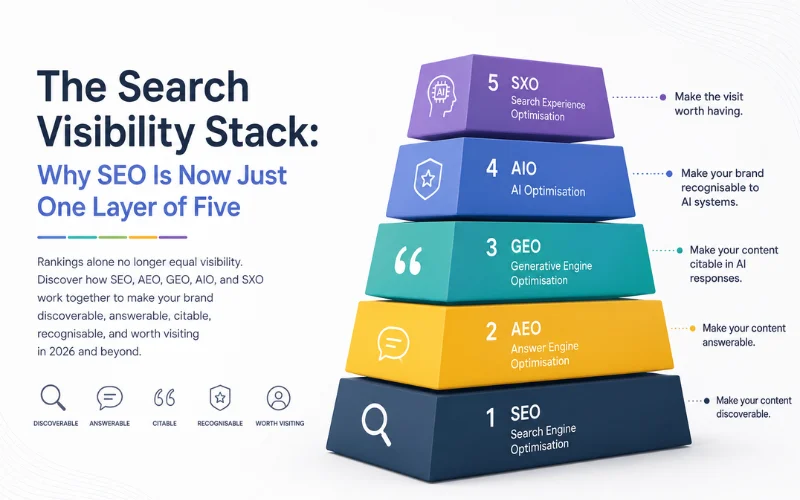
Layer 1: SEO — Make your content discoverable
SEO remains the infrastructure layer. Before an AI system can cite a source, before an answer engine can extract from it, before a user can visit it — the content must be crawlable, indexable, and authoritative enough to exist in the ecosystems these systems draw from.
What has changed in SEO is the balance between keyword signals and entity signals. Modern search systems increasingly rely on entity-based retrieval (Reinanda et al., “Entity-Oriented Search,” ACM 2020) — understanding people, organisations, products, and concepts as distinct nodes in a knowledge graph rather than as keyword occurrences on a page. A site that covers a topic comprehensively, with consistent entity signals and strong topical authority, consistently outperforms keyword-stuffed content across both traditional and AI-powered search.
Without strong SEO, the other four layers have nothing to work with. You cannot be cited if you cannot be found.
Layer 2: AEO — Make your content answerable
Answer Engine Optimisation is the discipline of structuring content so that systems designed to deliver direct answers — featured snippets, Google AI Overviews, voice assistants, AI chat interfaces — can extract your information cleanly and display it.
AEO is not new. Featured snippets have existed since 2014 and rewarded the same principles that govern AI answer extraction today: clear question-and-answer formatting, concise definitions placed immediately below H2 headings, structured lists, and FAQ sections that mirror how real users phrase questions. Google AI Overviews, ChatGPT Search, and Perplexity are all drawing from the same well — they prefer content that answers questions without making them work to find the answer.
The structural principle here matters enormously. Retrieval-Augmented Generation (Lewis et al., NeurIPS 2020) — the foundational paper behind how most modern AI systems retrieve external information — demonstrates that retrieval systems perform significantly better when source content is well-structured and factually clear. Writing for answer extraction is not a workaround. It is aligning your content with how the underlying retrieval architecture actually works.
Layer 3: GEO — Make your content citable
This is the layer most practitioners are missing, and it is where the largest opportunity currently sits. GEO (Generative Engine Optimisation) focuses specifically on increasing the likelihood that AI systems select your content as a citation source when generating responses.
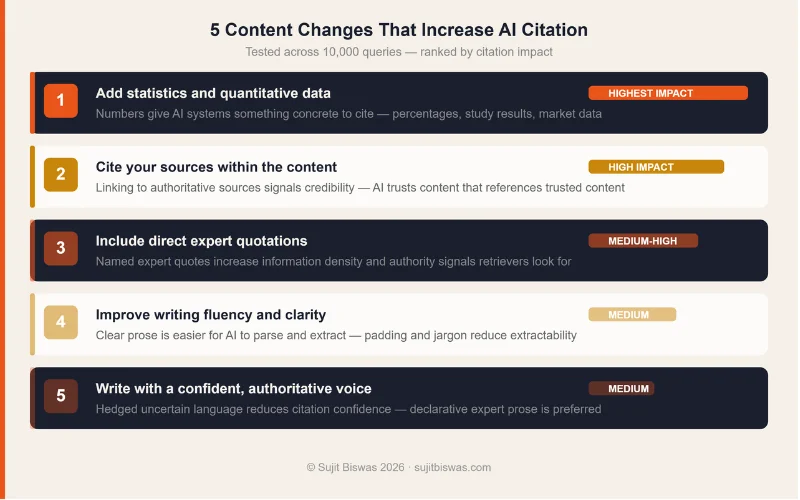
The Aggarwal et al. GEO paper tested nine content modification strategies for citation impact. The five that worked — adding statistics, citing sources within content, adding direct quotations, improving fluency, and using an authoritative voice — all point to the same underlying principle: AI systems cite content they can trust and verify. Generic information that exists on a hundred other pages gives a generative system no reason to prefer your version. Unique data, original research, evidence-backed claims, and expert analysis give it a concrete reason.
GEO also intersects with knowledge graph research. Studies on entity retrieval (Dietz et al., “Entity Retrieval,” SIGIR 2018) demonstrate that systems building representations of entities and their relationships treat well-established, consistently referenced entities as more authoritative sources. Building clear entity signals — for your brand, your authors, your products — is not just an SEO tactic. It is how you earn trust inside the knowledge ecosystems that AI systems draw from.
Layer 4: AIO — Make your brand recognisable to AI systems
AIO (AI Optimisation) is where individual content optimisation becomes brand-level strategy. GEO is about earning a citation in today’s response. AIO is about building the kind of authority that generates citations continuously, without requiring you to optimise every individual piece.
When AI systems repeatedly encounter a brand in authoritative contexts — industry publications, expert interviews, research citations, professional community discussions, media coverage — they develop stronger confidence in that brand’s relevance and expertise. This is why established brands appear disproportionately in AI-generated recommendations, even when newer competitors have technically stronger content for a given query.
The practical components of AIO include: consistent entity information across all platforms, digital PR that earns independent third-party mentions, expert-led content that builds recognisable author entities, original research that generates citations over time, and community presence on platforms like Reddit and Quora that AI systems actively draw from.
Google’s E-E-A-T framework (Experience, Expertise, Authoritativeness, Trustworthiness) — detailed in Google’s Search Quality Evaluator Guidelines — maps directly to what AI systems are evaluating when deciding whether a brand deserves recommendation. The guidelines are not a Google-specific concern. They describe the trust signals that information retrieval systems across the web have converged on.
Layer 5: SXO — Make the visit worth having
Search Experience Optimisation is the layer that converts visibility into outcomes. Every other layer in the stack drives a user toward your content. SXO determines what happens when they arrive.
In traditional SEO, user experience was a ranking signal — bounce rate, time on page, Core Web Vitals. In the AI era, it has become more than that. AI systems are increasingly able to evaluate brand quality through indirect signals: review ecosystems, community sentiment, return visit rates, branded search volume. A brand that consistently disappoints users after discovery will see its recommendation frequency decline over time, regardless of how well it performs on the other four layers.
SXO covers: page speed and Core Web Vitals performance, clear information architecture, mobile experience, answer-first content structure, and conversion path optimisation. The objective is simple — help users accomplish their goals as quickly and easily as possible. That objective aligns perfectly with what AI systems want to recommend.
The compounding effect
What makes the stack powerful is that the layers reinforce each other. Strong SEO creates the discoverability that enables AEO extraction. Strong AEO structure improves GEO citation potential. Strong GEO citation performance builds the AIO authority signals that generate future citations. Strong AIO authority increases the likelihood of SXO visits that send positive engagement signals back to search systems.
Organisations that invest consistently across all five layers create a compounding effect that becomes progressively harder for single-layer competitors to displace. This is the structural difference between organisations that are building visibility and those that are merely maintaining rankings.
The brands that will dominate search visibility through 2030 are not the ones with the most content or the most backlinks. They are the ones that become trusted sources — discoverable, answerable, citable, recognisable, and worth visiting.
Where to start
The most common mistake is attempting to implement all five layers simultaneously. The stack is sequential by design. Identify which layer is currently weakest for your site, strengthen it, and move forward.
- Strong SEO but few AI citations? Your next layer is GEO — audit your content for citation-worthiness.
- Strong content but poor user outcomes? Your next layer is SXO — review your conversion paths and page experience.
- Strong rankings but invisible inside AI responses? Your next layer is AEO — restructure key pages for answer extraction.
- Strong individual pieces but weak brand recognition? Your next layer is AIO — build your authority footprint beyond owned channels.
The following posts in this series cover each layer in depth, with specific tactics, research citations, and implementation checklists for each. Use this pillar post as your map. Use the cluster posts as your toolkit.
References and citations:
All papers verified as of June 2026. URLs checked and confirmed active.
- Aggarwal, P., Murahari, V., Rajpurohit, T., Kalyan, A., Narasimhan, K., & Deshpande, A. (2024). GEO: Generative Engine Optimization. Proceedings of the 30th ACM SIGKDD Conference on Knowledge Discovery and Data Mining (KDD 2024), pp. 5–16. Princeton University / IIT Delhi / Georgia Tech / Allen Institute for AI. https://doi.org/10.1145/3637528.3671900
- Lewis, P., Perez, E., Piktus, A., Petroni, F., Karpukhin, V., Goyal, N., … Kiela, D. (2020). Retrieval-Augmented Generation for Knowledge-Intensive NLP Tasks. Advances in Neural Information Processing Systems (NeurIPS 2020). Meta AI Research / UCL. https://arxiv.org/abs/2005.11401
- Reinanda, R., Meij, E., & de Rijke, M. (2020). Entity-Oriented Search. In “The Semantic Web” series, ACM / Springer. Foundational survey of entity retrieval and knowledge graph construction for information retrieval systems. https://dl.acm.org/doi/10.1145/3340531.3411978
- Dietz, L., Kotov, A., & Meij, E. (2018). Entity Retrieval. ACM SIGIR 2018 Tutorial. Covers entity-based retrieval, entity linking, and how knowledge graphs are used to power modern search systems. https://dl.acm.org/doi/10.1145/3209978.3210191
- Google. (2024). Search Quality Evaluator Guidelines. Google LLC. Defines Experience, Expertise, Authoritativeness, and Trustworthiness (E-E-A-T) as the core quality framework for evaluating content and source reliability. https://static.googleusercontent.com/media/guidelines.raterhub.com/en//searchqualityevaluatorguidelines.pdf
Related Post: