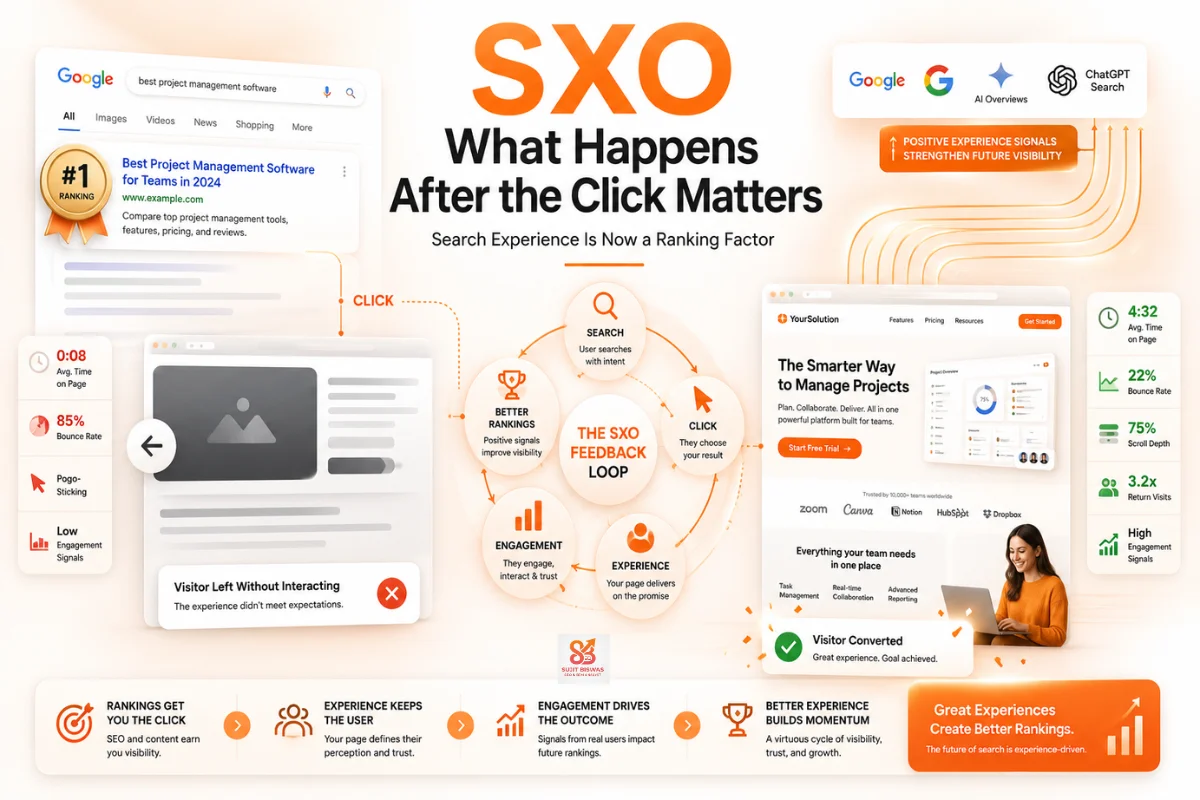

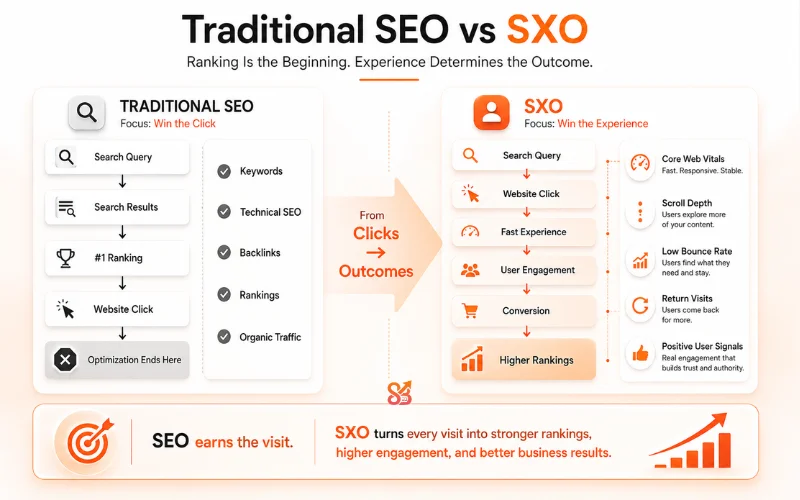
Search Experience Optimization (SXO) is the practice of combining SEO, user experience, Core Web Vitals, search intent, and conversion optimization to ensure visitors not only find your website but also stay, engage, and take meaningful action.
Yet most SEO thinking still stops at the click. Get the ranking, earn the click, job done. The rest—what users actually do on your site, whether they find what they came for, whether they convert or bounce straight back to Google—gets handed to a different team with a different budget and a different set of metrics.
That separation no longer reflects how search systems actually work. In 2026, what happens after the click is feeding directly back into the algorithm’s assessment of your page quality. Dwell time, scroll depth, pogo-sticking rate, engagement rate, return visits, branded search volume — these are not UX vanity metrics. They are ranking inputs. And in a search environment where 65% of all searches now end without a single click — up from 58.5% in 2025 — the experience you deliver on the visits you do receive has never mattered more.
Traditional SEO brings people to the door. SXO ensures they walk in, stay, and do something. In 2026 those two things are no longer separable — because the algorithm is watching what happens after you open the door.
Search Experience Optimisation (SXO) is Layer 5 of the Search Visibility Stack and the discipline that closes the loop between visibility and outcomes. It combines technical performance (Core Web Vitals), content experience (intent matching, answer-first structure), and conversion path design (CRO principles) into a single user-outcome framework. This post explains why it matters more than ever, what the research shows about its direct business impact, and the specific changes that produce measurable results.
The zero-click environment: why user experience is now the primary competitive variable
The structural context for SXO in 2026 is the zero-click search environment. Semrush’s 2025 zero-click study found 58.5% of US searches ended without a click. By Q1 2026 that figure had reached 65%. For searches triggering AI Overviews, the zero-click rate is higher still — 83% of AIO-triggered queries result in no click to any website. Mobile users are 66% more likely to experience zero-click searches than desktop users — and mobile accounts for over 63% of all Google queries.
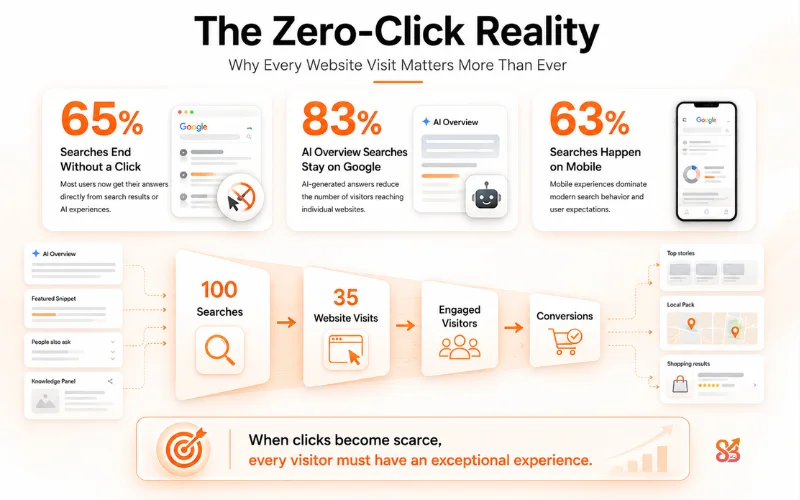
65%
of all searches in Q1 2026 end without a single click to any website- Semrush Zero-Click Study 2025 / BloqArena360 Q1 2026 update
What does this mean for SXO? It means the visits you do receive are increasingly high-intent. Users who navigate past an AI Overview, past featured snippets, past knowledge panels, and still click your result are users who want something more than what the SERP surface provided. They are in a research, evaluation, or purchase mode. They came for depth, specificity, or a relationship.
Disappointing those users has consequences that extend beyond a single lost conversion. Google’s machine learning ranking systems now incorporate behavioural signals as primary inputs. A page that consistently produces fast return-to-SERP behaviour — users clicking and immediately clicking back — registers as a page that failed to satisfy the query. Over time, that signal degrades rankings. The algorithm is not reading your content. It is reading your users’ behaviour. SXO is the discipline of making sure that behaviour tells the right story.
Core Web Vitals: the performance floor that everything else depends on
Core Web Vitals are Google’s three primary user experience metrics: Largest Contentful Paint (LCP) measures loading performance — target under 2.5 seconds. Interaction to Next Paint (INP) measures responsiveness — target under 200 milliseconds. Cumulative Layout Shift (CLS) measures visual stability — target under 0.1. Google rates sites as Good, Needs Improvement, or Poor on each metric, and uses the worst-performing metric to determine the overall page experience score.
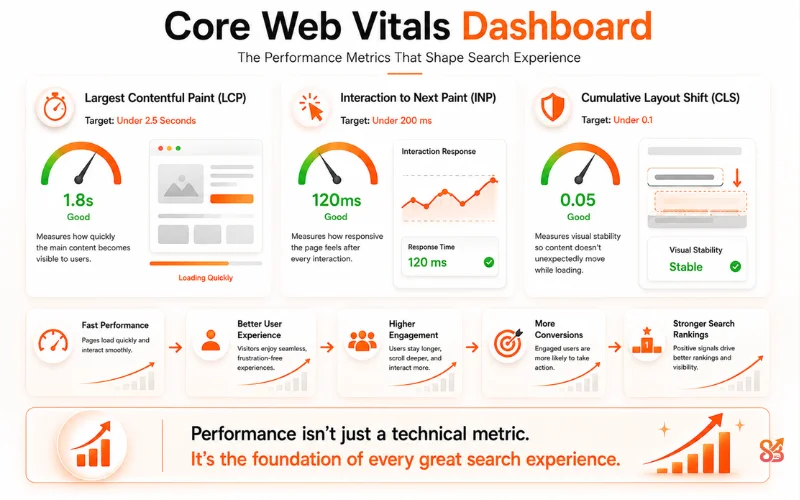
The business case for Core Web Vitals optimisation is unusually concrete. Research from Deloitte and Google found that improving page speed by 0.1 seconds boosts retail conversion rates by 8.4% and increases average order value by 9.2%. The case study evidence is consistent across industries:
- Vodafone: 31% LCP improvement → 8% sales increase
- Rakuten 24: All three CWV optimised → 53% revenue per visitor increase, 33% higher conversion rate
- Renault: 1-second LCP improvement → 14% bounce rate reduction, 13% conversion increase
- Swappie: 55% LCP improvement, 91% CLS improvement → 42% mobile revenue increase
- Product pages (general): 40–50% lower conversion rates when LCP is 4–5 seconds vs 2 seconds
The performance picture across the web remains poor. The 2025 Web Almanac found only 48% of mobile pages and 56% of desktop pages pass all three Core Web Vitals. Only 62% of mobile pages achieve good LCP scores. That means more than half the web is failing on the metric most directly correlated with conversion rates — which represents a significant competitive opportunity for any site that meets the threshold consistently.
Only 48% of mobile pages pass all three Core Web Vitals. If your competitors are in the failing half and you are not, you hold a measurable conversion advantage on every visit — before a single word of your content is read.
The four pillars of SXO
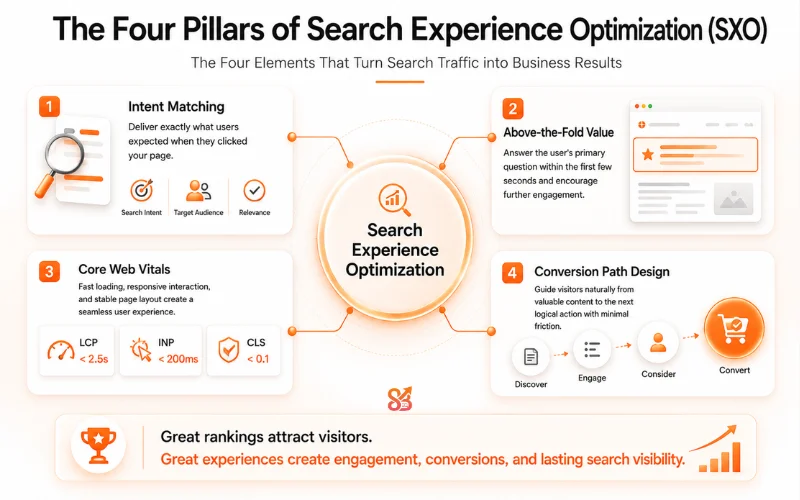
1. Intent matching: giving users exactly what they came for
The most common SXO failure is a mismatch between what the search result promises and what the page delivers. A result that promises a definitive guide but delivers a listicle. A result that promises pricing information but delivers a contact form. A result that promises a quick answer but delivers a 2,000-word introduction.
Every page has an implicit contract with its visitor, established by the title tag, meta description, and position in the SERP. SXO begins by auditing whether each page honours that contract. The four primary search intent types — informational (learning), navigational (finding a specific site), commercial (researching before purchase), and transactional (ready to act) — each require a fundamentally different page structure. Mapping the wrong structure to the intent is the single most reliable way to produce pogo-sticking behaviour that degrades rankings over time.
In 2026, a fifth intent type is emerging: agentic intent — queries where AI agents search on behalf of users to complete tasks autonomously. Optimising for agentic intent means ensuring your content is machine-parseable, your conversion paths are accessible without JavaScript, and your structured data is comprehensive enough for an AI agent to understand what action it should take on your page.
2. Above-the-fold value: answering the implicit question within three seconds
The first 100 words of any landing page should answer the implicit question the user arrived with. Not a value proposition. Not a hero image. Not a company overview. The answer to why they clicked.
This principle connects SXO directly to AEO (Layer 2). The same answer-first writing discipline that makes content extractable by AI systems also makes it immediately satisfying to human visitors. A user who finds their answer in the first paragraph does not bounce — they scroll. A user who cannot find their answer in the first paragraph often does not wait to discover it further down the page.
3. Core Web Vitals and technical performance
Meeting Google’s Core Web Vitals thresholds — LCP under 2.5 seconds, INP under 200 milliseconds, CLS under 0.1 — is the technical floor of SXO. These are not aspirational targets. They are the minimum performance standard that Google uses to differentiate between sites in competitive ranking scenarios.
The most impactful optimisation for most sites is LCP. The most common cause of poor LCP is unoptimised hero images — large, uncompressed files that delay the largest visible content element from rendering. Image compression, next-gen formats (WebP, AVIF), preloading priority images with fetchpriority=’high’, and eliminating render-blocking resources typically resolve LCP issues on sites that are not actively serving them from a CDN.
CLS — visual stability — is most commonly caused by images without explicit dimensions, dynamically injected content (cookie banners, ads, chat widgets), and web fonts that swap at a different size from their fallback. Each of these has a specific technical fix. INP — interactivity responsiveness — is most often caused by excessive JavaScript execution on the main thread, particularly third-party scripts that were added incrementally without performance impact assessment.
4. Conversion path design: making the next step obvious
A user who is satisfied with your content and ready to take action should never have to work out what to do next. SXO treats the conversion path — the sequence from landing to action — as a design problem that deserves the same deliberate attention as the content itself.
The practical principles: one primary call-to-action per page, positioned prominently without requiring scroll; form fields reduced to the minimum necessary (every additional field on a mobile contact form reduces submission rate measurably); social proof — testimonials, case studies, review scores — placed at the decision point rather than on a separate page; and internal links that guide users toward topically related content when they are not yet ready to convert.
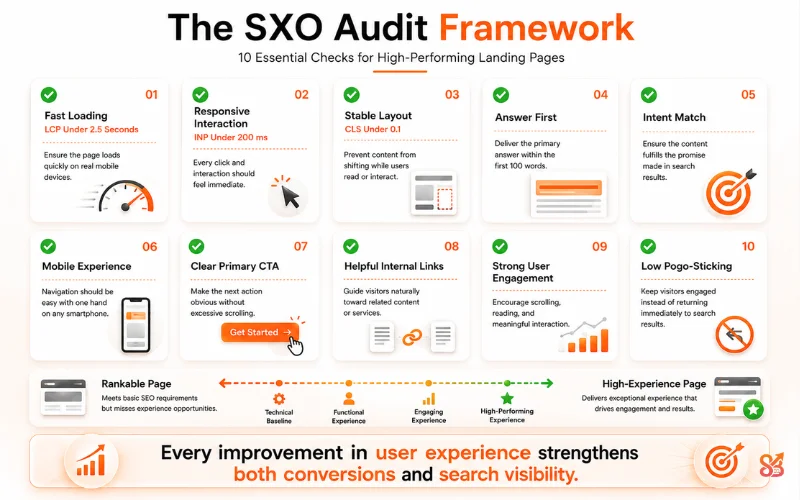
The SXO audit: 10 checks for your top landing pages
Run this audit on your ten highest-traffic landing pages. Each item represents a measurable user experience variable that is currently feeding back into your search quality assessment.
- LCP under 2.5 seconds on mobile (use PageSpeed Insights field data, not lab scores)
- INP under 200 milliseconds (check Search Console Core Web Vitals report for real user data)
- CLS under 0.1 (check for image dimension declarations, font swap behaviour, dynamic content injection)
- First 100 words answer the implicit search query (test by reading only the above-fold content — does it satisfy the user’s question?)
- Heading hierarchy matches reading flow (each H2 should describe the next section’s argument, not just label a topic)
- Search intent correctly matched (informational / commercial / transactional — does the page structure match the intent behind the ranking query?)
- Mobile navigation usable with one thumb (test on a mid-range Android device, not a high-end iPhone)
- Single primary CTA visible without scrolling (what action do you want this user to take? Is it obvious?)
- Internal links guide toward conversion (links should match topical intent, not just popular pages in the navigation)
- No pogo-sticking signals in GA4 engagement data (check engagement rate — formerly bounce rate — and session duration on Search Console landing pages report)
SXO measurement: the metrics that connect experience to search performance
| Metric | What it signals | Tool | Target |
| Engagement rate (GA4) | % of sessions with meaningful interaction — replaces bounce rate | Google Analytics 4 | >60% for informational content |
| Average session duration | Whether users are consuming content or bouncing | Google Analytics 4 | Benchmark against category average |
| LCP (field data) | Real-user loading experience — ranking input | Search Console / PageSpeed Insights | <2.5 seconds |
| INP (field data) | Real-user interactivity — ranking input | Search Console CWV report | <200ms |
| CLS (field data) | Visual stability — user trust signal | Search Console CWV report | <0.1 |
| Conversion rate by landing page | Whether SXO is producing outcomes | Google Analytics 4 | Benchmark vs site average |
| Branded search volume | Long-term trust and recognition signal | Google Search Console | Month-on-month trend |
| Return visitor rate | Strongest satisfaction signal available | Google Analytics 4 | Track trend, not absolute |
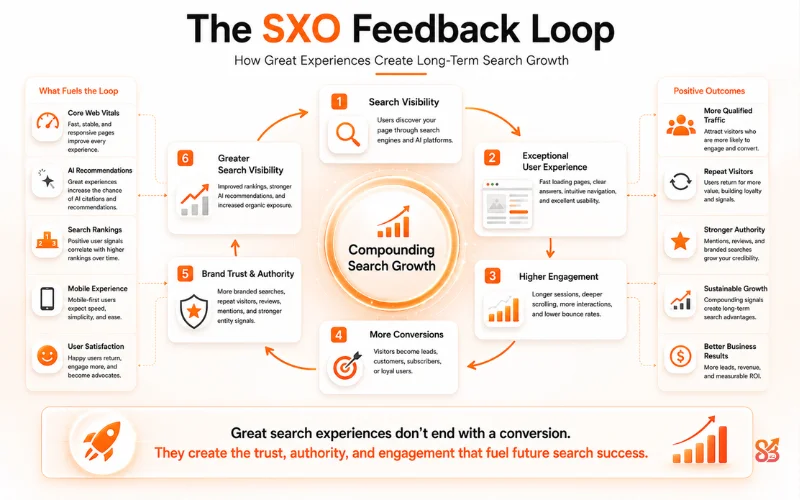
The metric most practitioners underweight is branded search volume. When users have a satisfying experience on your site, they return by searching your brand name directly. That branded search volume is a trust signal that feeds into how AI systems perceive your authority — connecting SXO directly back to AIO (Layer 4). The loop is complete: great experience generates return visits, return visits generate branded searches, branded searches strengthen entity authority, entity authority improves AI recommendation frequency.
Search experience optimization and agentic search: the horizon worth preparing for
The emerging frontier for SXO is agentic search — queries where AI assistants act autonomously on behalf of users. “Find me the best contractor SEO agency in Texas and book a discovery call” is not a hypothetical. It is the direction the major AI platforms are moving. In that world, SXO becomes about machine-to-machine trust: can an AI agent parse your service offering, understand your conversion path, and complete an action on your site without human assistance?
Preparing for agentic search means: ensuring conversion paths are accessible without JavaScript execution; implementing comprehensive structured data so AI agents understand your services, pricing, and contact options; making forms simple enough for programmatic completion; and ensuring your site’s information architecture is logical enough for a non-human agent to navigate without confusion.
This is not an immediate priority for most practitioners. It is a two-to-three year horizon that is worth building toward now, because the sites that will perform well in agentic search are the sites that are already doing excellent SXO today — clear paths, minimal friction, comprehensive structured data, honest intent matching.
Where SXO completes the Search Visibility Stack
SXO is Layer 5 — the final layer and the one that closes the loop. Every other layer in the stack drives a user toward your content. SEO creates discoverability. AEO creates extractability. GEO creates citation-worthiness. AIO creates brand recognition. SXO determines what happens when they actually arrive.
But SXO does not just convert visits into outcomes. The positive user signals it generates — engagement, return visits, branded searches, conversion rates — feed back into every layer above it. Better user signals strengthen SEO rankings. Better engagement improves AI citation confidence. Better branded search volume builds the entity authority that drives AIO visibility. SXO is both the final layer and the foundation of the feedback loop that makes the entire stack compound over time.
Rankings are vanity. Revenue is sanity. SXO is the discipline that connects them — and in 2026, it does so by making the user experience the primary signal that search systems use to decide whether you deserve to keep ranking.
Next: The Search Visibility Maturity Model — Which Stage Is Your Strategy At?
Previous post in the layer: Artificial intelligence optimisation
References and citations
- Semrush. (2025). Zero-Click Search Study. 58.5% of US searches and 59.7% of EU searches end without a click; Q1 2026 figure reached 65%. Reported via BloqArena360 SXO Guide. https://blogarena360.com/what-is-sxo-search-experience-optimisation/
- Google. (2025, updated December). Core Web Vitals — LCP, INP, CLS thresholds and ranking guidance. LCP: under 2.5s. INP: under 200ms. CLS: under 0.1. Official ranking signal documentation. https://developers.google.com/search/docs/appearance/core-web-vitals
- Deloitte / Google. (2020, updated 2025). Speed Matters: How page speed affects conversion rates. 0.1-second LCP improvement → 8.4% retail conversion rate increase, 9.2% average order value increase. Vodafone: 31% LCP improvement → 8% sales increase. Cited by MonsterInsights Core Web Vitals Guide. https://www.monsterinsights.com/what-are-core-web-vitals/
- HTTP Archive / Web Almanac. (2025). State of the Web — Core Web Vitals performance. 48% of mobile pages and 56% of desktop pages pass all three Core Web Vitals. Only 62% of mobile pages achieve good LCP scores. https://www.corewebvitals.io/core-web-vitals
- BluTriangle / Google. (2025). LCP Case Study: Business KPI impact. Product pages see 40–50% lower conversion rates when LCP is 4–5 seconds vs 2 seconds. Rakuten 24: 53% revenue per visitor increase from CWV optimisation. https://bluetriangle.com/blog/web-vitals-impact-lcp
- Fishkin, R. & O’Donnell, P. (2026). SparkToro AI Brand Recommendation Consistency Research. Establishes visibility rate as the only statistically valid AI tracking metric; AIO→SXO loop: branded search volume feeds AI entity authority. https://sparktoro.com/blog/new-research-ais-are-highly-inconsistent-when-recommending-brands-or-products-marketers-should-take-care-when-tracking-ai-visibility/