
AI optimisation (AIO) is reshaping how brands get discovered — not through rankings, but through recommendations. Someone on your prospect’s team opens ChatGPT and asks: what are the best tools for X? Which agencies specialise in Y? Who should I hire for Z? They screenshot the answer and send it to leadership as evidence that you either appear in AI responses — or you don’t.
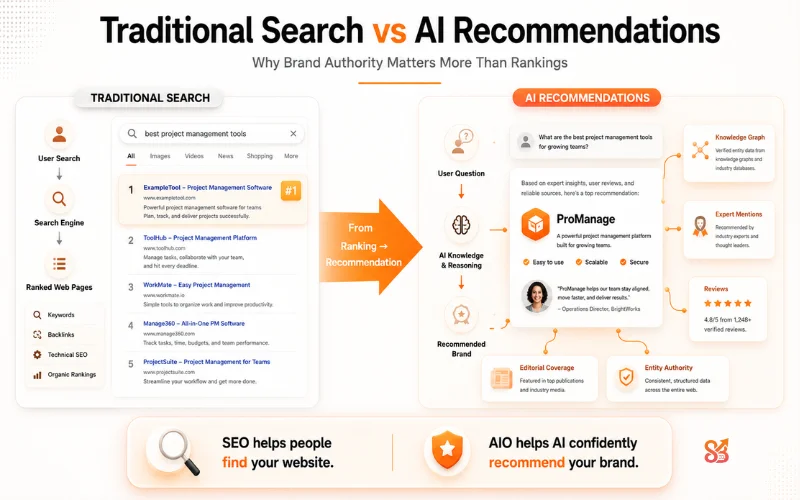
The instinct is to treat this as a ranking problem. Build more content, optimise more pages, track your position in AI responses. The problem is that new research from SparkToro (January 2026) has made that approach look exactly as fragile as it is: AI recommendation lists differ more than 99% of the time when the same prompt is run repeatedly. The same list in the same order? Less than one chance in a thousand.
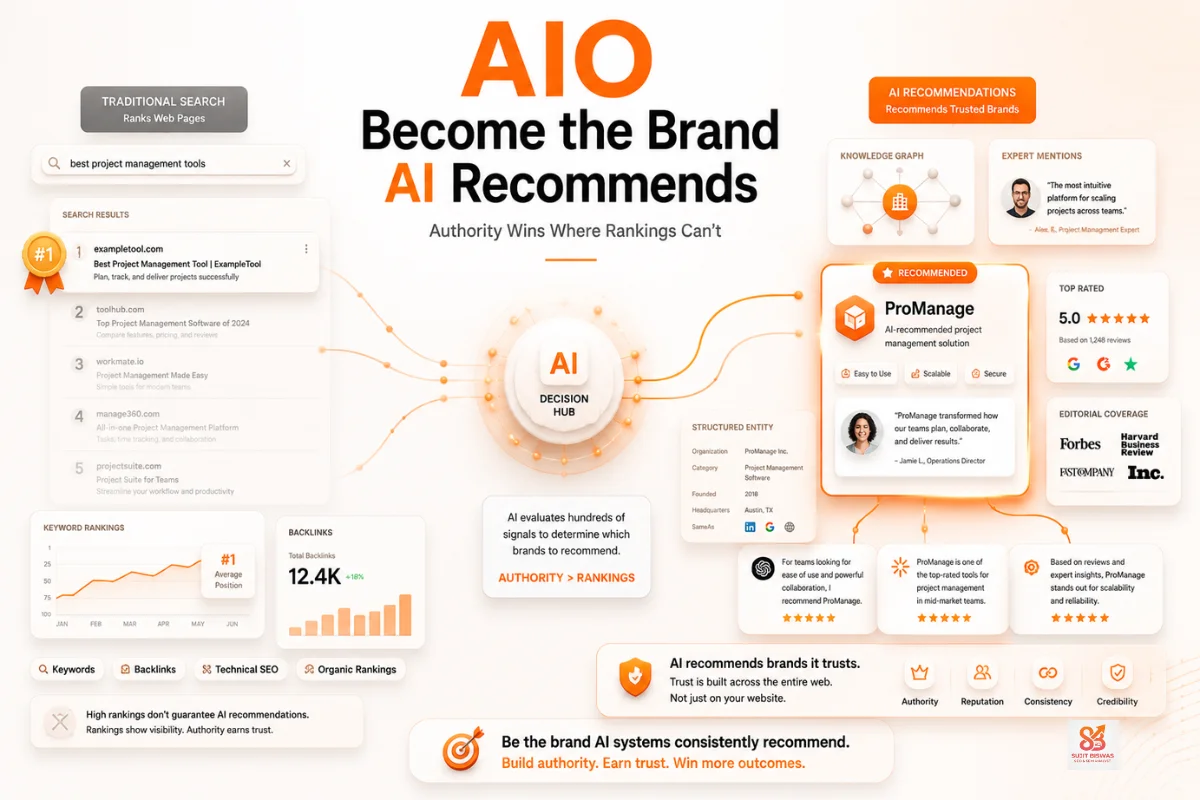
AI recommendations are not rankings. They are probabilistic outputs shaped by everything AI systems have been trained to associate with your brand. Building that association is a completely different discipline from traditional SEO — and most brands have not started.
AI Optimisation (AIO) is Layer 4 of the Search Visibility Stack. It is the discipline of building the kind of brand authority that makes AI systems consistently associate your name with your category, regardless of which prompt version they receive or which platform generates the answer. This post explains what that actually requires, what the research says about how AI systems form these associations, and the practical steps for building them deliberately.
The SparkToro finding that changes everything about AIO strategy
In January 2026, Rand Fishkin and Patrick O’Donnell of Gumshoe.ai ran the most comprehensive public study of AI recommendation consistency to date. Six hundred volunteers ran 12 different prompts across ChatGPT, Claude, and Google AI a combined 2,961 times over November and December 2025. The prompts covered diverse categories: headphones, chef’s knives, digital marketing consultants, cancer care hospitals, cloud computing providers, science fiction novels.
The finding was unambiguous. Ask ChatGPT for brand recommendations 100 times and there is less than a 1-in-100 chance of receiving the same list twice. Want the same list in the same order? The probability drops below 0.1% — less than one chance in a thousand.
<1 in 100 chance of receiving the same AI brand recommendation list twice from the same promptSparkToro / Gumshoe.ai — 2,961 prompt runs across ChatGPT, Claude, Google AI, Jan 2026
This finding matters enormously for how you think about AIO strategy. If AI recommendation lists are this variable, tracking your ‘position’ in any single AI response is statistically meaningless. What matters is not where you appear in one response — it is how often you appear across many responses to many variations of the same underlying question.
The SparkToro research identified the metric that does hold: visibility percentage — how often your brand appears across a large sample of relevant prompt runs. In narrow, well-defined categories, top brands appeared in 55–77% of responses. In broad categories, results were far more scattered. The narrower and more specific your category positioning, the more consistent your AI visibility becomes.
Why AI systems form brand associations the way they do
Understanding why some brands appear consistently in AI responses — while others with equivalent content quality do not — requires understanding how large language models form associations in the first place.
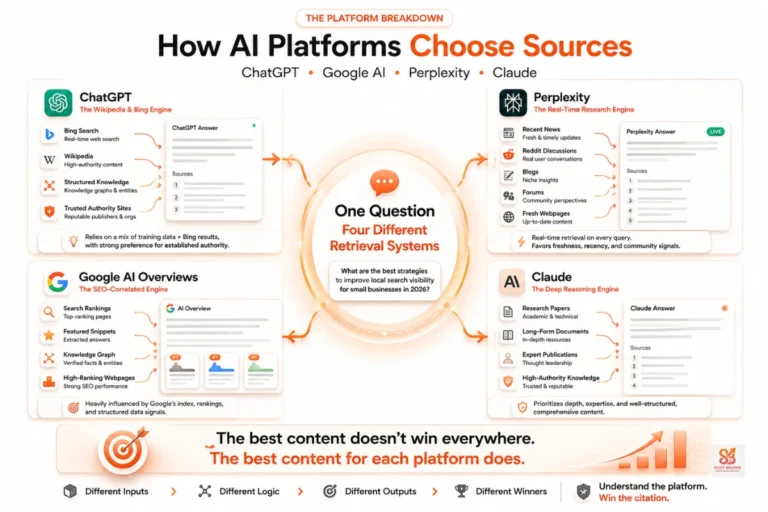
AI systems are trained on vast corpora of text from across the web. The associations they form between brand names and topic areas are determined by how frequently and in what contexts those brands appear in that training data. A brand that appears consistently in authoritative contexts — industry publications, expert interviews, research papers, professional directories, community discussions, reputable review platforms — will be more strongly associated with its category than a brand whose presence is concentrated only on its own website.
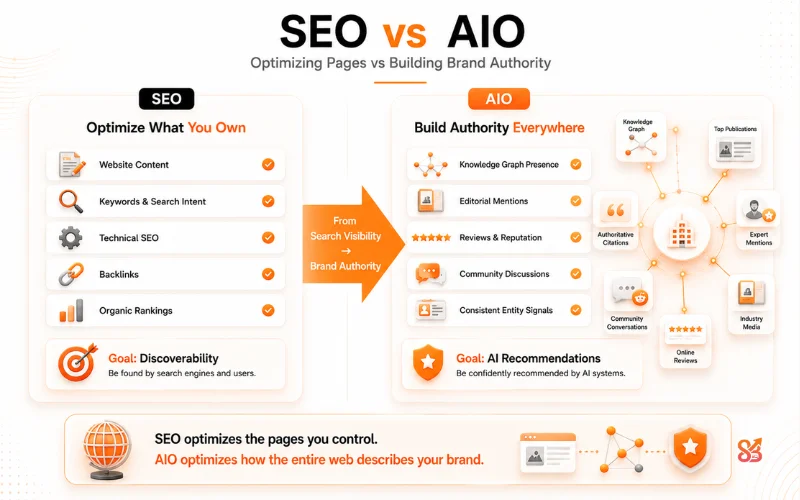
This is what makes AI optimisation fundamentally different from SEO. SEO optimises content you control. AIO optimises the signals about you that exist across the entire web. Your owned content matters — but it is estimated to represent only around 15% of the signal surface that determines AI brand associations. The other 85% lives in third-party publications, community platforms, review ecosystems, knowledge graphs, and the web of external citations that reference your brand.
The four signal categories that build AI brand authority
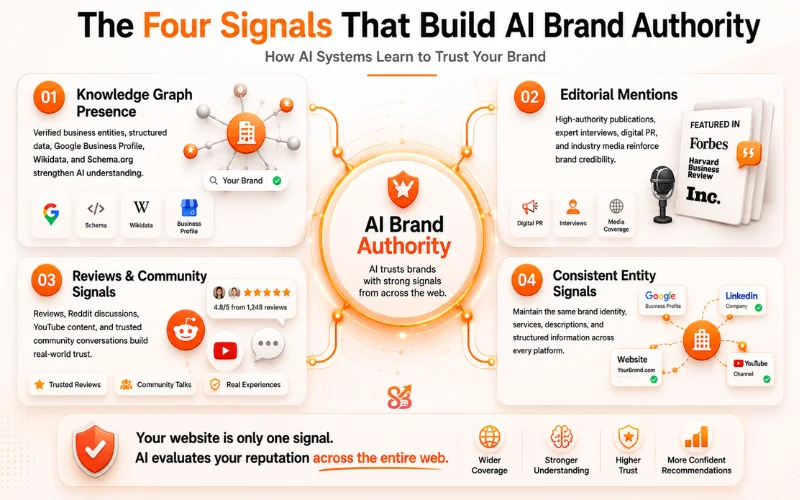
Based on the emerging research and practitioner evidence across GEO and AIO disciplines, four categories of external signal most consistently determine how AI systems represent and recommend a brand.
1. Knowledge graph presence
AI systems — particularly Google AI Overviews, which run on Google’s Knowledge Graph of over 800 billion facts — draw heavily from structured entity data when generating responses about brands. A brand with a verified, complete, and consistent knowledge graph entry is easier for AI systems to classify accurately and recommend confidently. Yext’s State of AI Search research (2025) found that participation in knowledge graphs and review platforms significantly boosts recommendation rates.
Practical components: a complete and verified Google Business Profile, a Wikidata entry for your organisation, consistent Name/Address/Phone (NAP) data across all platforms, and Schema.org Organization markup on your website that uses sameAs properties to connect your entity across multiple platforms.
2. Third-party editorial mentions
The SparkToro analysis points clearly to high-authority third-party editorial coverage as a primary signal. Research from the AI monitoring community indicates that 65.3% of ChatGPT citations come from domains with a Domain Rating of 80 or above. Coverage in industry publications, expert roundups, trade press, and mainstream media carries disproportionate weight in shaping AI associations — not because of direct citation in AI responses, but because this content forms part of the training and retrieval data that determines what AI systems know about your brand.
The practical implication: traditional digital PR — earning editorial mentions in authoritative publications — is one of the highest-leverage AIO activities available. Not press releases on wire services. Genuine editorial placements in publications that carry real authority in your category.
3. Community and review platform presence
AI systems draw actively from community platforms when constructing recommendations. OtterlyAI data (April 2026) shows that YouTube and Reddit combined account for 78.2% of AI social media citations — Reddit at 46.4% and YouTube at 31.8%. A brand with no meaningful presence on the platforms where users discuss its category is missing a substantial portion of the signal surface that AI systems sample from.
This extends to review platforms. Google Reviews, Trustpilot, G2, Clutch, and industry-specific review ecosystems all contribute to the aggregate trust picture that AI systems draw on. A consistent pattern of positive reviews across multiple credible platforms compounds over time in ways that are difficult for competitors to replicate quickly.
4. Consistent entity signals across all touchpoints
One of the most consistent findings across AIO research is that brand information inconsistency actively undermines AI confidence. When your brand name, description, service list, and positioning are described differently across your website, your Google Business Profile, your LinkedIn company page, your industry directory listings, and your press coverage — AI systems encounter conflicting signals and have lower confidence in how to represent you.
Here is what inconsistency looks like in practice — and why it matters:
| ✗ Inconsistent entity signals (undermines AI confidence) | ✓ Consistent entity signals (builds AI confidence) |
| Website: “Sujit Biswas — Semantic SEO Specialist” Google Business Profile: “SujitSEO.com — SEO Services” LinkedIn: “Sujit Biswas Digital Marketing” Clutch directory: “Sujit Biswas — SEO & Content Strategy” Press mention: “Sujit, founder of Texas Contractor SEO” Five touchpoints. Five different entity descriptions. AI systems cannot confidently map these to a single authoritative entity. | Website: “Sujit Biswas — SEO & AI Search Specialist” Google Business Profile: “Sujit Biswas — SEO & AI Search Specialist” LinkedIn: “Sujit Biswas — SEO & AI Search Specialist” Clutch directory: “Sujit Biswas — SEO & AI Search Specialist” Press mention: “Sujit Biswas, SEO & AI Search Specialist” One entity. Consistent across every touchpoint. AI systems can reference this brand with confidence. |
Entity consistency means: the same brand name format everywhere, the same core service description, the same positioning language, and the same factual claims about what you do and who you serve. Most brands have accumulated significant inconsistency simply through the natural drift of updating some platforms and not others over time.
The AIO paradox: why content alone is not enough
The most common mistake in AI optimisation strategy is treating it as an extension of content production. Publish more content, optimise it better, and AI visibility will follow. The SparkToro research exposes why this is insufficient. Brands that appear consistently in AI responses are not necessarily the ones with the most or best content. They are the ones with the densest, most corroborated presence across multiple knowledge layers.
A brand with 200 thoroughly optimised blog posts but minimal third-party editorial mentions, a thin review profile, and inconsistent entity signals will be outperformed in AI recommendations by a brand with 40 solid pieces of content and robust external authority signals. The content creates the foundation. The external signals create the confidence.
AI systems do not recommend brands because they found a great page. They recommend brands they have been trained to recognise as credible authorities in a category — through repeated, consistent exposure across authoritative sources. That recognition is built off-site, not on it.
Measuring AIO: the metrics that actually work
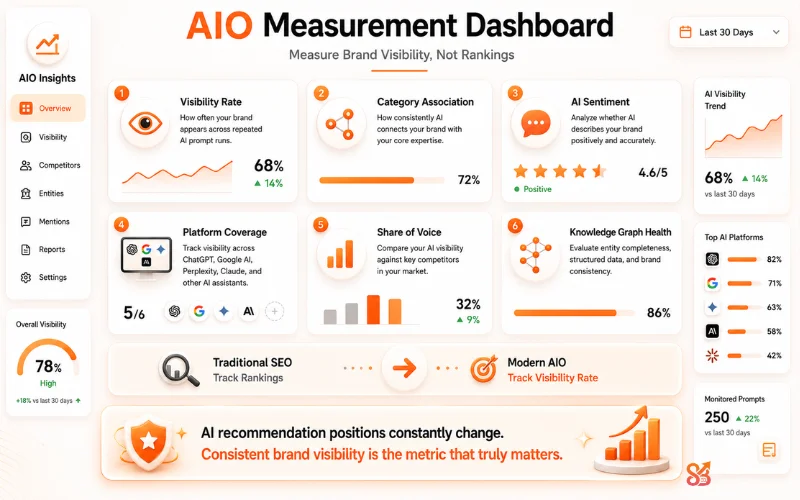
Given the SparkToro finding that individual AI response positions are essentially random, the measurement framework for AIO must be built differently from SEO measurement.
| Metric | What it measures | How to track it | Target |
| Visibility rate | % of prompt runs where brand appears | Run target prompts 60–100x; use GetPassionFruit, Profound.io, or a manual spreadsheet tracker. Count appearances ÷ total runs | 55–77% for dominant brands in narrow categories (SparkToro) |
| Category association strength | How consistently AI links brand to category | Cross-platform prompt testing across 5–10 query variations per month | Improving month-on-month trend |
| Sentiment framing | What AI says about you when you appear | Qualitative review of AI response text across multiple runs — screenshot and categorise positive / neutral / negative | Positive framing in 80%+ of appearances |
| Platform coverage | Visibility across ChatGPT, Perplexity, Gemini, Copilot | Platform-by-platform tracking — same prompts, separate runs per platform | Presence on minimum 3 of 5 major platforms |
| Share of voice vs competitors | Your visibility rate relative to 3–5 key competitors | Run identical prompt sets for yourself and competitors; compare visibility rates | Closing gap with category leader month-on-month |
| Knowledge graph completeness | Coverage and accuracy of entity data | Manual audit: GBP, Wikidata, schema implementation, directory listings | All fields complete, all platforms consistent |
The recommended tooling stack for AIO measurement in 2026: GetPassionFruit and Profound.io both offer automated AI brand monitoring across multiple platforms. For practitioners who prefer manual tracking, a simple spreadsheet — prompt, platform, date, appeared (Y/N), framing (positive/neutral/negative) — is sufficient for monthly visibility rate calculation across 60+ runs.
The AIO action plan: what to build over 90 days
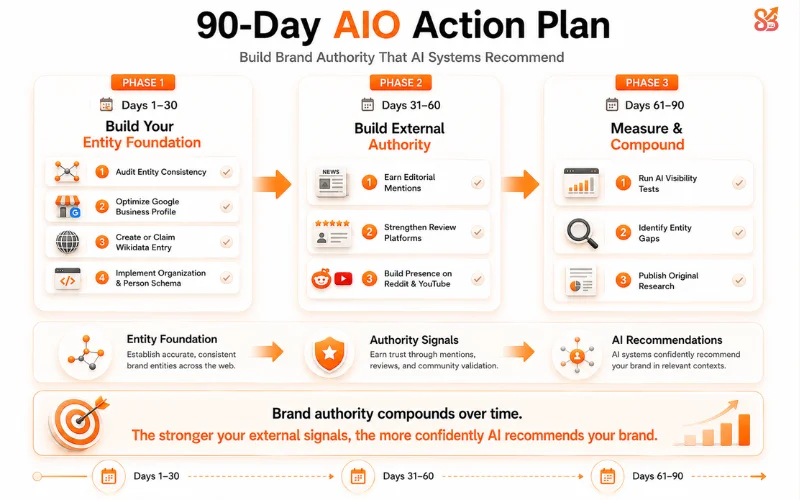
AIO is a compounding discipline. The foundations take time to establish, but once established they are genuinely difficult for competitors to replicate quickly. Each phase below includes a success metric so you can self-assess progress before moving forward.
Days 1–30: Establish and audit your entity foundation
- Audit entity consistency across all touchpoints. Check your brand name, description, service list, and positioning across your website, Google Business Profile, LinkedIn, Facebook, Twitter/X, industry directories, and any press coverage from the past two years. Document every inconsistency and create a single master entity record.
- Verify and complete your Google Business Profile. This is the most direct input to Google’s Knowledge Graph. Ensure every field is complete, accurate, and consistent with your master entity record.
- Create or claim your Wikidata entry. A verified entry with accurate information and proper sameAs links creates a confirmed entity node that AI systems can reference with confidence.
- Implement Organisation and Person schema site-wide. Ensure Schema.org Organisation markup includes sameAs properties linking to all verified third-party profiles. Add Person schema for key authors and team members.
Phase 1 success metric: By end of Day 30: master entity record documented, NAP consistent across all platforms, GBP complete, Wikidata entry live or claimed, Organisation schema implemented with sameAs properties.
Days 31–60: Build external authority signals
- Identify the 10 publications most cited in your category’s AI responses. Run your target queries across ChatGPT and Perplexity, note which publications are cited most frequently, and build a targeted editorial pitch list. These publications’ mentions carry the most weight for your category.
- Build or strengthen your review platform presence. Identify the most relevant review platforms for your category. Implement a systematic process for requesting reviews from satisfied clients. Respond to all existing reviews — response patterns are an authority signal.
- Create community presence on Reddit and YouTube. Given that these two platforms account for 78.2% of AI social media citations, a brand with no presence is missing a significant portion of the signal surface. Identify relevant subreddits and begin contributing genuine expertise. Publish video content addressing questions your audience is asking AI systems.
Phase 2 success metric: By end of Day 60: editorial pitch list of 10 target publications built, minimum 5 new reviews collected, at least 3 substantive Reddit or YouTube contributions published in category-relevant communities.
Days 61–90: Measure, adjust, and compound
- Run your baseline AIO measurement protocol. Execute 60+ prompt runs across your priority queries on ChatGPT, Perplexity, and Google AI. Calculate your baseline visibility rate and compare against your top 3 competitors. This is your starting point for all future AIO measurement.
- Identify and address your biggest entity gaps. Review what AI systems actually say about you when you appear in responses. Are descriptions accurate? Are you being associated with the right services and positioning? Gaps between how you want to be represented and how you are actually represented point directly to signals that need strengthening.
- Publish original research that earns external citations. One of the highest-leverage long-term AIO investments is original research that other publications cite. A single well-designed study — even a small survey of your client base — that generates five to ten editorial citations in authoritative publications does more for AI brand association than dozens of well-optimised blog posts.
Phase 3 success metric: By end of Day 90: baseline visibility rate calculated and documented across ChatGPT, Perplexity, and Google AI. Competitor benchmarks recorded. At least one original research piece published or in final draft. Monthly tracking cadence established.
Where AIO sits in the Search Visibility Stack
AI optimisation is Layer 4 — built on the SEO infrastructure (Layer 1) that creates discoverability, the AEO structure (Layer 2) that makes content extractable, and the GEO signals (Layer 3) that make individual pieces of content citation-worthy. Without those three layers, AIO has no foundation to compound from.
What AIO adds is the brand-level authority that makes citation automatic rather than piece-by-piece. GEO earns you a citation for a specific piece of well-optimised content. AIO earns you recommendations for your brand as a category authority — across queries you have not specifically optimised for, on platforms that may never have directly indexed your content.
Stop tracking positions, start tracking visibility rates. Stop optimising individual responses, start building the signal density that makes consistent appearance inevitable.
Next: Layer 5 — SXO: How to Convert AI Visibility Into Outcomes
Previous: Layer 4 — How to optimize for GEO
References and citations
- Fishkin, R. & O’Donnell, P. (2026, January). New Research: AIs are highly inconsistent when recommending brands or products. SparkToro / Gumshoe.ai. 2,961 prompt runs across ChatGPT, Claude, and Google AI from 600 volunteers. https://sparktoro.com/blog/new-research-ais-are-highly-inconsistent-when-recommending-brands-or-products-marketers-should-take-care-when-tracking-ai-visibility/
- Yext. (2025, December). Why Brands Must Have a Knowledge Graph to Master AI Visibility in 2026. Knowledge graph participation significantly boosts AI recommendation rates. https://www.yext.com/blog/2025/12/knowledge-graph-for-ai-visibility-2026
- OtterlyAI / Position.Digital. (2026, April). AI SEO Statistics 2026. YouTube and Reddit account for 78.2% of AI social media citations. https://www.position.digital/blog/ai-seo-statistics/
- Aggarwal, P., et al. (2024). GEO: Generative Engine Optimization. KDD 2024. Princeton / IIT Delhi / Georgia Tech / Allen Institute for AI. https://doi.org/10.1145/3637528.3671900
- GetPassionFruit. (2026, April). How to Monitor Your Brand in ChatGPT, Perplexity & AI Search. Visibility rate as the valid AI tracking metric; top brands in tight categories appear in 55–77% of responses. https://www.getpassionfruit.com/blog/how-to-monitor-your-brand-across-chatgpt-perplexity-and-ai-search
- Google. (2024). Search Quality Evaluator Guidelines (E-E-A-T). https://static.googleusercontent.com/media/guidelines.raterhub.com/en//searchqualityevaluatorguidelines.pdf