
Search visibility myths spread faster than the corrections that follow them. Some were true a decade ago and never got updated. Some are misreadings of a single Google statement taken out of context. Some are simply easier to believe than the more complicated, more current reality. Believing the wrong one can cost months of wasted effort and budget pointed at strategies that stopped working years ago — or, just as damagingly, panic decisions made in response to threats that are overstated.
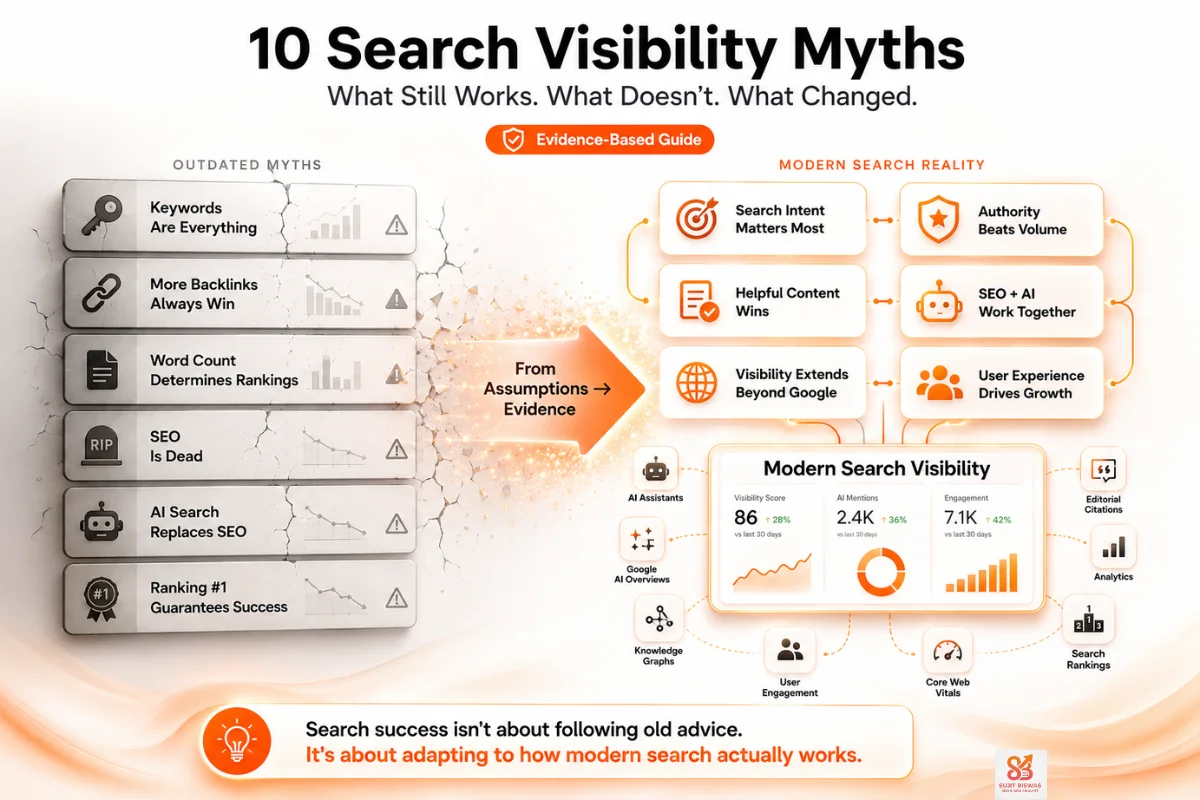
This post tackles ten of the most persistent myths circulating in 2026 — five evergreen SEO misconceptions that simply will not die, and five newer myths specific to the AI search era. Each one is addressed with current data, specific evidence, and the practical implication for your strategy.
The myths that survive longest are not the ones that were never true. They are the ones that were true once, under a previous algorithm generation, and never got updated in the collective understanding of the discipline.
Part 1: Five evergreen SEO myths that still will not die
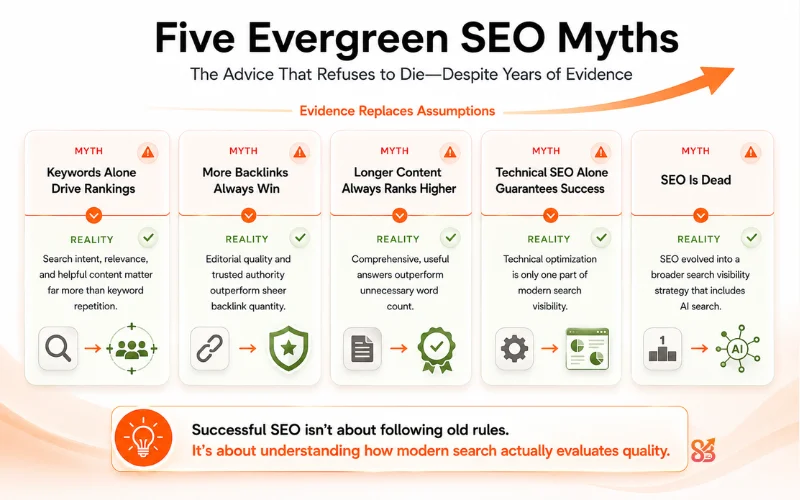
MYTH 1:
You need your keyword to appear at a specific density — 2%, 3%, or 5% — for a page to rank.
REALITY:
Keyword density has never been a confirmed Google ranking factor — not in 2015, not in 2026. Google’s search systems use natural language processing and semantic understanding to determine relevance. They recognise synonyms, related concepts, and topical context rather than counting keyword occurrences.
The practical guideline is simple: include your primary keyword in the title tag, H1, and naturally within the first paragraph. Then cover the topic comprehensively. Forcing exact-match repetition throughout content actively reduces quality and readability — and readability is what both users and AI retrieval systems reward. If you are still using a keyword density checker, you are optimising for a version of search that no longer exists.
The myth persists because keyword frequency did matter in the directory era (pre-2013), when search algorithms were essentially keyword-counting machines. Google’s Hummingbird update (2013) and BERT (2019) fundamentally changed the evaluation from ‘how often does this keyword appear’ to ‘does this content answer this question?’ The two evaluations are so different that tactics optimised for one actively underperform on the other.
MYTH 2:
More backlinks always means higher rankings — link volume is what matters most.
REALITY:
Link volume has not been the primary ranking signal since the Penguin update in 2012, and even before Penguin, quality was always more important than Google publicly acknowledged. A single editorial link from an authoritative, topically relevant publication outperforms thousands of links from irrelevant directories, comment spam, or paid link networks. Google evaluates the authority of the linking domain, the topical relevance of the linking page, whether the link appears naturally in editorial content, and whether the overall link profile looks earned rather than manufactured. Buying backlinks in bulk remains one of the fastest routes to a manual penalty in 2026.
The more damaging version of this myth in 2026 is its extension to AI citation: the assumption that high backlink counts automatically translate into AI citation frequency. They do not. The GEO research (Aggarwal et al., KDD 2024) found that content modifications — statistics, source citations, expert quotations, authoritative voice — drove citation improvement independently of domain authority. A mid-authority site with well-structured, evidence-dense content earns AI citations that a high-DA site with thin content does not.
A separate sub-myth worth addressing: Domain Authority (Moz) and Domain Rating (Ahrefs) are not Google ranking factors. Google has confirmed this directly on multiple occasions. They are useful third-party proxies for estimating authority, but Google does not use either metric in its ranking algorithm. Treating them as if they are Google’s own signals leads to misallocated priorities.
MYTH 3:
Longer content always outranks shorter content — word count is a ranking signal.
REALITY:
Content length has never been a direct ranking signal in Google’s confirmed algorithm. What matters is whether the page completely satisfies the user’s search intent. Sometimes that takes 600 words. Sometimes 4,000. The correlation between content length and rankings that early content marketing research identified was not causation — comprehensive pages tended to rank because they addressed topics thoroughly, not because they were long.
Google’s Helpful Content System specifically targets ‘content that seems to exist just to provide answers to specific popular searches’ — which includes padded, repetitive long-form content written primarily to hit a word count target.
The AI-era extension of this myth is that longer content earns more AI citations. The GEO research contradicts this directly: the modifications that increased citation visibility were evidence quality, source citations, and structural clarity — not length. A 900-word piece containing original data and three properly sourced statistics will consistently earn more AI citations than a 3,500-word piece covering the same ground with generic information and no unique evidence.
MYTH 4:
Social media signals — likes, shares, followers — directly improve your search rankings.
REALITY:
Social signals are not a confirmed Google ranking factor. Google’s John Mueller stated clearly in 2015 that Google does not use social signals as a ranking factor, and this position has been consistent across multiple confirmations since. The observed correlation between social sharing and rankings is real but indirect: content that earns genuine social engagement tends to attract more organic backlinks, generate more branded searches, and accumulate more user engagement signals — all of which do influence rankings.
The social activity is a proxy for content quality, not a signal Google reads directly. Building social presence for brand visibility and referral traffic is worthwhile. Building it specifically to move Google rankings is not the mechanism.
MYTH 5:
Once you have done SEO on your site, the work is finished — it maintains itself.
REALITY:
SEO is continuous maintenance, not a one-time project. Search algorithms update dozens of times per year, with several major updates annually. Competitors improve their own content and authority every month. Published content decays in accuracy, freshness, and relevance over time. The sites that rank consistently in competitive categories are those with ongoing content programmes, regular technical audits, and proactive authority building — not those that completed an SEO project in 2022 and left it untouched.
The maturity model in Post 07 frames Stage 5 as a maintenance state precisely because no organisation reaches full-stack visibility and then coasts indefinitely without losing ground.
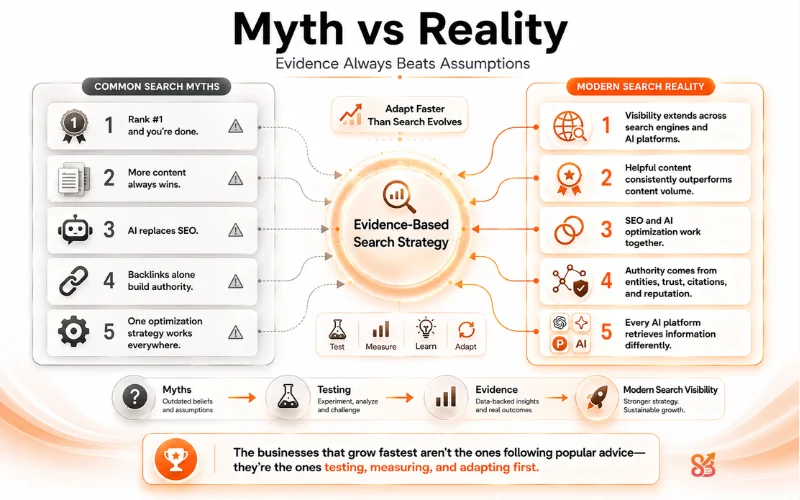
Part 2: Five myths specific to the AI search era
Before debunking each one, anchor yourself to this number:
38%
of pages cited in Google AI Overviews also rank in the traditional top 10 — ranking and being cited are now measurably different outcomes requiring different optimisation approaches- Navoto / industry citation overlap research, 2026
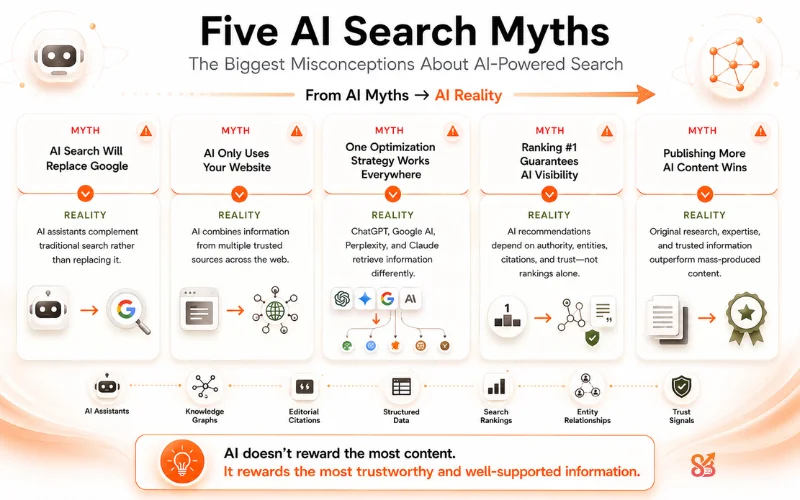
Here are the myths specific to the AI search era:
MYTH 6:
AI Overviews and zero-click search mean SEO is finished — investing further is pointless.
REALITY:
Zero-click search is real and accelerating — Similarweb measured the zero-click rate climbing from 56% to 69% between May 2024 and May 2025, and 2026 figures sit around 64-65%. But the conclusion that SEO investment is pointless does not follow from that data. Total global search volume grew 26% in the same period — more queries, with fewer clicks per query. The traffic that survives the zero-click filter is dramatically higher-intent: AI-referred visitors convert at 4.4x to 23x the rate of standard organic visitors depending on the study and platform.
The strategic response is not abandonment. It is expanding what you measure — tracking citation frequency and conversion rates alongside clicks — and investing in the GEO and AIO layers that earn citation alongside the SEO layer that earns ranking.
The local and transactional search categories that most SMBs compete in are also substantially less affected by AI Overview zero-click behaviour than broad informational queries. A contractor, dentist, or accountant searching ’emergency plumber near me’ produces a different SERP than ‘how does photosynthesis work’. Understanding which of your query categories are genuinely affected — rather than applying a broad panic response — is the correct analytical approach.
MYTH 7:
AI-generated content gets penalised by Google — everything must be written by hand to rank.
REALITY:
This is demonstrably false at scale. Ahrefs analysed over 600,000 pages and found zero statistically significant correlation between AI content percentage and search ranking position. The same dataset found that 86.5% of currently top-ranking pages contain some AI-generated content, and 91.4% of pages cited inside Google AI Overviews contain AI-assisted content. Google’s own guidance has consistently been that it evaluates content for helpfulness, accuracy, and evidence of genuine expertise — not for the tool used to produce the first draft.
AI-assisted production paired with genuine editorial review, original data, expert oversight, and accurate factual claims performs identically to fully human-written content on every measurable search signal.
The real risk is not AI assistance — it is unedited, unverified, generic AI output published at volume. The Helpful Content System targets content that is thin, unhelpful, and exists primarily to capture keyword traffic rather than to genuinely inform users. That description applies to bad AI content and bad human content equally. The problem is the content quality, not the production method.
MYTH 8:
If you rank #1 organically, you will automatically appear in AI Overviews and AI chat responses.
REALITY:
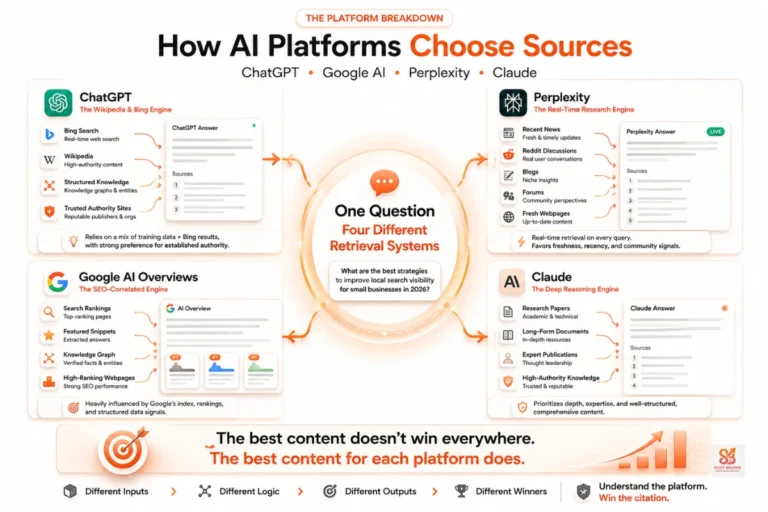
Only 38% of pages cited in Google AI Overviews also rank in the traditional top 10 — a figure that has been declining as AI Overviews select more widely from the index. Across the broader AI platform landscape, the overlap is even thinner: ChatGPT and Google AI Overview share only 13.7% of citation sources (SiteUp.ai, 2026), and only 11% of domains are cited by both ChatGPT and Perplexity.
Ranking first means your page is in Google’s index and considered relevant. Being cited means the AI system has determined your content is trustworthy, well-structured, and evidentially strong enough to include in a synthesised answer. These are separate evaluations. GEO (Layer 3) and AEO (Layer 2) of the Search Visibility Stack exist precisely to close the gap between ranking and being cited.
MYTH 9:
AI summaries make attribution and ROI tracking impossible — you cannot measure whether AI search is working.
REALITY:
Standard last-click attribution genuinely struggles with AI search, but the signal is not invisible — it is indirect. When a prospect discovers a brand through ChatGPT and visits days later, it typically appears as direct traffic or a branded search query, with zero attribution to the originating AI mention.
The tracking methodology that works: monitor branded search volume trends in Google Search Console (rising branded queries alongside declining informational organic clicks signals AI-driven discovery); track direct traffic trends; segment GA4 referral traffic for any AI platform referrals that do pass through; and run regular manual prompt testing across ChatGPT, Perplexity, and Google AI — recording citation frequency as a visibility metric rather than a click metric.
Sales conversations where prospects reference AI as their discovery method are direct confirmation. This is measurable — it simply requires a different measurement framework than standard SEO reporting.
MYTH 10:
Keywords no longer matter in conversational AI-driven search — just write naturally and intent takes care of itself.
REALITY:
Keywords remain essential to search visibility in 2026 — what has changed is how they function, not whether they matter. Keyword research still identifies what real users are actually asking and exactly how they phrase it. That phrasing is the foundation of the AEO framework in Post 03: FAQ headings sourced from real search queries, structured answers aligned to specific question formats, and content that uses the same natural language users type into search systems.
What no longer works is exact-match keyword repetition, density targets, and keyword-stuffed meta descriptions. What does work is identifying the intent behind the keyword cluster, structuring content to answer the primary question directly, and covering the topic comprehensively enough that semantic variants and related questions are addressed without forcing artificial keyword placement.
Why these myths persist — and how to stop spreading them
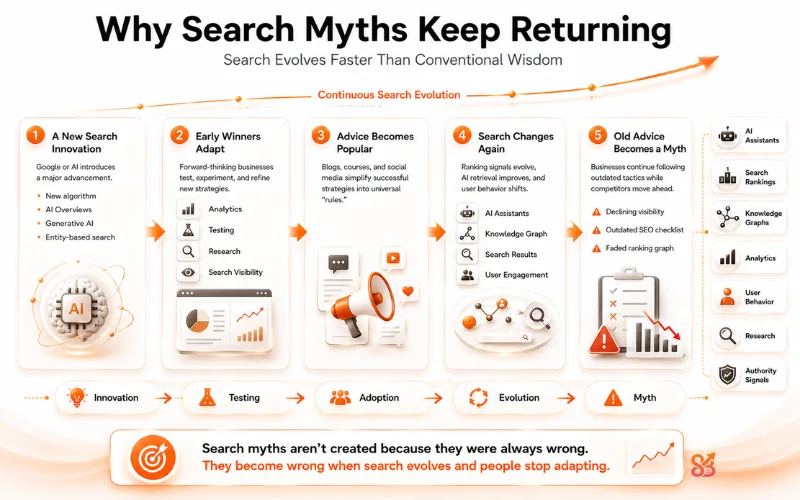
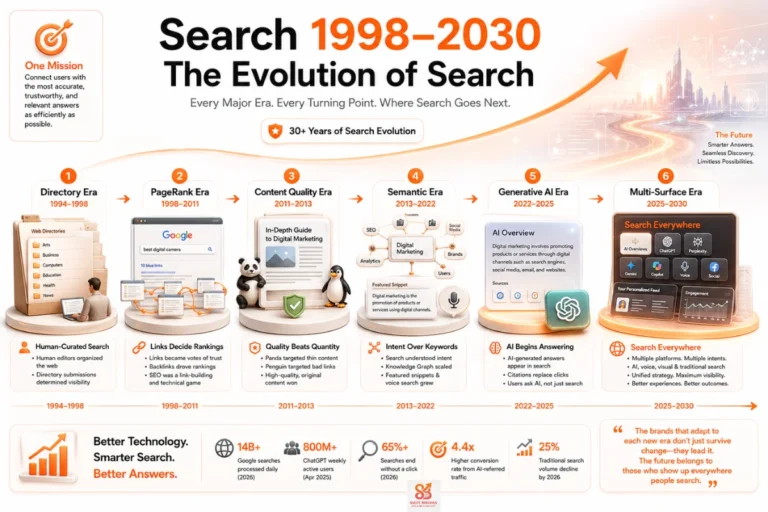
Search visibility myths share a common origin story: they were usually true at some point, under a previous algorithm generation, and the correction never fully displaced the original belief. Keyword density mattered in the directory era. Link volume mattered in the PageRank era. Social signals were being actively tested by some search systems in 2012. These were not always myths — they became myths as the discipline matured, and the people who learned the original version often never updated it.
The AI-era myths follow a faster, more dangerous version of the same pattern: panic-driven overcorrection. A single dramatic statistic — ‘93% of AI Mode searches end without a click’ — gets extracted from its full context and used to justify either complete SEO abandonment or complete denial that anything has changed. Both overreactions are costly. The accurate response sits between the extremes: measure what is actually happening to your specific traffic and citation patterns, adjust investment proportionally, and update beliefs as new evidence arrives rather than as headlines shift.
Before repeating any search visibility claim — to a client, a colleague, or your own strategy document — ask: is this still true under the current algorithm generation, or is this a correct statement about 2015 being applied to 2026?
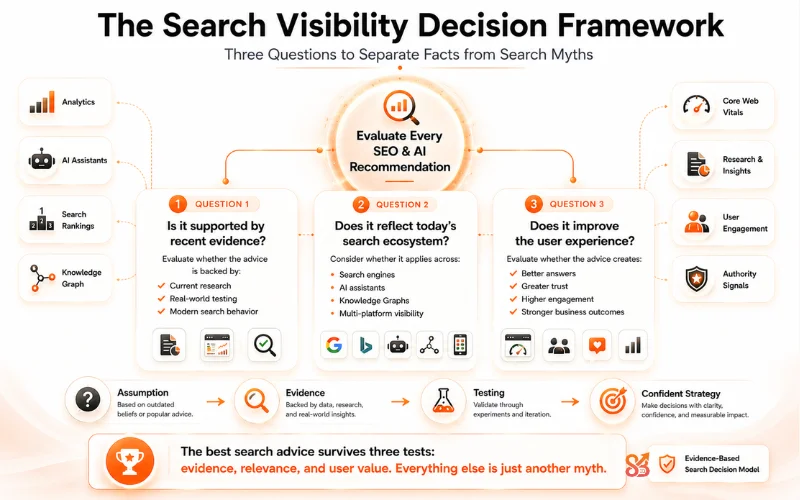
The practical test for any search visibility claim
When evaluating any piece of SEO or AI search advice — whether from a blog post, a tool vendor, or a well-meaning colleague — three questions reliably separate current guidance from outdated myth:
- Is this attributed to a credible, current source with a specific date? Claims with no named source, no publication date, and no specific data point are the easiest to mistake for received wisdom. The discipline moves fast enough that 2022 data is already potentially outdated on AI search topics.
- Does this claim hold across multiple independent sources, or only in one study? Single-study statistics — especially dramatic ones — deserve scrutiny. The best-evidenced claims in this series appear across multiple independent research teams with different methodologies reaching consistent conclusions.
- Would this advice have been correct five years ago, ten years ago, or both? If a piece of advice has been unchanged since 2015, it is either a genuinely durable principle (like ‘serve users genuinely’) or an unexamined myth (like ‘more content ranks better’). The discipline has changed enough in a decade that static advice deserves explicit examination before repetition.
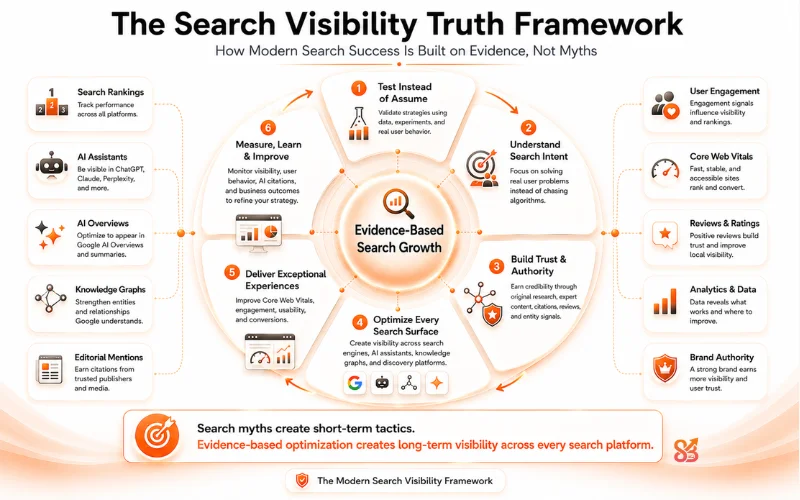
Where each myth maps to the Search Visibility Stack
Every myth in this post connects directly to a specific layer of the Stack covered earlier in this series — and to the research that refutes it:
- Myths 1–3 (keyword density, link volume, content length): Layer 1 — SEO. The foundational misunderstandings that arise from the PageRank era. Post 02 covers what has actually changed in SEO and what has not.
- Myth 4 (social signals): Layer 1 — SEO. A persistent confusion between correlation and causation in how social activity influences rankings.
- Myth 5 (SEO is one-time): Spans all five layers. The maturity model in Post 07 addresses this directly — Stage 5 is a maintenance state, not a completion state.
- Myth 6 (zero-click means SEO is dead): Layer 5 — SXO. Post 06 covers exactly why the surviving visits in a zero-click environment are higher-value, not worthless.
- Myth 7 (AI content penalty): Layer 3 — GEO. What earns AI citations is evidence quality and structural clarity, not human vs machine authorship.
- Myth 8 (ranking = AI citation): The central argument of Layer 3 — GEO (Post 04). Ranking and citation are different evaluations requiring different optimisation.
- Myth 9 (attribution impossible): Layer 4 — AIO. Post 05 covers the visibility rate measurement framework that closes most of the attribution gap.
- Myth 10 (keywords irrelevant): Layer 2 — AEO. Post 03 is built on keyword research as the foundation of answer-first content structure.
→ Next: The Blueprint — Where to Start Your Search Visibility Strategy (SMB and Agency Editions)
→ Previous: The Platform Breakdown — How ChatGPT, Perplexity, Gemini, Claude, and Copilot Select Sources Differently
References and citations
- Symaxx. (2026, March). SEO Myths and Misconceptions for 2026. Keyword density not a confirmed ranking factor; meta keywords ignored since 2009. https://symaxx.com/resources/seo/foundations/seo-myths
- Soapbox Digital Media. (2026, April). SEO Myths Debunked. Link quality vs quantity; Domain Authority not a Google ranking factor. https://www.soapboxdigital.co.uk/seo-myths-debunked
- SEO Forge. (2026, April). 10 SEO Myths That Still Mislead Marketers in 2026. Google indexing via links not manual submission; social signals not a direct ranking factor (citing Google’s John Mueller, 2015). https://www.seoforge.ai/blog/seo-myths
- Aggarwal, P., et al. (2024). GEO: Generative Engine Optimization. KDD 2024. Princeton / IIT Delhi / Georgia Tech / Allen Institute for AI. Evidence quality, not domain authority, drives citation improvement. https://doi.org/10.1145/3637528.3671900
- Unodeskly. (2026, May). Google AI Overviews Killed 58% of SEO Clicks. Ahrefs study of 600,000+ pages: no correlation between AI content percentage and ranking; 86.5% of top-ranking pages contain AI-generated content; 91.4% of AI Overview citations contain AI-assisted content. https://unodeskly.com/blog/google-ai-overviews-killing-seo-traffic-2026.html