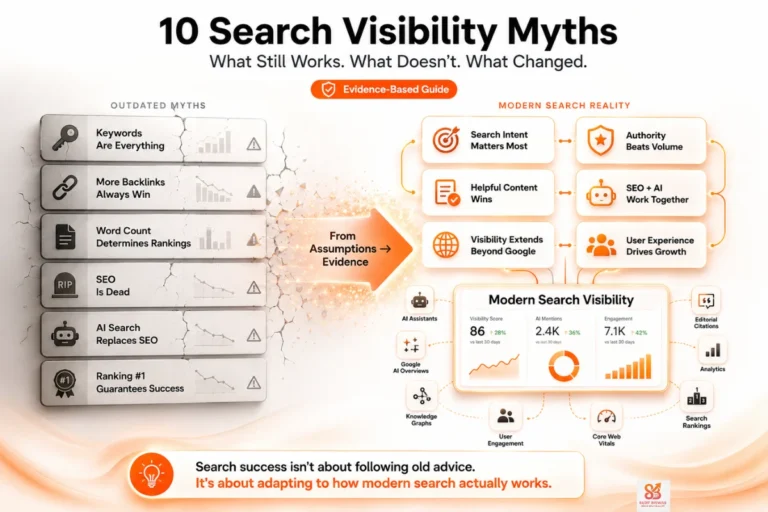

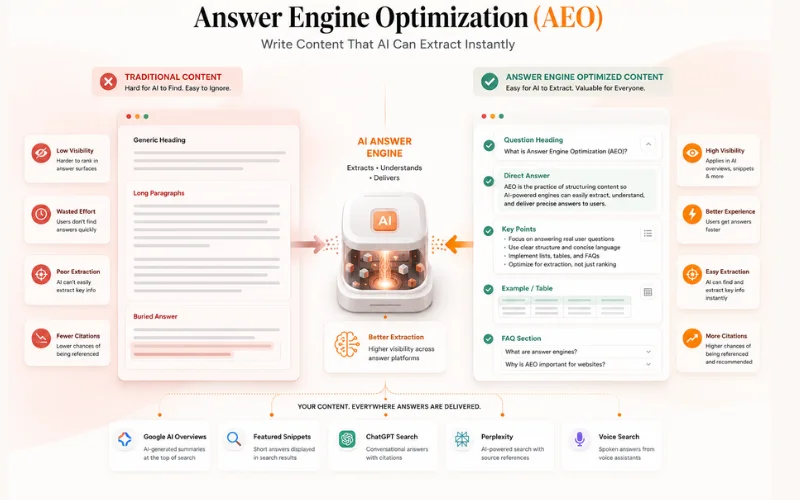
What is AEO content structure? AEO Content Structure is the way a web page is organised — its headings, answer placement, formatting, and section logic — so that answer engines can extract and display a direct response without requiring the user to visit the page.
Most content is written to be read. AEO requires content written to be extracted. Those are fundamentally different objectives — and confusing them is the reason so many well-written, well-ranked pages never appear in a featured snippet, an AI Overview, or a voice assistant response.
This post is about the craft layer: the specific structural decisions you make at the sentence, paragraph, and section level that determine whether a retrieval system can pull a clean answer from your page. For the broader strategy — how different AI platforms cite differently, how to measure your AI visibility, and the business case for AEO — see the AEO Complete Guide.
An answer engine does not care how beautifully your introduction is written. It cares whether your answer appears before the second paragraph.
Below are the five structural principles that make content extractable, each with before-and-after examples that show the difference in practice.
Why extraction is a different problem from writing
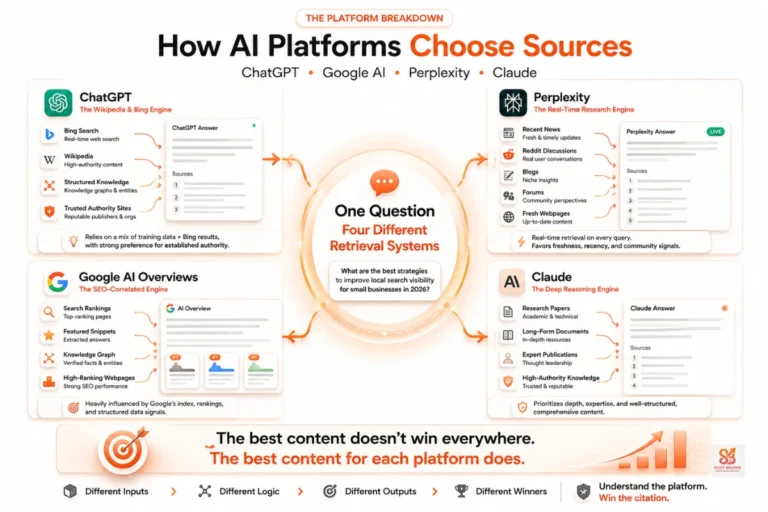
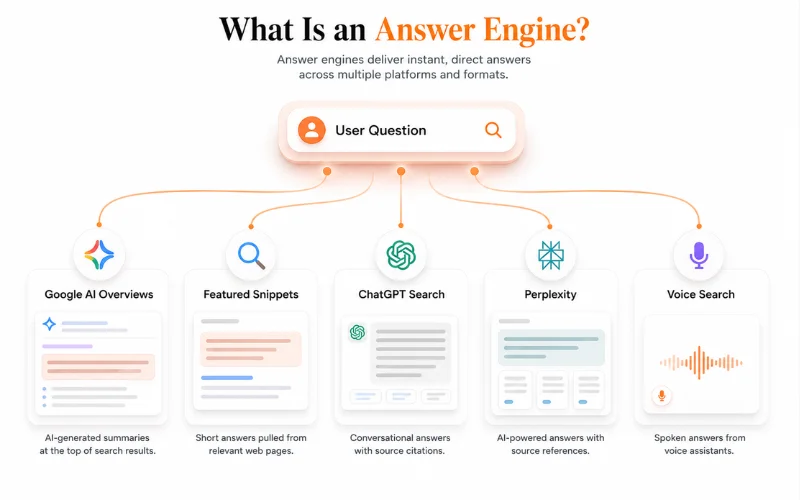
An answer engine is any system designed to provide a direct response rather than a list of links — Google AI Overviews, featured snippets, voice assistants, ChatGPT Search, Perplexity. Their shared objective is to resolve the user’s question without requiring them to visit a website.
The technology underneath most of these systems is the Retrieval-Augmented Generation (RAG) framework — introduced by Lewis et al. at Meta AI / UCL (NeurIPS 2020). RAG combines a large language model with a retrieval mechanism that fetches relevant passages from external sources before generating a response. The quality of the retrieval depends directly on how cleanly information is structured in the source content.
The practical implication for writers is direct: you are not writing for the human who will scroll through your article at leisure. You are writing for a retrieval system that will scan your content in milliseconds, looking for a passage that cleanly matches the user’s question. Structure is not a formatting preference — it is a retrieval prerequisite.
The five structural principles of extractable content
1. Answer before you explain
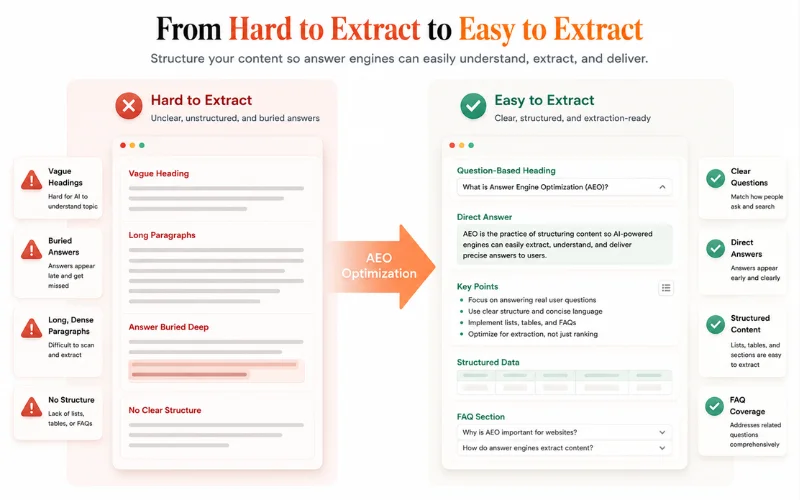
The most common AEO failure is delaying the answer. Traditional essay writing builds toward a conclusion. Academic writing establishes context before making claims. These conventions make sense for long-form reading — they make no sense for extraction.
Answer-first writing reverses the structure. The primary answer appears in the first sentence of each major section. The explanation, context, examples, and elaboration follow. This aligns with how both users and retrieval systems consume content: they are looking for the answer, not the journey toward it.
| ✗ BEFORE | ✓ AFTER |
|---|---|
| Defining a concept | |
| Search engine optimisation has evolved considerably since the early days of keyword stuffing and directory submissions. As algorithms have become more sophisticated, businesses have had to adapt their approaches accordingly. Today, SEO encompasses technical factors, content quality, and authority signals — all of which play a role in determining visibility. With that context in mind, we can define modern SEO as… | Modern SEO is the practice of improving a website’s discoverability across search engines and AI platforms through technical optimisation, content quality, topical authority, and entity signals. It remains the foundation of digital visibility because AI systems cannot cite content they cannot first find and understand. |
The second version gives a retrieval system everything it needs in two sentences. The first version buries the definition behind three sentences of context that add no extractable value.
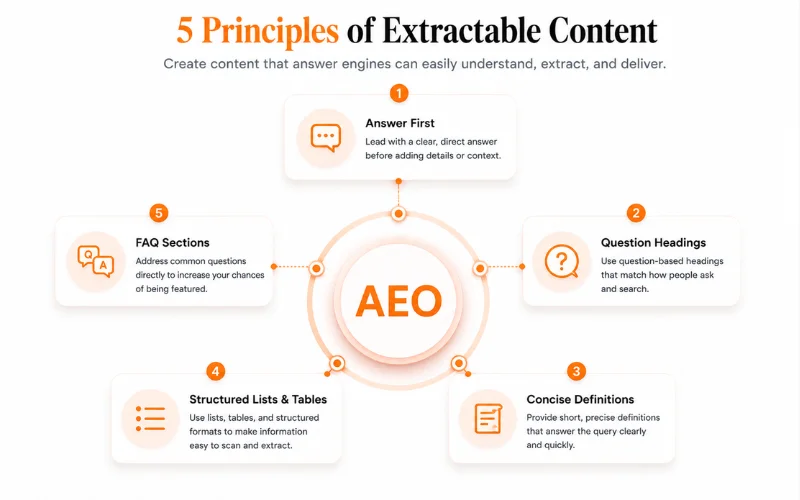
2. Use headings as questions
Heading tags (H2, H3) serve two functions simultaneously: they organise content for human readers and communicate topic structure to retrieval systems. When headings are phrased as questions that users actually search for, they align your content architecture with the query format that answer engines are trying to match.
| ✗ BEFORE | ✓ AFTER |
| H2 heading for a section about content structure | |
| H2: Content Considerations | H2: What makes content extractable by AI answer engines? |
The question heading tells the retrieval system exactly what query this section answers. When a user asks that question — or a semantically close version of it — the system knows precisely where to look.
The discipline here is writing headings from the user’s perspective, not from the writer’s. Ask: what exact words would someone type into Google or ChatGPT to find this section? That phrasing — not a tidy content-outline label — is what the heading should say.
3. Write concise definitions immediately below each heading
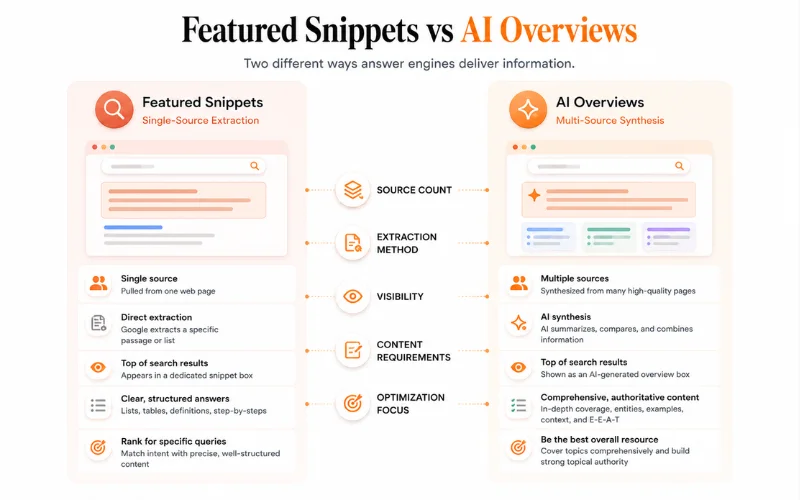
Featured snippet research consistently shows that paragraph-format snippets are extracted most often from the first 40 to 60 words directly below an H2 or H3 heading. The same pattern applies to AI Overview extraction. A concise definition in that position gives the retrieval system a clean, self-contained answer it can use without needing to extract across multiple paragraphs.
The target is a definition that answers the question, could stand alone if extracted, and uses plain language rather than industry jargon. Everything below that definition can elaborate — but the definition must never depend on what came before it.
| ✗ BEFORE | ✓ AFTER |
| Opening a section on schema markup | |
| As we covered in the previous section, structured data has become increasingly important. Schema markup is one of the key implementation methods — let’s look at what it actually involves and why practitioners recommend it… | Schema markup is code added to a web page that tells search engines and AI systems exactly what the content means — not just what it says. The most widely used vocabulary is Schema.org, which provides standardised tags for content types including articles, FAQs, products, and local businesses. |
The second version is self-contained. A retrieval system can extract it, display it, and the user gets a complete answer. The first version is context-dependent — it cannot stand alone.
4. Use lists, tables, and structured formats for multi-part answers
When the answer to a question has multiple components — a process, a list of factors, a comparison — prose is harder to extract accurately than structured formatting. Numbered lists work best for sequential processes. Bullet points work best for unordered factors or features. Tables work best for comparisons where rows and columns carry meaningful relationships.
| ✗ BEFORE | ✓ AFTER |
| Listing the characteristics of extractable content | |
| The five main characteristics of AEO-friendly content include clear question-and-answer formatting, which helps systems identify answer passages, concise definitions that appear near the top of sections without unnecessary preamble, strong heading hierarchies using H2 and H3 tags that communicate topic structure, structured lists and tables that organise multi-part answers, and FAQ sections that directly address common user queries. | AEO-friendly content has five characteristics: 1. Question-and-answer formatting in headings 2. Concise definitions immediately below each heading (40–60 words) 3. H2/H3 hierarchy that mirrors user query language 4. Lists and tables for multi-part answers 5. FAQ sections addressing specific user questions |
The list version is faster to read, easier to scan, and — critically — far simpler for a retrieval system to extract and format correctly in a response. Prose buries structure. Lists expose it.
5. Build FAQ sections that mirror real user questions
FAQ sections serve a dual purpose in AEO. For users, they anticipate and answer follow-up questions that naturally arise after reading the main content. For retrieval systems, they create additional question-answer pairs that can be matched against a wider range of queries.
Implementing FAQ Schema markup (Schema.org FAQPage) adds a machine-readable layer that explicitly identifies these question-answer relationships, making extraction significantly more reliable.
The discipline in writing FAQ sections is sourcing questions from what users actually ask, not what you assume they would ask. Google Search Console’s query data, People Also Ask results, and community forums like Reddit and Quora all provide direct access to the language users use. That language — not cleaned-up marketing language — is what retrieval systems are matching against.
What extractable content looks like across answer surfaces
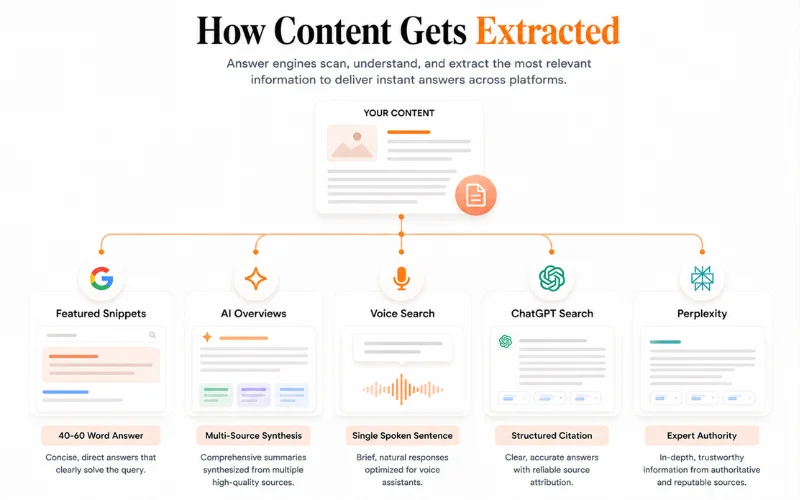
The five structural principles above apply across all answer surfaces, but the strictness of the extraction requirements varies. Voice search is the most demanding — it can deliver only a single spoken sentence, so content must be answerable in one clear sentence below the heading. Featured snippets extract the first 40–60 words. AI Overviews synthesise across multiple sources, so your content must also contribute something distinctive enough to be worth including.
The practical hierarchy is: write for voice search strictness and you will automatically satisfy featured snippets, AI Overviews, and AI chat citations. The tightest constraint sets the standard.
| Surface | Primary extraction requirement |
| Featured Snippet | First 40–60 words below H2/H3 — answer before explanation |
| Google AI Overview | Distinctive, evidence-backed passage — unique info + clear structure |
| Voice Search | Single sentence below heading — no jargon, no context dependency |
| ChatGPT Search | Well-structured factual content with authority signals |
| Perplexity | Accurate, expert-led content with topical depth |
The content writer’s AEO checklist
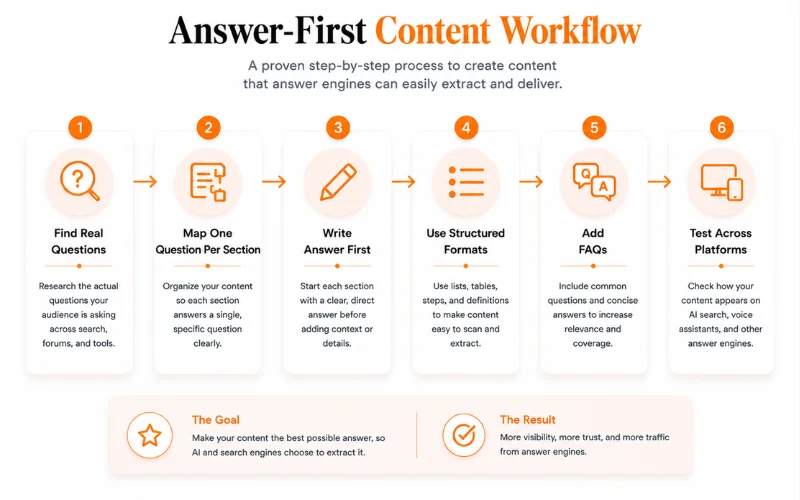
Before you publish any page you want to be cited by an answer engine, run through these checks at the writing level. These are craft decisions — not platform or channel decisions.
- Start with real user questions, not keyword labels. Pull questions from Google autocomplete, People Also Ask, Search Console queries, Reddit threads, and Quora. These reveal exact phrasing — which is what retrieval systems match against.
- Map one primary question per H2 section. If a section tries to answer multiple questions, split it. A section that answers one question cleanly is more extractable than a section that covers two questions partially.
- Write the definition first, then test it. After writing the first paragraph below each H2, ask: could this be extracted and displayed as a complete answer without the surrounding context? If it depends on something that came before it, rewrite until it is self-contained.
- Use structured formats for any multi-part answer. If answering a question requires listing three or more items, or comparing two or more options, use structured formatting rather than prose.
- Write your FAQ from real search queries. Pull 5–10 questions from People Also Ask and Search Console. Write concise answers — one to three sentences each. Implement FAQPage Schema. This extends your extractable coverage across a wider range of queries without requiring separate pages.
- Test on target surfaces after publishing. Search your target questions on Google, Perplexity, and ChatGPT. If you are not being extracted, the most common causes are: the answer is buried below the first paragraph; the heading does not match the user’s query phrasing; or the definition depends on prior context to make sense.
The two AEO writing mistakes that undermine everything else
The most consistent AEO failure is burying the answer. It does not matter how authoritative the source is, how well the page ranks, or how comprehensive the content is — if the answer is in paragraph four, it will not be extracted by a system scanning for it in paragraph one.
The second most common mistake is writing definitions that only make sense in context. A definition that begins with “As mentioned above…” or relies on terminology introduced three paragraphs earlier cannot be extracted as a standalone answer. Every answer-bearing paragraph must be able to stand alone.
AEO is not about writing shorter content. It is about putting the most important information first — and making sure every answer-bearing passage can stand alone when extracted from its context.
Where AEO fits in the Search Visibility Stack
AEO is Layer 2 of the Search Visibility Stack. It builds directly on the SEO infrastructure covered in Post 02 — your content must be crawlable, indexable, and topically authoritative before any answer engine will consider extracting from it. Without Layer 1 (SEO), Layer 2 has no foundation.
AEO is also the structural prerequisite for Layer 3 (GEO). Content that is difficult to extract is also difficult to cite. The same clarity, structure, and answer-first formatting that makes content extractable by featured snippets also makes it more citation-worthy for generative AI systems. Getting the writing mechanics right is not just about answer visibility — it is infrastructure for everything above it in the stack.
For the strategy layer — how to audit your AI visibility across platforms, how to earn mentions from third-party sources, and how to measure the ROI of AEO — see the AEO Complete Guide.
Read AEO (answer Engine Optimization) complete guide
References and citations:
[1] Lewis, P., Perez, E., Piktus, A., Petroni, F., Karpukhin, V., Goyal, N., … Kiela, D. (2020). Retrieval-Augmented Generation for Knowledge-Intensive NLP Tasks. NeurIPS 2020, vol. 33, pp. 9459–9474. Meta AI Research / UCL.
[2] Aggarwal, P., Murahari, V., Rajpurohit, T., Kalyan, A., Narasimhan, K., & Deshpande, A. (2024). GEO: Generative Engine Optimization. Proceedings of KDD 2024. Princeton University / IIT Delhi / Georgia Tech / Allen Institute for AI. https://doi.org/10.1145/3637528.3671900
[3] Google. (2014–present). Featured Snippets in Google Search. Google Search documentation. https://developers.google.com/search/docs/appearance/featured-snippets
[4] Schema.org. (ongoing). FAQPage structured data vocabulary. https://schema.org/FAQPage
[5] Google. (2024). Search Quality Evaluator Guidelines (E-E-A-T). https://static.googleusercontent.com/media/guidelines.raterhub.com/en//searchqualityevaluatorguidelines.pdf
[6] LaunchCodex. (2026). What is Position Zero? Structured content articles appear as featured snippets 66% more often than unstructured content; structured articles average 14.5 heading tags. https://launchcodex.com/blog/seo-geo-ai/what-is-position-zero-featured-snippets/