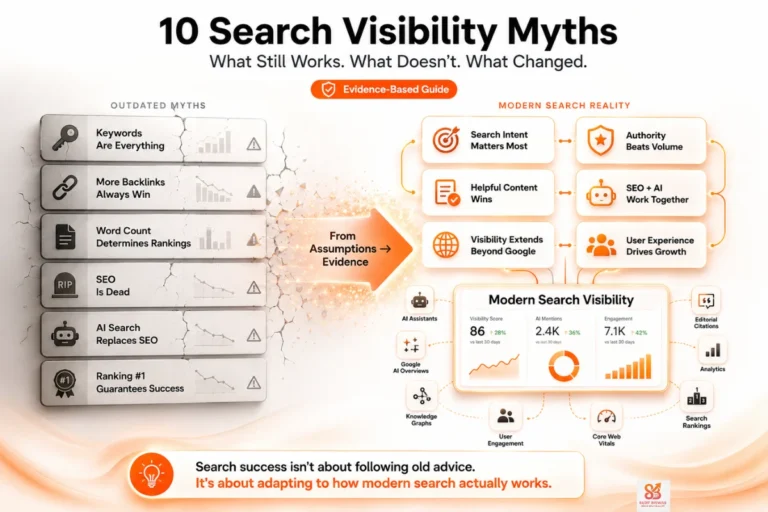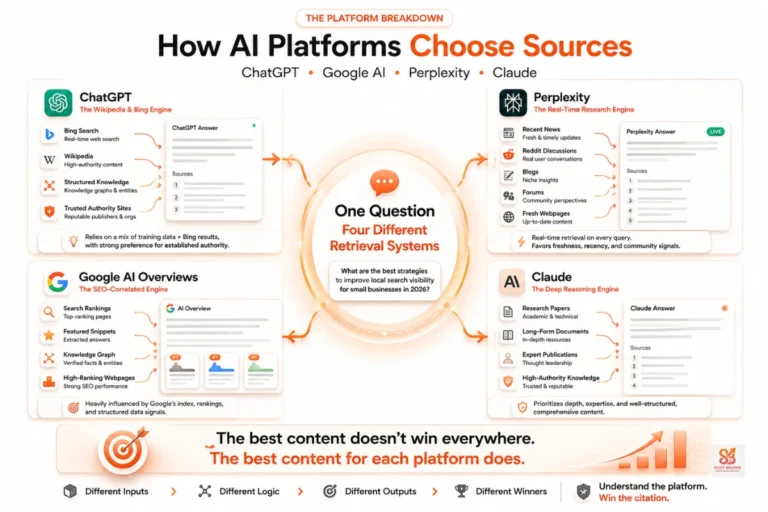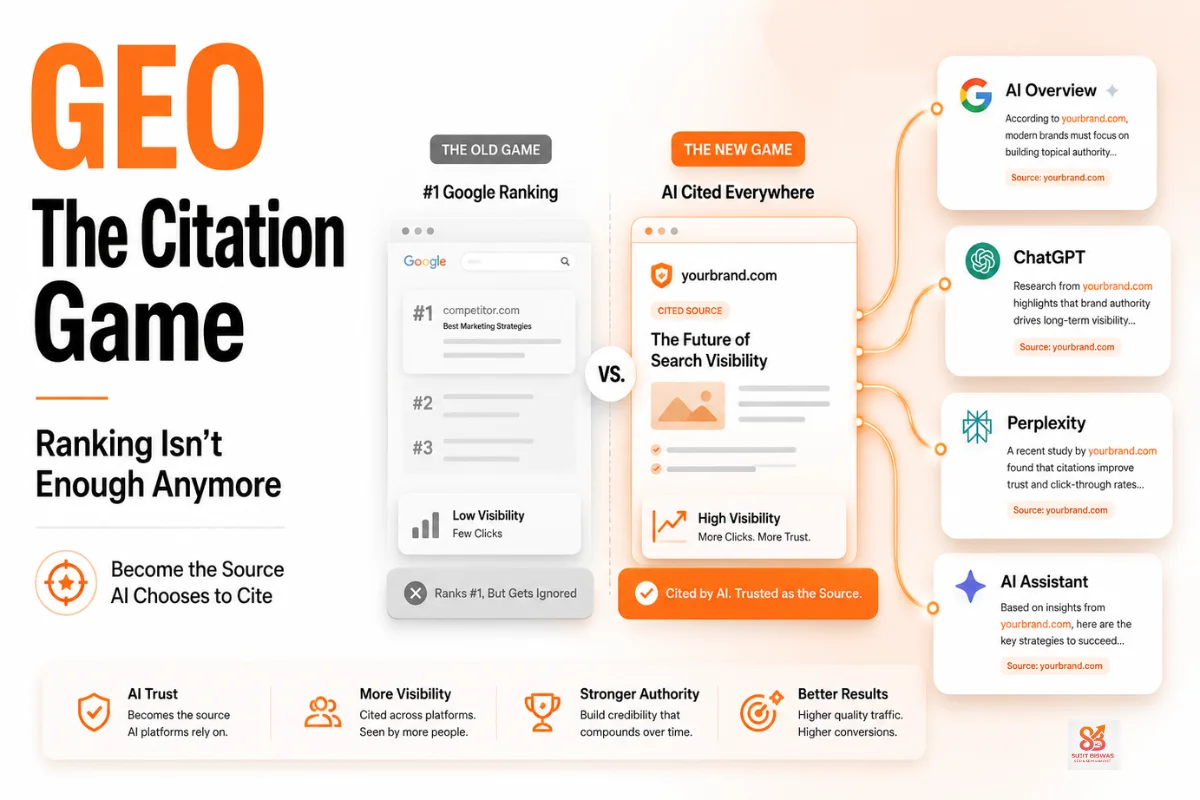

If you’ve been working in SEO recently, you’ve probably noticed something that doesn’t make sense at first. A page ranks #1 on Google, attracts consistent organic traffic, and follows every established SEO best practice. Yet when someone asks ChatGPT, Perplexity, Claude, or Google’s AI Overviews the very question that page answers, your content isn’t cited. Instead, the AI references another website—sometimes one with lower rankings, fewer backlinks, and far less domain authority.
This isn’t a bug or a temporary quirk of AI search. It’s a fundamental shift in how information is discovered and recommended.
Traditional SEO is designed to help pages rank. Generative AI systems are designed to help users find trustworthy answers. Those objectives overlap, but they are no longer the same. Modern AI search engines don’t simply repeat Google’s rankings; they evaluate content independently, selecting sources they consider the most credible, complete, and useful for generating an answer. As a result, ranking well no longer guarantees visibility inside AI-generated responses.
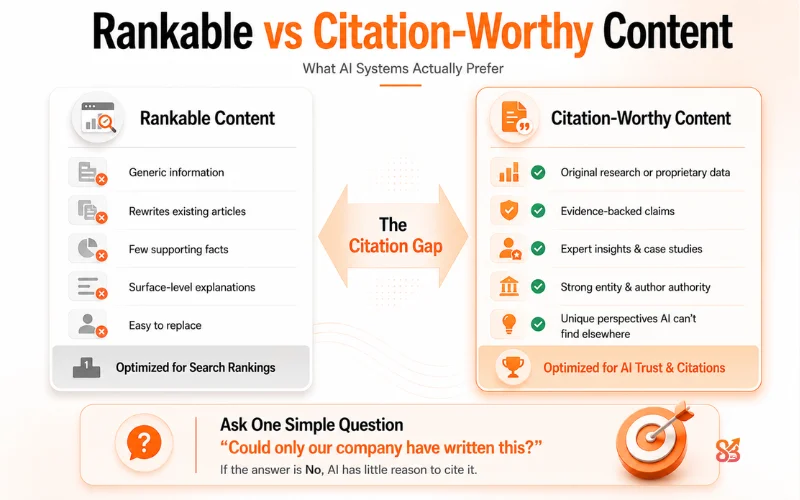
This has created what many marketers now call the citation gap—the growing difference between content that ranks in search engines and content that AI systems choose to cite. Closing that gap requires more than conventional SEO. It requires understanding how generative search evaluates information and structuring content to become citation-worthy.
In this guide, you’ll learn what Generative Engine Optimisation (GEO) actually is, what the landmark research from Aggarwal et al. (KDD 2024) revealed about AI citation behaviour, the characteristics that consistently influence citation selection, and a practical audit framework you can use to evaluate and improve any existing page for AI search visibility.
Ranking first is a traffic strategy. Being cited is a trust strategy. In 2026, AI systems are making trust decisions independently of your ranking position — and most content is not built for that evaluation.
The citation economy: why being cited is now more valuable than ranking
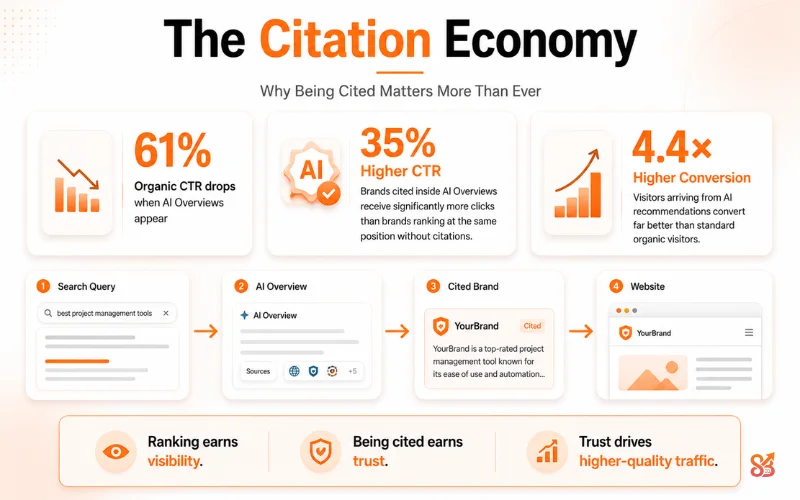
The scale of the shift matters here, and the numbers are specific enough to warrant attention. Seer Interactive’s study of 25.1 million organic impressions across 42 organisations (June 2024–September 2025) found that organic CTR dropped 61% on queries where an AI Overview appeared — from 1.76% to 0.61%. But that average conceals a critical split.
35% higher organic CTR for brands cited inside AI Overviews vs uncited brands at the same ranking positionSeer Interactive, November 2025 — 25.1M impressions across 42 organisations
Brands cited inside the AI Overview achieved 0.70% organic CTR. Brands that ranked but were not cited achieved 0.52%. The citation advantage is 35% more clicks — from the same SERP. And the conversion data makes this even more striking.
AI-referred visitors convert at rates 4.4 times higher than standard organic search visitors (Seer Interactive / Ahrefs, 2025). The reason is not mysterious. When a user receives a recommendation from an AI system, the AI has already done the evaluation work — it has assessed sources, synthesised information, and presented a conclusion. The user arrives pre-sold, not still researching. That is a fundamentally different intent state from someone who clicked a blue link.
The implication for content strategy is direct: in a search environment where AI Overviews appear on 48% of tracked queries and are growing, the question is no longer only how to rank. The question is how to be cited when the AI generates its answer. That is the question GEO exists to answer.
What GEO actually is — and what separates it from SEO
Generative Engine Optimisation (GEO) is the practice of structuring content and building brand signals so that AI systems are more likely to select, cite, and reference your content when generating responses. It is distinct from SEO in its objective, its evaluation criteria, and its competitive landscape.
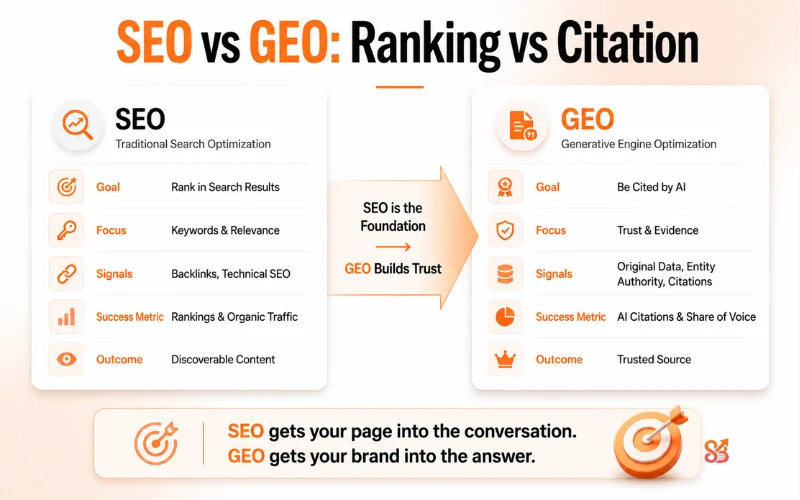
| Dimension | SEO | GEO |
| Primary goal | Rank in search results | Be cited in AI-generated responses |
| What’s being optimised | Discoverability and relevance signals | Trustworthiness and citation-worthiness |
| Competition | Pages competing for the same keyword | Sources competing for inclusion in the same AI answer |
| Key signals | Backlinks, keywords, technical factors | Evidence quality, entity clarity, unique data, authority |
| Measurement | Rankings, organic traffic | Citation frequency, AI share of voice, recommendation rate |
| Relationship to ranking | Is the objective | Is a prerequisite but not sufficient on its own |
The crucial distinction: SEO determines whether your content enters the pool of sources an AI system can draw from. GEO determines whether your content is selected from that pool when the AI constructs its answer. Both are necessary. Neither alone is sufficient.
What the research actually found: the GEO paper in plain terms
The GEO paper by Aggarwal et al. (Princeton / IIT Delhi / Georgia Tech / Allen Institute for AI, presented at ACM KDD 2024) is the first peer-reviewed study to measure what content modifications actually change citation visibility in generative engines. The team tested nine optimisation strategies across 10,000 queries using GEO-bench — a benchmark designed to mirror how Bing Chat and similar generative search systems evaluate and select sources.
The findings reveal a clear hierarchy. Not all content changes move the citation needle equally. Some tactics that dominate traditional SEO thinking — keyword optimisation, increased content length — produced negligible citation improvement. The changes that worked share a common theme: they made content more evidentially trustworthy.
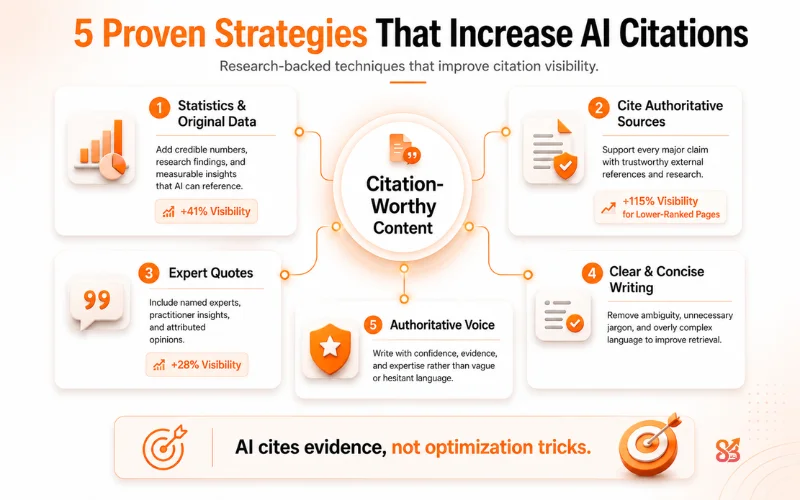
The five strategies that actually improved citation visibility
- Statistics addition: +41% visibility improvement. Adding specific quantitative data — percentages, study results, market figures — was the single strongest citation signal. Numbers give AI systems something concrete to anchor a claim. Generic assertions have dozens of competing sources; a specific statistic from a credible source has far fewer.
- Citing sources within your content: +115% visibility for lower-ranked pages. This is the most counterintuitive finding in the paper. Content that itself cites other authoritative sources receives substantially more citations — particularly for pages outside the top rankings. The mechanism makes sense: content that demonstrates epistemic rigour by referencing its own sources signals to AI systems that its claims can be trusted and traced.
- Expert quotations: +28% visibility improvement. Named expert quotes increase information density and authority signals simultaneously. They provide the kind of attribution that retrieval systems look for when deciding whether to include a passage in a synthesised response.
- Improved fluency and clarity. Well-constructed, unambiguous prose is easier for retrieval systems to parse accurately. Jargon, padding, and hedged language reduce extractability and therefore reduce citation probability.
- Authoritative, declarative voice. Content written with confident, expert authority outperforms content written with excessive hedging or uncertainty. This does not mean overclaiming — it means writing from a position of genuine expertise rather than tentative approximation.
The four strategies that did not work: keyword stuffing, increasing content volume without improving quality, adding generic summaries, and basic meta optimisation. GEO rewards trustworthiness, not optimisation theatre
Rankable vs citation-worthy: the content audit that reveals the gap
Most content that ranks well was built to satisfy an algorithm’s relevance signals. Citation-worthy content was built to satisfy a reader’s — and increasingly, an AI system’s — trust evaluation. The gap between them is usually visible on the page, if you know what to look for.
Audit question 1: Does this content say anything only we could say?
Generic content — content that summarises existing information without adding original data, observations, or analysis — gives an AI system no reason to cite your version over any of the other versions of the same information. If your content could have been written by anyone with a Google search and an afternoon, it is rankable. It is not citation-worthy.
Citation-worthy content has a provenance signal — something that makes it the primary source rather than a secondary one. Examples include original research data, proprietary client results, case studies from real engagements, first-hand observations, or expert analysis that goes beyond summarising existing literature.
✗ Rankable but not citation-worthy“Topical authority is important for SEO. It refers to a website’s expertise in a specific subject area. Building topical authority requires covering a topic comprehensively with multiple related pieces of content.”
✓ Citation-worthy“Across 23 contractor SEO engagements tracked over 18 months, sites that deployed full topic cluster architecture before any link building saw AI Overview citation frequency increase 3.1x faster than sites that prioritised backlink acquisition first. The sequence matters as much as the tactics.”
The second version contains a claim that no AI system can find anywhere else. That uniqueness is what makes it citation-worthy.
Audit question 2: Is every major claim supported by evidence?
AI systems are fundamentally evaluating whether your content is trustworthy enough to be included in an answer they will put their name on. Unsupported claims — assertions without data, quotes without attribution, conclusions without reasoning — reduce that trust. Evidence-backed claims increase it.
The practical test: read through your content and mark every assertion that makes a specific claim. For each one, ask whether a reader could independently verify that claim from the information you have provided. If not, either add the evidence or remove the assertion.
Audit question 3: Are your entities clearly established?
AI systems organise understanding around entities — people, organisations, products, concepts — and the relationships between them. Content that clearly establishes its entity context is easier for retrieval systems to classify and cite accurately. This means: named authors with verified credentials, consistent organisation information across all platforms, structured data implementing Schema.org Organization, Person, and Article markup, and explicit identification of the entities your content discusses.
Vague authorship, inconsistent brand information across web properties, and content that discusses topics without clearly establishing its entity context all weaken the confidence an AI system can have in your source. Entity clarity is not an SEO nice-to-have — it is a GEO prerequisite.
Audit question 4: Is your content genuinely the deepest treatment of this topic available?
One of the most consistent findings across AI search research is that generative systems favour sources demonstrating topical depth over those that provide surface-level coverage. A website with a single article on a topic is evaluated less favourably than a website with a comprehensive cluster of interconnected resources demonstrating sustained expertise. This is where the hub-and-spoke content architecture — the approach this entire series is built on — directly serves GEO objectives.
Depth is measured by the quality of the questions you answer, not the volume of words you use. A 800-word piece that contains a genuinely original analysis and supports every claim with specific evidence will outperform a 3,000-word piece that restates the same points in different ways.
The GEO audit framework: six questions for any existing page
Apply these six questions to any page you want to improve citation performance on. They surface the gap between rankable and citation-worthy faster than any tool currently available.
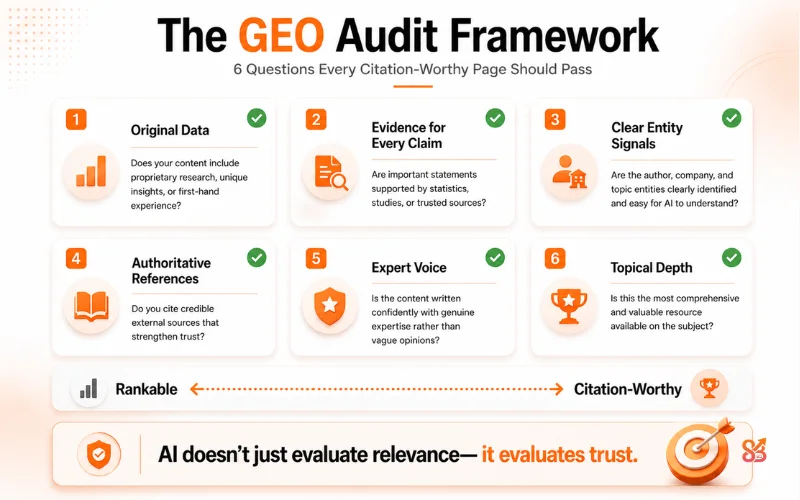
| Audit question | Rankable answer | Citation-worthy answer |
| Does it contain original data? | No — synthesises existing information | Yes — proprietary research, case data, or original analysis |
| Is every claim evidenced? | Partially — some assertions unsupported | Yes — statistics, studies, or traceable sources for every claim |
| Are entities clearly identified? | Brand mentioned but not structured | Schema markup, named authors, consistent entity signals |
| Does it cite other sources? | No — standalone content | Yes — references authoritative external sources inline |
| Is the voice authoritative? | Hedged, tentative, qualifies everything | Declarative, expert, confident — appropriate to the subject |
| Is it the deepest treatment available? | Covers the basics adequately | Comprehensive, unique insights, cannot be replaced by a competitor |
A page that scores well on all six is citation-worthy. A page that scores well on only the first two columns is rankable. The goal of GEO work is to move pages from the second column to the third.
Practical GEO: what to do in the next 30 days
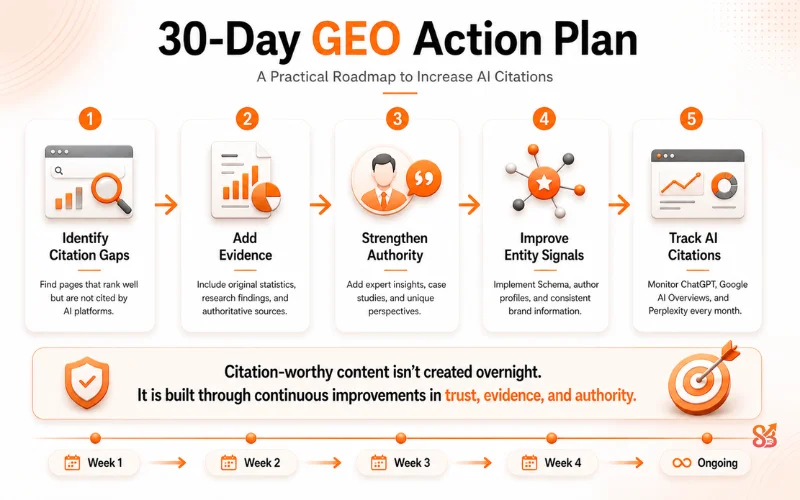
GEO improvement does not require rebuilding your entire content strategy. The highest-leverage changes are usually additions to existing content rather than rewrites.
- Identify your top-5 ranking pages where you are not being cited. Search your primary target queries across ChatGPT, Perplexity, and Google AI Overview. Note which pages rank but are not cited. These are your highest-priority GEO candidates.
- Add a statistics section to each candidate page. Find the three to five most relevant statistics from authoritative sources and integrate them into the body of the content with inline citations. This addresses the single highest-impact finding from the GEO paper.
- Add an expert perspective or case study. Even a single paragraph of first-hand practitioner insight — a client result, a real observation from your own work — differentiates your content from every generic treatment of the same topic.
- Implement or improve structured data. Ensure Organization and Person schema are implemented site-wide. Add Article schema to key pages. Add FAQPage schema to content with FAQ sections.
- Establish or strengthen author entities. Every substantive piece of content should have a named author with a bio page, verifiable credentials, and consistent identification across your web properties. Anonymous content is increasingly at a citation disadvantage.
- Track citation frequency monthly. Define 10–15 priority queries. Test them across the major AI platforms every 30 days. Record which sources are cited, where you appear (or don’t), and how citation patterns change as you make improvements.
GEO is not a one-time optimisation pass. It is a sustained practice of making your content more trustworthy, more evidential, and more distinctive than any competing source on the same topic. The organisations that build this as a habit in 2026 will hold citation advantages that are genuinely difficult to replicate.
Where GEO fits in the Search Visibility Stack
GEO is Layer 3 of the Search Visibility Stack. It builds on the SEO foundation (Layer 1) that makes content discoverable, and the AEO structure (Layer 2) that makes it extractable. Without those two layers, GEO has nothing to work with — AI systems cannot cite content they cannot find and cannot parse.
GEO also feeds directly into Layer 4 (AIO). Every time your content is cited, it contributes to the entity authority signals that make AI systems more likely to cite you again in the future. Citation frequency is not just a vanity metric — it is the mechanism through which GEO builds into AIO. The brands that earn the most citations today are building the brand recognition that will drive automatic recommendation tomorrow.
Related Post:
- AIO: How to Build the Kind of Brand Authority That AI Systems Recommend Without Being Asked
- Content structure for AEO.
References and citations:
- Aggarwal, P., Murahari, V., Rajpurohit, T., Kalyan, A., Narasimhan, K., & Deshpande, A. (2024). GEO: Generative Engine Optimization. Proceedings of the 30th ACM SIGKDD Conference on Knowledge Discovery and Data Mining (KDD 2024), Barcelona, Spain. Princeton University / IIT Delhi / Georgia Tech / Allen Institute for AI. https://doi.org/10.1145/3637528.3671900
- Seer Interactive. (2025, November). AIO Impact on Google CTR: September 2025 Update. Longitudinal study of 25.1 million organic impressions across 42 organisations and 3,119 informational queries (June 2024–September 2025). Key findings: 61% organic CTR decline; 35% higher CTR for AI-cited brands; 91% higher paid CTR for cited brands. Reported via Search Engine Land. https://searchengineland.com/google-ai-overviews-drive-drop-organic-paid-ctr-464212
- Pew Research Center. (2025, July). AI Overviews and user click behaviour. Study of 900 US adults and 68,879 Google searches. Key findings: organic click rate drops from 15% to 8% when AI Overview present; only 1% of users click cited links within AI Overviews. https://www.pewresearch.org/
- Ahrefs. (2025, December). AI Overviews Reduce Clicks Study. Analysis of 300,000 informational keywords using Search Console data. Key finding: position-one CTR drops 58% when AI Overview appears. Updated February 2026.
- Lewis, P., Perez, E., Piktus, A., et al. (2020). Retrieval-Augmented Generation for Knowledge-Intensive NLP Tasks. NeurIPS 2020. Meta AI Research / UCL. Foundational architecture underlying most AI search retrieval systems. https://arxiv.org/abs/2005.11401
- Google. (2024). Search Quality Evaluator Guidelines (E-E-A-T). Defines Experience, Expertise, Authoritativeness, and Trustworthiness as the quality framework for evaluating content and source reliability across search and AI surfaces. https://static.googleusercontent.com/media/guidelines.raterhub.com/en//searchqualityevaluatorguidelines.pdf
- Schema.org. (ongoing). Organization, Person, Article, and FAQ Page structured data vocabulary. Machine-readable markup for entity identification and relationship definition.