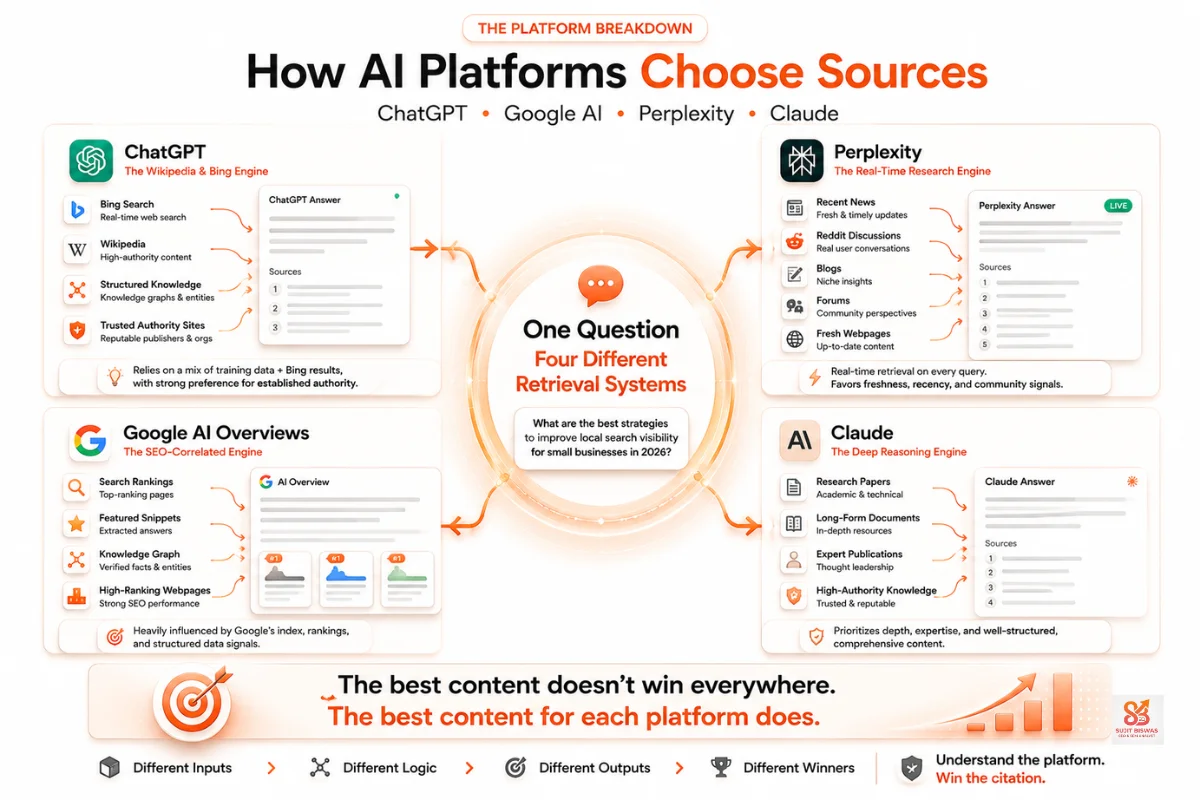

How AI search platforms choose sources has become one of the most important questions in modern SEO. Ask the same question on ChatGPT, Perplexity, and Google AI Overviews and you will frequently receive three entirely different sets of cited sources. This is not a quirk or a temporary inconsistency that will eventually converge. It is the structural reality of how these platforms work — and it is the single most important fact that most GEO strategies miss entirely.
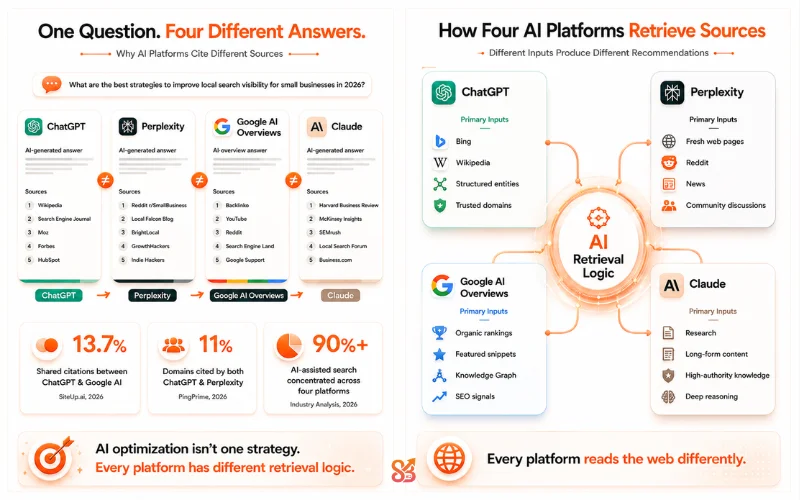
The scale of the divergence is striking when you see the numbers. Yext’s analysis of 17.2 million AI citations across four major engines found that while content quality matters on every platform, visibility ultimately depends on retrieval logic — and that logic is fundamentally different on each one. SiteUp.ai’s 2026 research found ChatGPT and Google AI Overview share only 13.7% of their citation sources. The 5W AI Citation Source Index found only 11% of domains are cited by both ChatGPT and Perplexity. A content strategy built around a single generic notion of ‘AI optimisation’ is leaving most of the opportunity on the table.
Optimising for ChatGPT, Perplexity, and Google AI Overviews with the same strategy is like running identical ad creative on LinkedIn, TikTok, and a trade press publication. The mechanics are different, the audiences are different, and the rules are different. Treating them as one channel guarantees underperformance on at least two of the three.
This post breaks down exactly how each major AI platform retrieves and selects sources, what the citation data reveals about what each platform specifically rewards, the practical content strategy that earns citations on each, and the signals that work universally across all of them.
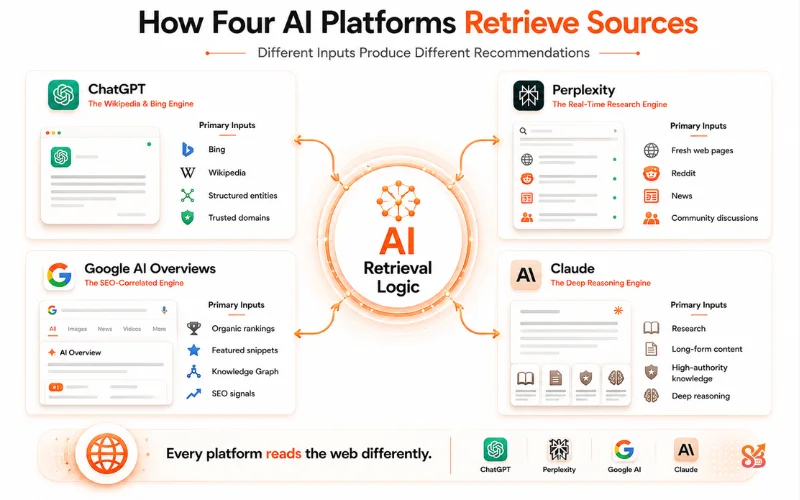
Why AI Platforms Cite Different Sources
Although users often think of ChatGPT, Perplexity, Google AI Overviews, and Claude as competing AI search engines, they are built on fundamentally different retrieval systems. Some rely heavily on training data, others retrieve live information from the web, while some are closely tied to traditional search indexes. These architectural differences explain why the same question can produce different answers—and different cited sources—across platforms. Understanding these differences is the foundation of an effective Generative Engine Optimisation (GEO) strategy.
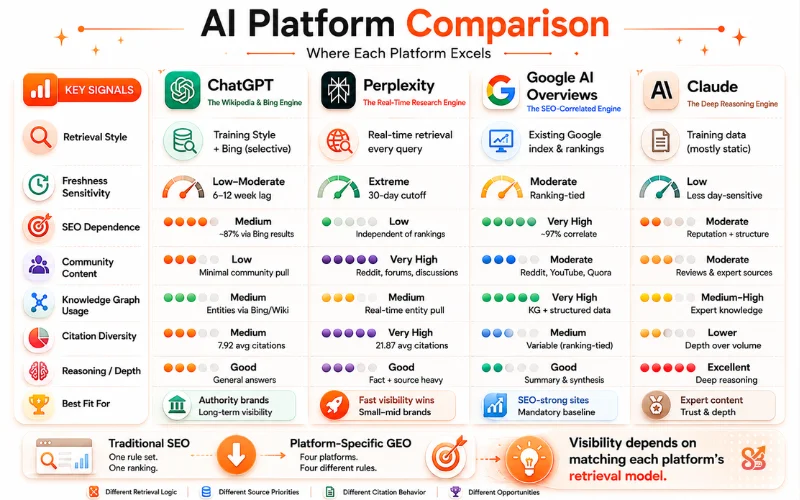
AI Search Platforms at a Glance
Before diving into each platform individually, here’s a high-level comparison of how the major AI search systems retrieve and evaluate information.
| Signal | ChatGPT | Perplexity | Google AI Overview | Claude |
| Retrieval method | Training data + Bing (selective, ~35% of queries) | Real-time crawl on every query | Existing Google index + E-E-A-T signals | Training data (mostly static, early 2025 cutoff) |
| Top citation source | Wikipedia (47.9% of top 10) | Reddit (46.7% of top 10) | Reddit 21%, YouTube 19%, Quora 14% | Structured/bulleted content + review signals |
| Citations per response | 7.92 average (fewest) | 21.87 average (most) | Variable, query-dependent | Fewer, depth-focused |
| Freshness sensitivity | Low–moderate (6–12 week lag) | Extreme (82% vs 37%, 30-day gap) | Moderate (ranking-tied) | Low (training data) |
| SEO correlation | ~87% trace to Bing top results | Low — independent of Google ranking | ~97% correlate with organic rank | Moderate |
| Authority bar to clear | Highest (DR 80+ dominates) | Lowest (freshness + community presence) | Moderate (existing rankings required) | Moderate (structure + reputation) |
| Best first move | Bing Webmaster Tools + DR-building | Reddit presence + fresh structured content | FAQ schema + AEO restructure | Bullet formatting + review profile |
Although every platform has unique preferences, they all reward content that is trustworthy, well-structured, factually accurate, and easy for AI systems to extract and cite.
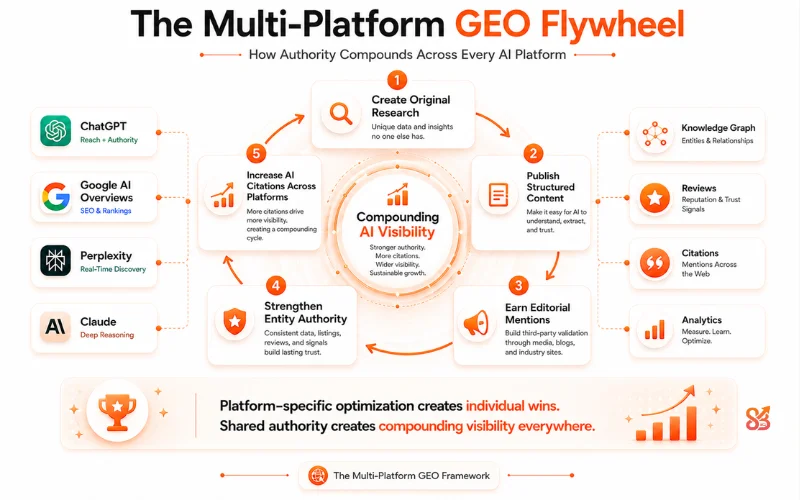
Why the divergence is so wide: the architecture behind each platform
The 13.7% source overlap between ChatGPT and Google AI Overview — and the 11% overlap between ChatGPT and Perplexity — is not a coincidence. It reflects genuinely different retrieval architectures built for different objectives. ChatGPT was built primarily as a language model that generates answers from training data. Perplexity was built as a real-time research tool that retrieves and synthesises live web content. Google AI Overview was built to enhance an existing search index. These are fundamentally different systems, not variants of the same one.
13.7%
source overlap between ChatGPT and Google AI Overview — out of 100 sources one cites, fewer than 14 appear in the other – SiteUp.ai, 2026
Platform 1: ChatGPT
ChatGPT
64.5% AI search market share – 800M weekly active users – Bing-powered retrieval layer
How ChatGPT retrieves and selects sources
ChatGPT operates on a two-layer retrieval system that most practitioners do not fully understand. The base layer is static training data with a fixed knowledge cutoff — this is the model’s internal knowledge, with no live web access. The retrieval layer is Bing-powered and activates selectively, primarily for commercial-intent queries containing signals like ‘reviews’, ‘comparison’, ‘best’, ‘vs’, or a recent year. The critical finding from SiteUp.ai’s research is that approximately 65.5% of ChatGPT queries never trigger web search at all — the response comes entirely from the model’s training data, with zero live retrieval. This means that for the majority of queries, there is no ‘source’ being selected in real time — the answer exists entirely from what the model was trained on.
Retrieval mechanism
Two-layer: static training data (base) + Bing-powered live retrieval (activates selectively on commercial, comparative, and time-sensitive queries). ~65.5% of queries never trigger live retrieval.
Top citation source
Wikipedia — 47.9% of ChatGPT’s top 10 most-cited sources and 7.8% of total citation volume across the full dataset. Approximately 87% of ChatGPT citations when retrieval does activate trace directly to Bing’s top-ranking organic results.
Freshness sensitivity
Low-to-moderate. Training data has a fixed cutoff (approximately early 2025 in current model versions); the Bing retrieval layer introduces a 6–12 week lag between publication and citation appearance. Content published last week is unlikely to appear.
Citations per response
7.92 on average when sources are cited — the lowest of the four major platforms, making each slot more competitive.
Platform 2: Perplexity
Perplexity
780M queries/month – Real-time retrieval on every query – Fastest feedback loop of any platform
How Perplexity retrieves and selects sources
Perplexity is architecturally the most different from ChatGPT. It performs real-time web retrieval on every single query — there is no fixed knowledge cutoff and no static base layer. Every response is synthesised from live web content retrieved moments before the answer is generated. This makes Perplexity the most up-to-date of any major AI search platform, and the one most sensitive to when your content was published.
Perplexity’s generosity with citations is the other striking difference. While ChatGPT averages 7.92 citations per response, Perplexity averages 21.87 citations per response — nearly three times as many. This makes Perplexity the platform with the most available citation slots, the lowest effective barrier to entry for brands without massive domain authority, and the fastest path to measurable GEO progress. A well-structured article published this week can appear in Perplexity citations within 2–4 weeks.
Retrieval mechanism
Real-time retrieval on every query — no fixed knowledge cutoff. Draws from multiple search APIs (Google, Bing, and proprietary sources), retrieves and reads candidate pages live, then synthesises with inline numbered citations as standard.
Top citation source
Reddit — 46.7% of Perplexity’s top-cited sources, nearly double Wikipedia’s share on the same platform. Community-validated, experience-based content is explicitly favoured over institutional authority. YouTube is the second largest source.
Freshness sensitivity
Extreme — the highest of any platform. Content published in the last 30 days earns an 82% citation rate versus 37% for older content, a 45-percentage-point gap. Including a year or update date in content (‘Updated June 2026’) improves citation rates by approximately 30%.
Citations per response
21.87 on average — three times ChatGPT’s rate, making this the most accessible platform for brands building citation presence from a lower starting authority level.
What this means for your Perplexity strategy
Perplexity’s Reddit dominance (46.7% of top citations) is the most direct strategic signal on this platform: genuine, substantive participation in relevant Reddit communities is a direct path to Perplexity citation eligibility. This does not mean promotional posts or link drops — Perplexity’s retrieval system reads the quality and relevance of the content. Detailed, experience-based answers to real questions in subreddits your audience uses are the format that gets cited. A contractor SEO specialist answering real questions in r/SEO, r/smallbusiness, or r/contractors with substantive, non-promotional expertise is building Perplexity citation currency with every post.
The freshness gap — 82% citation rate for content under 30 days old versus 37% for older content — creates a clear publishing cadence implication. Monthly publication of fresh, clearly dated content is more valuable on Perplexity than a large backlog of evergreen pieces. Add ‘Updated [Month Year]’ timestamps to high-priority pages. Structure content in short, discrete claim-level paragraphs rather than dense prose — Perplexity’s real-time retrieval system extracts passage-level content, and scannable structure aids extraction accuracy.
For brands with moderate domain authority, Perplexity is the priority starting platform — the one where a well-executed 90-day content and community programme produces measurable citation results fastest. The feedback loop is the shortest of any major AI platform.
Platform 3: Google AI Overviews
Google AI Overviews
~48% of Google queries – 1.5 billion users – Strongest correlation with traditional SEO of any platform
How Google AI Overviews retrieves and selects sources
Google AI Overviews is the platform with the strongest connection to traditional SEO — and this is both its most important feature and its most important constraint. Approximately 97% of pages cited in AI Overviews correlate with pages that already rank in the traditional Google organic results, making this the only major AI platform where your existing SEO foundation directly determines your AI visibility. If your page does not rank in traditional Google search for a given query, it is unlikely to appear in the AI Overview for that query.
The source distribution on Google AI Overviews is the most balanced of the four platforms. GrowthOS analysis of 2026 data shows the top citation sources as Reddit (21%), YouTube (19%), Quora (14%), and LinkedIn (13%) — a genuinely diverse mix of authoritative publishers, community platforms, and professional networks. No single source dominates the way Wikipedia dominates on ChatGPT or Reddit dominates on Perplexity.
Retrieval mechanism
Built on Google’s existing search index enriched with E-E-A-T authority signals. Retrieval is index-driven rather than live web crawl, meaning existing SEO foundation directly determines eligibility for AI Overview inclusion.
Top citation source
Diverse distribution: Reddit 21%, YouTube 19%, Quora 14%, LinkedIn 13%. Authoritative publishers and how-to / instructional content also well-represented. No single source type dominates — balanced authority evaluation across content types.
Freshness sensitivity
Moderate — tied to existing organic ranking freshness rather than independent recency signals. Pages that update regularly and maintain strong engagement signals benefit from the same freshness signals that apply in traditional search.
Citations per response
Variable — tied to query type and complexity. Informational and how-to queries generate the most citation-rich responses. Transactional queries may trigger AI Overviews with fewer or no external citations.
What this means for your Google AI Overview strategy
The 97% SEO-to-AIO correlation makes Google AI Overview the mandatory baseline platform for any brand already investing in traditional SEO. If you have strong organic rankings, you are already halfway to AI Overview visibility — the marginal cost of closing the gap is lower than on any other platform. The specific additions that move ranking pages into AI Overview citations: implementing FAQ schema (which Leapd’s research associates with 73% improvement in AI Overview selection rates), restructuring content to answer-first per the AEO principles in Post 03, and ensuring structured data is complete and accurate sitewide.
The community platform dominance on Google AI Overviews — Reddit, Quora, LinkedIn collectively accounting for 48% of cited sources — mirrors the AIO signal covered in Post 05. A brand with no meaningful presence on these community platforms is missing nearly half the citation surface that Google AI Overview draws from, regardless of how strong its owned website content is. Building genuine presence on LinkedIn and participating in Quora in your category are direct inputs to Google AI Overview visibility, not optional extras.
Platform 4: Claude
Claude
Distinct retrieval behaviour – Structure and reputation-driven – 30% bias toward bulleted content
How Claude retrieves and selects sources
Claude operates primarily on training data with a fixed cutoff rather than live web retrieval for most queries — a retrieval architecture more similar to ChatGPT’s base layer than to Perplexity’s real-time system. Its knowledge cutoff in current research datasets sits around early 2025 for most queries, meaning very recently published content is unlikely to influence Claude’s responses directly through training data alone.
What distinguishes Claude from ChatGPT despite their similar retrieval architectures is how each platform weights content structure and reputation signals differently. Discovered Labs’ January 2026 analysis found that Claude is approximately 30% more likely to cite bullet-pointed, clearly structured pages than equivalent unstructured prose. This structural preference is the most pronounced of the four platforms — making content formatting a genuine citation differentiator on Claude in a way that matters less on Perplexity or ChatGPT.
Retrieval mechanism
Primarily training data with fixed cutoff (approximately early 2025). Limited live retrieval except in explicitly web-enabled versions. Anthropic’s Constitutional AI framework appears to correlate with stronger weighting of review and user-validated content compared to ChatGPT.
Top citation source
Well-structured, clearly formatted content — particularly bulleted lists, discrete sections, and unambiguous factual claims. Review platforms and reputation signals carry more relative weight in Claude’s citation pattern than on ChatGPT or Google AI Overview.
Freshness sensitivity
Low — training-data dependent for most queries. Content published in recent months is unlikely to have entered training data. Evergreen, well-structured content with strong reputation signals performs consistently regardless of publication date.
Citations per response
Lower than Perplexity, focused on depth — Claude tends to cite fewer sources but engage with them more substantively, making citation quality more important than citation frequency on this platform.
What this means for your Claude strategy
Claude’s 30% structural bias toward bulleted content creates a direct, actionable formatting implication: for any content you want Claude to cite, restructure multi-part answers as bulleted lists rather than prose paragraphs. A three-part answer written as a paragraph is structurally harder for Claude to extract accurately than the same answer written as three clean bullet points. This is the same AEO formatting principle covered in Post 03, applied with Claude’s specific structural bias in mind.
The stronger weight Claude appears to give to review platforms and reputation signals — a pattern consistent across the Discovered Labs and Yext’s 17.2-million-citation dataset — means that active review management is not optional for Claude visibility the way it can be deprioritised for ChatGPT. A consistent, positive review presence across Google, Trustpilot, G2, or Clutch — depending on your category — contributes to the credibility signals Claude’s training data weights more heavily than other platforms.
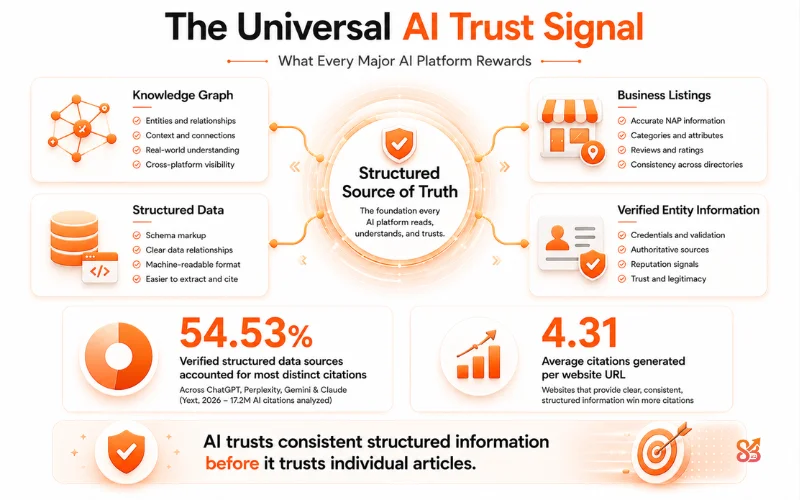
The one signal all four platforms agree on
Despite their architectural differences, the Yext 17.2-million-citation analysis found one pattern consistent across ChatGPT, Perplexity, Gemini, and Claude: verified, structured, directly distributed data accounted for 54.53% of distinct citation sources across all four engines combined. Websites generated an average of 4.31 citations per URL across the dataset.
This is the finding that cuts against the instinct to obsess over platform-specific quirks: the brands earning the most AI citations are not necessarily the ones with the best website content — they are the ones that own the source of truth that every engine reads from. Accurate, complete, consistently maintained listings across directories, review platforms, and structured data feeds outperform standalone web content across every platform measured. The mechanism is different on each platform — Bing for ChatGPT, live crawl for Perplexity, Google index for AI Overviews — but all four ultimately read from the same web of verified structured data.
‘Write better content’ is advice for one retrieval path. Maintaining verified, structured entity data in a central source that feeds the directories, review platforms, and knowledge graphs all four engines ultimately check is the strategy that earns citations everywhere — not just on your preferred platform.
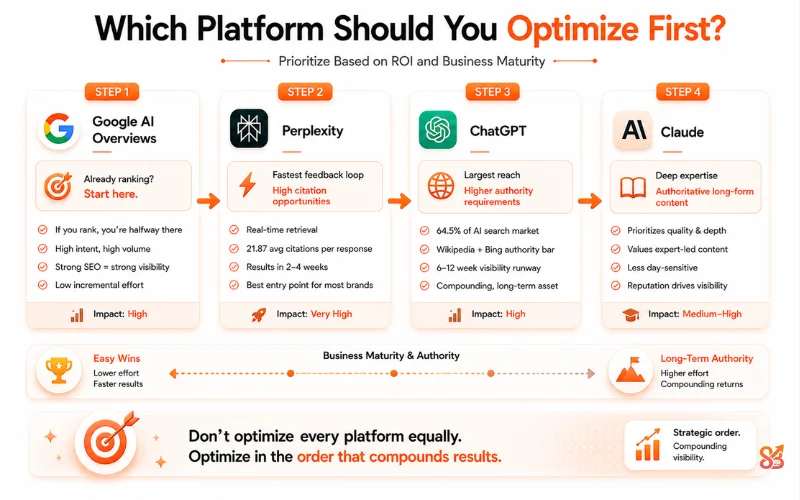
Where to focus first: a platform-prioritisation framework
Given limited time and budget, the research points to a clear prioritisation sequence based on your current authority level and speed-to-results requirements. SiteUp.ai’s analysis provides the most practical prioritisation logic available:
- Google AI Overview — mandatory if you already rank. If your site already has pages ranking in the top 20 on Google, AI Overview is the lowest-effort highest-return platform to start with. Your SEO foundation already qualifies you; FAQ schema, AEO restructuring, and structured data complete the picture. Start here if you have ranking pages and want the fastest visible return.
- Perplexity — fastest ROI for brands at any authority level. 21.87 citation slots per response, 2–4 week feedback loop, community-driven selection criteria. A brand with no domain authority history can appear in Perplexity citations faster than on any other platform through consistent fresh publishing and genuine Reddit participation. Start here if you are building from lower authority or want the fastest measurement cycle.
- Claude — best for structured, evergreen technical content. Low freshness sensitivity and structural bias toward bulleted content makes Claude ideal for technical guides, comparison frameworks, and reference material that holds its value over time. Start here if your content mix is naturally structured and your review presence is already solid.
- ChatGPT — the long game with the largest reach. 64.5% AI search market share but the highest authority bar. Building ChatGPT citation presence requires sustained domain authority growth, third-party editorial mentions, and Bing indexing — none of which happen quickly. Start building now, measure over a 6–12 month window rather than expecting results in weeks.
A page optimised for ChatGPT is not automatically picked up by Perplexity, and vice versa. Measure citation frequency separately for each major platform — not as a single blended AI visibility score — so you know precisely where you are winning and where the gap remains.
The universal GEO signals that improve citation across all four platforms
Despite their architectural differences, several content characteristics consistently improve citation probability across all four platforms simultaneously. These are the highest-leverage investments for any GEO strategy.
- Semantic completeness. Every platform favours content where an extracted paragraph makes complete sense in isolation. If a passage requires surrounding context to be understood, restructure it to stand alone — the same answer-first principle covered in Post 03 of this series.
- FAQ schema implementation. Leapd’s 2026 research associates FAQ schema with approximately 40% higher citation weighting in ChatGPT and 73% improvement in AI Overview selection rates. Microsoft’s Fabrice Canel confirmed at SMX Munich (March 2025) that schema markup directly helps Bing’s Copilot interpret content — which flows directly into ChatGPT’s retrieval layer.
- Verified, consistent listings across directories. 54.53% of citations across all four platforms trace to verified structured data. Incomplete or inconsistent directory listings are suppressing your citation eligibility regardless of how strong your website content is.
- Third-party editorial validation. 65.3% of ChatGPT citations come from DR 80+ domains. Independent expert mentions, industry awards, and press coverage carry more weight than self-asserted authority claims on every platform measured.
- Clear H2/H3 hierarchy with one discrete question per section. Listicles and structured articles dominate ChatGPT citations (21.9% and 16.7% respectively). Claude shows a 30% structural bias toward bullet-pointed content. Google AI Overview favours how-to and instructional formatting. Perplexity extracts at passage level. All four reward structural clarity over dense prose.
- Inline source citations within your content. The GEO paper (Aggarwal et al., KDD 2024) found that content citing other authoritative sources earns up to +115% citation visibility for lower-ranked pages. Citing sources within your own content signals epistemic rigour — and that signal holds across every platform in the dataset.
Where this fits in the Search Visibility Stack
The platform breakdown is not a separate discipline from GEO (Layer 3) — it is the operational layer underneath it. The GEO principles covered in Post 04 — original data, source citations, authoritative voice, entity clarity — are the content characteristics that earn citations in general. This post answers the next-level question: given those characteristics, which platform should you prioritise, and what platform-specific adjustments multiply your citation probability once the foundational content quality is in place.
The practical takeaway for any multi-surface visibility strategy: measure citation frequency separately for ChatGPT, Perplexity, and Google AI Overview rather than as a single blended AI visibility metric. A brand performing well on Perplexity and invisible on ChatGPT is not failing at GEO — it has succeeded on the most accessible platform first and has a clear, evidence-based roadmap for where to invest next. That is the correct sequence, not a failure.
Frequently Asked Questions About How AI Search Platforms Choose Sources
How does ChatGPT choose sources?
ChatGPT uses a combination of its training data and Bing-powered web retrieval for certain queries. When live retrieval is triggered, most cited sources come from Bing’s organic search results.
Does Perplexity use Google Search?
Perplexity performs live web retrieval using multiple search providers and proprietary retrieval systems, allowing it to cite recently published content more frequently than most AI platforms.
Why does Google AI Overviews cite different websites?
Google AI Overviews build on Google’s search index and E-E-A-T signals, so they tend to cite pages that already perform well in traditional search, although the cited sources may differ depending on the query.
Which AI platform is easiest to get cited by?
Based on current research, Perplexity generally has the lowest barrier because it retrieves fresh web content for every query and cites significantly more sources per response than ChatGPT or Google AI Overviews.
Can the same optimisation strategy work for every AI platform?
No. While foundational GEO principles apply everywhere, each platform evaluates authority, freshness, retrieval, and content structure differently, so platform-specific optimisation delivers better results.
→ Next: Search Visibility Myths — 10 SEO and AI Search Misconceptions Debunked With Data
→ Previous: The Historical Timeline — Search 1998–2030: Every Era and What It Demanded
References and citations
- Yext. (2026). How ChatGPT, Perplexity, Gemini, and Claude Actually Decide What to Cite. Analysis of 17.2 million AI citations. Verified structured data = 54.53% of distinct citation sources; 4.31 citations per URL average; 65.3% of ChatGPT citations from DR 80+ domains. https://www.yext.com/blog/how-chatgpt-perplexity-gemini-claude-decide-what-to-cite
- SiteUp.ai. (2026, April). ChatGPT vs Perplexity vs Google AI Overview: Citation Preference Research. 13.7% source overlap; Perplexity 21.87 vs ChatGPT 7.92 citations/response; 87% ChatGPT citations trace to Bing top results; 65.5% of queries never trigger ChatGPT search; 82% vs 37% Perplexity freshness gap. https://siteup.ai/blog/chatgpt-perplexity-google-ai-overview-citation-preference
- Profound / tryprofound.com. (2025, August). AI Platform Citation Patterns. 680 million citations dataset. Wikipedia 47.9% of ChatGPT’s top 10 sources; Reddit leading source for Perplexity. https://www.tryprofound.com/blog/ai-platform-citation-patterns
- Discovered Labs. (2026, January). How ChatGPT, Claude, Perplexity, and Google AI Overviews Cite Sources Differently. Reddit 46.7% of Perplexity’s top citations; Claude 30% more likely to cite bullet-pointed pages; content updated past 3 months averages 6 citations vs 3.6 for older content. https://discoveredlabs.com/blog/chatgpt-claude-perplexity-and-google-ai-overviews-how-each-platform-cites-sources-differently
- Leapd. (2026, April). How ChatGPT, Google AI Overviews, and Perplexity Source Information in 2026. FAQ schema = ~40% higher ChatGPT citation weighting; structured data = 73% improvement in AI Overview selection; year-date signals improve citation rates ~30%. https://www.leapd.ai/blog/ai-visibility/how-chatgpt-google-ai-overviews-and-perplexity-source-information-in-2026
- PingPrime. (2026, May). ChatGPT Search vs Google AI Overviews vs Perplexity: 2026 Guide. ChatGPT 800M weekly users; Google AI Overviews ~48% of queries; Perplexity 780M queries/month; 11% domain overlap between ChatGPT and Perplexity citations. https://www.pingprime.ai/en-be/blog/chatgpt-search-ai-overviews-perplexity
- GrowthOS. (2026, April). Google AI Overviews vs ChatGPT vs Perplexity: Which Wins in 2026. AI Overview source distribution: Reddit 21%, YouTube 19%, Quora 14%, LinkedIn 13%. https://www.usegrowthos.com/blog/google-ai-overviews-vs-chatgpt-vs-perplexity
- Pravin Kumar / Chris Long. (2026, April). AI Mode Citation Differences: ChatGPT fan-out behaviour checks industry award recognition; ~97% AI Overview citations correlate with traditional organic rankings. https://www.pravinkumar.co/blog/perplexity-chatgpt-google-ai-mode-citation-differences-2026
- Aggarwal, P., et al. (2024). GEO: Generative Engine Optimization. KDD 2024. Princeton / IIT Delhi / Georgia Tech / Allen Institute for AI. Inline source citations within content: +115% citation visibility for lower-ranked pages. https://doi.org/10.1145/3637528.3671900