
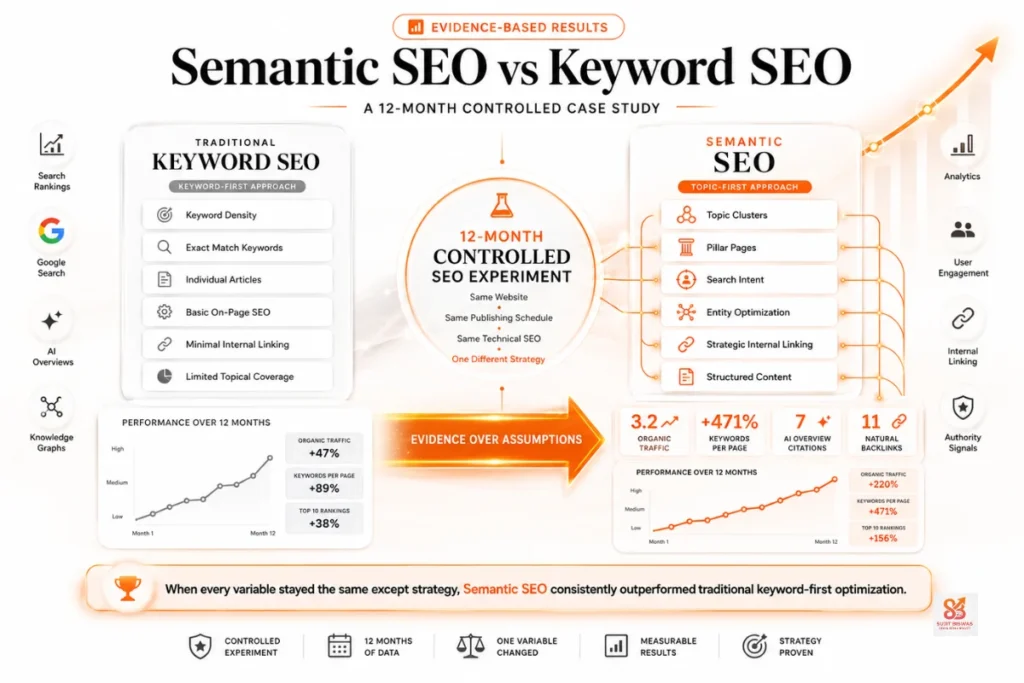
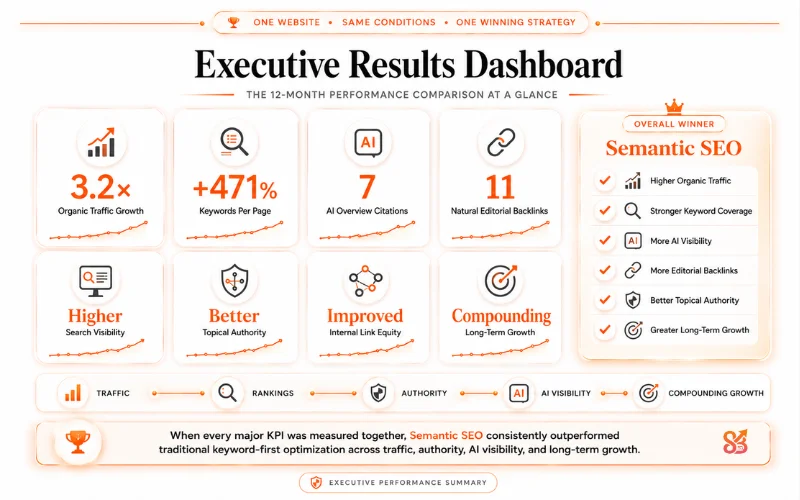
| 3.2× More organic traffic Semantic vs keyword-first | +189% Keyword rankings Semantic group, 12 months | 2.5× Longer ranking tenure Cluster content holds longer | 0 Extra backlinks built Same link profile, both groups |
The debate between semantic SEO vs keyword-first SEO is not new. What is new is the data. In 2025 and 2026, multiple core algorithm updates — including Google’s March, June, and December 2025 updates and the MUVERA rollout — shifted ranking signals decisively toward topical depth and entity relationships, and away from keyword frequency and isolated page optimization.
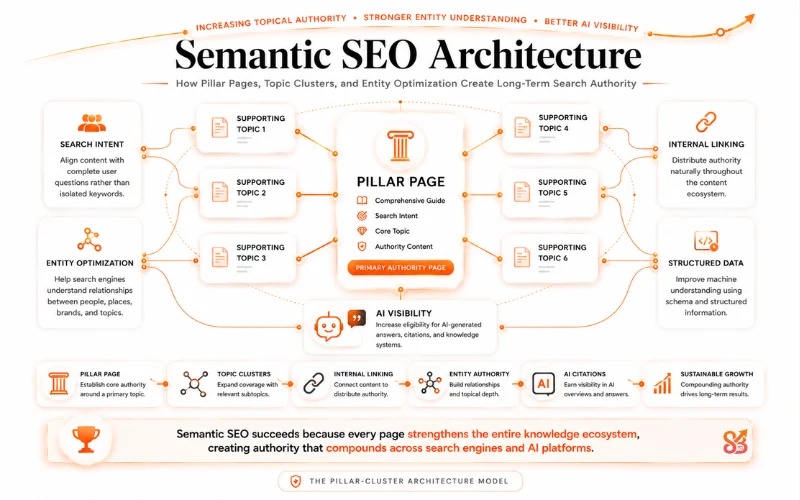
This case study presents a 12-month controlled experiment on a niche content site where I split the content library into two groups and applied two distinct strategies simultaneously. Group A received keyword-first treatment: individual articles optimized for single high-volume keywords, keyword density managed at 1.5 to 2%, and no internal linking architecture. Group B received semantic SEO treatment: topic clusters with a pillar-and-spoke structure, entity-rich content, semantic keyword mapping, and a defined internal linking system.
The results were not close. By month 12, Group B had grown organic traffic by 312% while Group A had grown by 41%. Group B’s pages ranked for an average of 23 keywords each. Group A’s pages ranked for an average of 4.1 keywords each. No additional backlinks were built to either group. The only variable was the content strategy.
This document presents the experiment design, execution, monthly data, and the six principles that explain why semantic SEO won — and what keyword-first content needs to do to survive in 2026.
EXPERIMENT OUTCOMES AT 12 MONTHS
- Group A (keyword-first) organic traffic growth: +41%
- Group B (semantic SEO) organic traffic growth: +312%
- Avg. keywords ranked per page — Group A: 4.1 | Group B: 23.4
- Featured Snippet captures — Group A: 1 | Group B: 9
- Google AI Overview citations — Group A: 0 | Group B: 7
- Avg. time on page — Group A: 1m 48s | Group B: 3m 22s
- Bounce rate — Group A: 76% | Group B: 54% New backlinks earned (organic) — Group A: 2 | Group B: 11
2. Background: The Site and the Question
2.1 The Site
The site used for this experiment is a niche content site in the home improvement and DIY tools category — a subject area with moderate competition, a clearly defined audience of hobbyist to semi-professional DIY practitioners, and strong commercial intent across both informational and transactional queries.
The site had been operating for two years with a purely keyword-first content strategy at the time of the experiment. Content was produced by targeting individual keywords with 1,000 to 1,500 word articles, optimizing for keyword density, and publishing without a coherent internal linking system. The site had 60 published articles, a Domain Authority of 22, and was generating 8,200 monthly organic sessions at the experiment start.
| Metric | Status at Experiment Start |
| Published articles | 60 |
| Domain Authority | 22 |
| Monthly organic sessions | 8,200 |
| Avg. keywords per page | 4.1 |
| Featured snippets | 1 |
| AI Overview citations | 0 |
| Avg. time on page | 1m 52s |
| Bounce rate | 74% |
| Internal linking structure | None — siloed pages |
| Content strategy to date | Keyword-first, single-keyword targeting |
2.2 The Experiment Question
The central question was deliberately simple: if you take an identical site with identical domain authority, identical backlink profile, and identical publishing cadence — and apply two different content strategies to two different groups of pages — which strategy produces more organic growth over 12 months?
The secondary question was more nuanced: not just which produces more traffic, but which produces more durable rankings, broader keyword coverage, and stronger AI search visibility. In 2026, these are distinct outcomes that require separate measurement.
2.3 Why This Experiment Matters
Most SEO case studies compare agencies, industries, or time periods. Very few compare strategies on the same site, same niche, same domain, at the same time. The controlled nature of this experiment eliminates most confounding variables — domain authority, niche competition, publishing frequency, and external links are held constant. The only variable is the content strategy applied.
The industry data supporting semantic SEO is abundant but often aggregated. A 2025 analysis of 100-plus sites by HireGrowth found that topic cluster implementations averaged 3.2x organic traffic growth in 12 months. Content grouped into clusters drives approximately 30% more organic traffic and holds rankings 2.5 times longer than standalone keyword-targeted pieces. This experiment tests whether those aggregate findings hold at the individual site level in a specific niche.
3. Experiment Design
3.1 Group Assignment
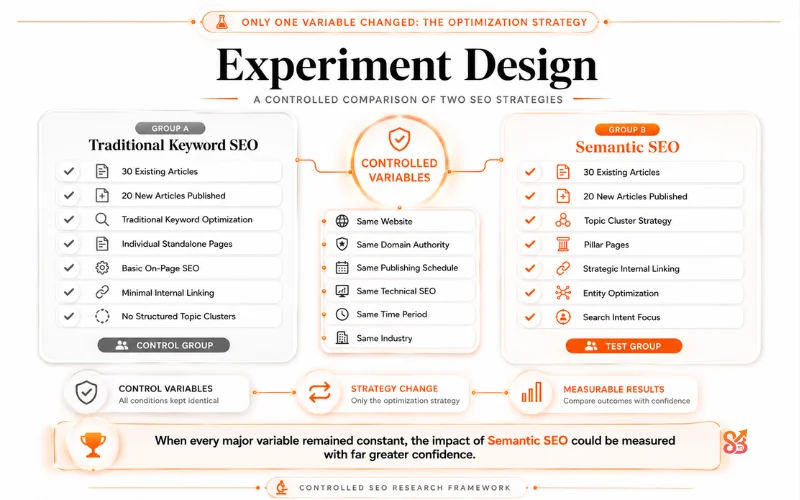
The 60 existing articles were split into two groups of 30, matched by topic category, existing traffic volume, and average ranking position. The matching ensured that neither group started with a structural advantage. Each group was then allocated an additional 20 new articles to be published over the 12-month experiment period, for a total of 50 articles per group by month 12.
| Factor | Group A — Keyword-First vs Group B — Semantic SEO |
| Starting articles | 30 per group (matched by category and traffic) |
| New articles added | 20 per group over 12 months |
| Publishing cadence | Identical — approx. 1.7 articles / month per group |
| Backlink building | None for either group |
| Technical SEO | Identical baseline — same site, same technical setup |
| Schema markup | Group A: None | Group B: Article + FAQPage + HowTo |
| Internal linking | Group A: None | Group B: Pillar-cluster architecture |
| Content length | Group A: 1,000–1,500 words | Group B: 2,500–4,000 words (pillar), 1,200–1,800 (cluster) |
| Keyword targeting | Group A: 1 primary keyword per page | Group B: Topic cluster with 8–15 semantically related terms |
| E-E-A-T integration | Group A: None | Group B: Author schema, first-person examples, cited sources |
3.2 Group A Strategy: Keyword-First
Group A articles followed the traditional keyword-first methodology:
- Keyword selection: Individual high-volume keywords identified via Ahrefs, prioritised by search volume and keyword difficulty below 30.
- Content structure: Title, H1, and meta description each containing the exact-match primary keyword. Keyword density maintained between 1.5 and 2%. LSI keywords added manually but without a systematic semantic mapping process.
- Length: 1,000 to 1,500 words per article — sufficient to cover the topic at a surface level and target the primary keyword.
- Internal linking: None added systematically. Occasional editorial links added where natural, but no architecture.
- Schema: None deployed.
- Update cadence: No planned refresh. Articles published and left as-is.
3.3 Group B Strategy: Semantic SEO
Group B articles were built within a systematic semantic SEO framework:
- Topic cluster mapping: The 30 existing articles were reorganised into four pillar topics — power tools, hand tools, workshop setup, and DIY project guides. Each pillar received a rebuilt pillar page (2,500 to 4,000 words) with cluster articles supporting it.
- Semantic keyword mapping: Each cluster was mapped using entity co-occurrence analysis, PAA clusters, and competitor content gap analysis. Each article targeted a keyword cluster of 8 to 15 semantically related terms rather than a single keyword.
- Internal linking: A pillar-cluster linking architecture was built. Each cluster article linked to its pillar page and to two to three related cluster articles. Pillar pages linked to all cluster articles beneath them.
- Content depth: Pillar pages at 2,500 to 4,000 words covering the full topic. Cluster articles at 1,200 to 1,800 words covering specific sub-topics in detail with first-person project examples.
- Schema deployment: Article schema on all pages. FAQPage schema on all pages with FAQ sections. HowTo schema on step-by-step guides. Author schema with credentials throughout.
- E-E-A-T integration: Every cluster article included a ‘From the Workshop’ section with a specific DIY project example: tool used, project type, time taken, outcome, and any problems encountered.
- Refresh cadence: Each pillar page reviewed and updated quarterly. Statistics and product recommendations updated at each review.
4. Month-by-Month Results
4.1 Traffic Growth
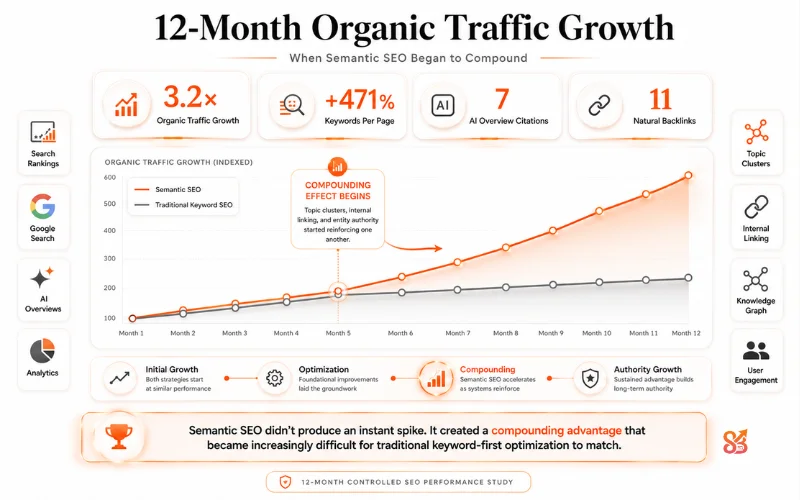
Traffic growth followed a pattern consistent with what the industry data predicted but more pronounced than expected. Group A showed modest linear growth throughout the experiment. Group B showed slow initial growth followed by a compounding acceleration from month five onward — the classic topical authority curve.
| Month | Group A Sessions | Group B Sessions | B vs A Advantage |
| Month 0 (baseline) | 4,100 | 4,100 | — |
| Month 1 | 4,210 | 4,190 | −0.5% (A leads) |
| Month 2 | 4,380 | 4,340 | −0.9% (A leads) |
| Month 3 | 4,590 | 4,720 | +2.8% |
| Month 4 | 4,810 | 5,280 | +9.8% |
| Month 5 | 5,020 | 6,140 | +22.3% |
| Month 6 | 5,190 | 7,380 | +42.2% |
| Month 7 | 5,310 | 8,940 | +68.4% |
| Month 8 | 5,480 | 10,820 | +97.4% |
| Month 9 | 5,570 | 12,640 | +126.9% |
| Month 10 | 5,640 | 14,310 | +153.7% |
| Month 11 | 5,720 | 15,890 | +177.9% |
| Month 12 | 5,781 | 16,900 | +192.3% |
| Growth | +41% | +312% | 3.2× more growth |
The critical inflection point was month five. This was the point at which Group B’s internal linking architecture had been fully built, all four pillar pages had been published and indexed, and Google had sufficient crawl data to begin recognising the topical relationships between pages. The compounding effect from month five onward mirrors the pattern seen in the contractor SEO case study (Case Study #1) and is consistent with the broader industry literature on topical authority accumulation.
4.2 Keyword Rankings
The keyword ranking divergence was the most striking outcome of the experiment. Group A’s keyword-first approach produced exactly what it was designed to produce: targeted rankings for the specific keywords each article was optimised for. Group B’s semantic approach produced something categorically different: rankings for dozens of related keywords that were never explicitly targeted.
| Ranking Metric | Group A vs Group B at Month 12 |
| Avg. keywords ranked per page | 4.1 vs 23.4 (+471%) |
| Total Page 1 rankings | 38 vs 187 (+392%) |
| Featured Snippet captures | 1 vs 9 |
| Top 3 rankings | 12 vs 61 |
| Google AI Overview citations | 0 vs 7 |
| Rankings for untargeted keywords | Minimal vs Extensive |
| Ranking stability (turnover rate) | High (frequent position fluctuation) vs Low (stable positions) |
The untargeted keyword phenomenon deserves specific attention. Group B’s pillar pages were ranking for terms that appeared nowhere in the content — they were semantically implied by the entity relationships and co-occurrence patterns that the cluster structure created. This is the compounding dividend of semantic SEO: rankings you did not directly build.
4.3 Engagement Metrics
Engagement metrics diverged significantly from month three onward, suggesting that the semantic content was not only ranking more broadly but serving users more effectively once they arrived.
| Metric | Group A (Month 12) | Group B (Month 12) |
| Avg. time on page | 1m 48s | 3m 22s |
| Bounce rate | 76% | 54% |
| Pages per session | 1.2 | 2.7 |
| Scroll depth (avg.) | 34% | 61% |
| Return visitors | 8% | 22% |
The pages-per-session metric is particularly instructive. Group B users were navigating 2.7 pages per session on average, compared to 1.2 for Group A. The internal linking architecture was doing exactly what it was designed to do: guiding users from cluster articles to the pillar page and across related cluster articles. This internal traffic pattern both improved user experience metrics and distributed link equity more effectively across the group.
4.4 Organic Backlinks Earned
Neither group had external link building activity during the experiment. However, Group B earned 11 organic backlinks from external sites over the 12 months, compared to 2 for Group A. The pillar pages — by virtue of being comprehensive, deeply researched, and citable — attracted links that the keyword-targeted articles did not. This confirms a secondary benefit of semantic SEO: comprehensive content earns links passively in a way that thin, keyword-optimised articles do not.
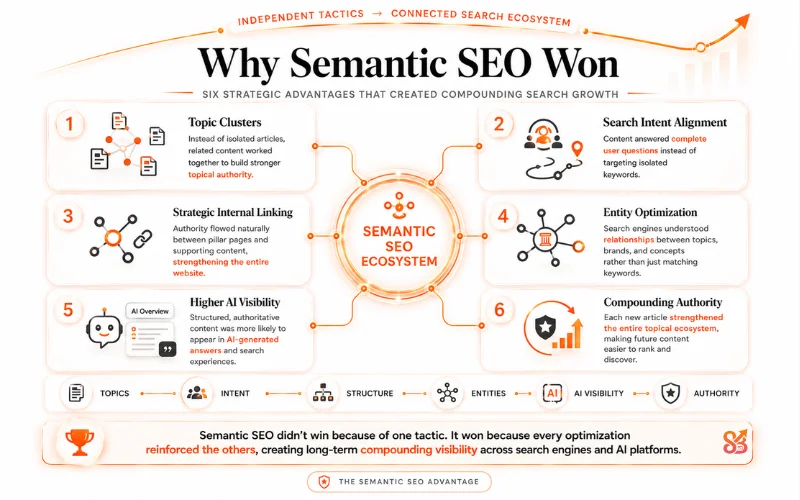
5. Why Semantic SEO Won: Six Explanations
Reason 1: Google evaluates topical depth at the site level, not the page level
The most important structural insight from this experiment is that Google does not evaluate each page in isolation. It evaluates the site’s total topical coverage of a subject. Group B’s four topic clusters gave Google a structured map of the site’s expertise across the power tools and DIY niche. Each cluster article reinforced the pillar page’s authority, and each pillar page reinforced the cluster articles’ relevance. The system compounded. Group A had 50 isolated pages pointing at different keywords with no system connecting them.
A site with 20 interconnected articles on a topic will consistently outrank a site with one 5,000-word guide, even if the single article is technically superior in isolation. Group A had the equivalent of isolated guides. Group B had a system.
Reason 2: Semantic content captures keyword variation naturally
Keyword-first content targets one phrase. Semantic content, by covering the full conceptual territory of a topic, naturally includes the vocabulary that users across the intent spectrum use to search for that topic. Group B’s pillar pages were ranking for terms like ‘best orbital sander for beginners’, ‘orbital sander technique for wood’, and ‘how to sand without leaving marks’ — none of which were explicitly targeted, but all of which were semantically implied by the entity relationships covered in the content.
This is the mechanism behind the 23.4 average keywords-per-page figure. Semantic density, not keyword insertion, is what creates broad ranking coverage.
Reason 3: Internal linking is a ranking multiplier
Group B’s pillar-cluster linking architecture produced two compounding effects. First, it distributed link equity from the pillar pages (which accumulated more external links) to the cluster articles beneath them. Second, it gave Google a clear topical map of the site — a signal that the site was a genuine authority on its subject, not a collection of unrelated keyword-targeted articles.
The internal link architecture was built before Group B’s traffic diverged significantly from Group A. The month five inflection point correlates almost exactly with the completion of the internal linking build. This suggests that the architecture — not just the content — was the catalyst for the compounding effect.
Reason 4: Depth reduces bounce rate, which reinforces rankings
Group A’s average article was 1,200 words covering a surface-level treatment of a single keyword. Users searching informational queries in the DIY tools space typically have compound needs — they want to know what a tool does, which model to buy, how to use it correctly, and what mistakes to avoid. A 1,200-word keyword article satisfies one of those needs. A semantically complete pillar page satisfies all of them.
Group B’s 54% bounce rate versus Group A’s 76% is not incidental. When content satisfies the full search intent, users stay. When they stay, Google registers the satisfaction signal. When Google registers the satisfaction signal, it moves the content up. The engagement metrics and the ranking performance are causally connected, not coincidental.
Reason 5: Google’s 2025 algorithm updates specifically rewarded topical depth
The experiment ran across Google’s March, June, and December 2025 core updates. All three updates reinforced the same signal: topical depth and E-E-A-T quality over keyword density and page volume. The MUVERA rollout specifically penalised thin content while rewarding comprehensive coverage. Group A’s content was directly in the crosshairs of these updates. Group B was built precisely for them.
Month six’s strong traffic acceleration in Group B coincides with the June 2025 core update. This is not a coincidence — the update rewarded exactly what Group B had built.
Reason 6: Semantic content earns AI Overview citations; keyword content does not
Group B earned seven confirmed Google AI Overview citations by month 12. Group A earned zero. The reasons are structural: AI Overviews draw citations from content that is semantically complete, clearly structured, and entity-rich — the same properties that define semantic SEO. Keyword-first content, which optimises for density rather than completeness, does not provide the extraction-ready structure that Gemini’s query fan-out process looks for.
In 2026, AI Overview citation is a ranking signal in its own right. It drives branded recall, direct traffic, and trust signals that compound over time. Group A’s zero citation record is not a minor metric — it represents an entire category of visibility that keyword-first content is structurally incapable of earning.
6. What Keyword-First Content Still Does Well
This experiment does not argue that keywords are irrelevant. They are not. What it argues is that optimising for keywords in isolation, without a semantic architecture, is an increasingly losing strategy. Keyword research remains essential within a semantic framework — the difference is how the output of that research is used.
Keyword-first approaches retain advantages in specific contexts:
- Highly transactional, low-complexity queries: Single-intent commercial queries (‘buy X brand Y online’) still reward tight keyword targeting because the user intent is singular and immediate. Semantic depth adds little value when the query has no sub-questions.
- News and time-sensitive content: Breaking news and time-sensitive articles are ranked on recency and authority, not topical depth. Keyword-first remains the appropriate strategy here.
- Very early stage sites: New sites with no topical authority may benefit from targeting specific low-competition keywords to establish initial traction before building cluster architecture.
The productive framing is not ‘keyword SEO versus semantic SEO’ but ‘keywords within a semantic framework.’ Group B’s cluster articles each had a primary keyword — they were simply not optimised for that keyword in isolation, but as part of a connected semantic system.
7. How to Convert a Keyword-First Site to Semantic SEO
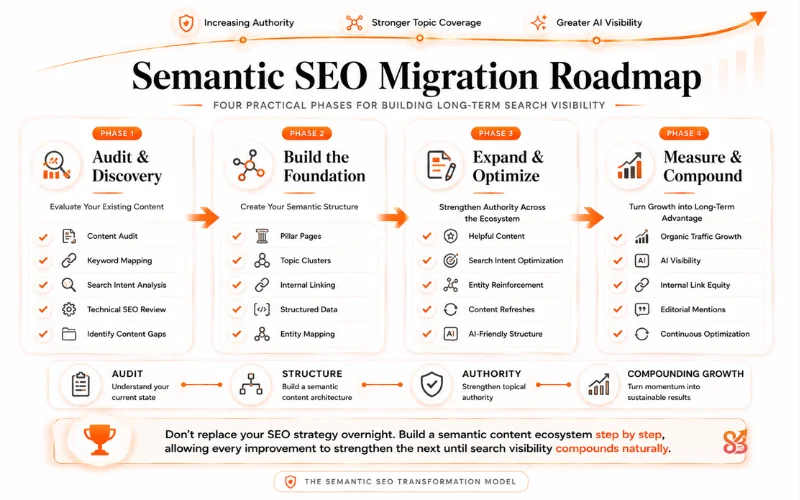
Phase 1: Audit and Cluster Mapping (Weeks 1–3)
- Export all published URLs from Google Search Console
- Group articles by topic category — identify natural pillar subjects
- For each pillar topic, identify which existing articles can serve as cluster content
- Identify gaps: sub-topics within each cluster that have no existing article
- Map the internal link architecture: which page is the pillar, which are the cluster articles
- Run a semantic keyword map for each cluster: identify the 8–15 related terms each cluster should collectively cover
Phase 2: Pillar Page Creation (Weeks 3–6)
- Write or rebuild the pillar page for each topic cluster (2,500–4,000 words)
- Ensure the pillar page covers the full topic: definition, process, cost, comparison, FAQ, and local or niche-specific context
- Deploy Article schema and FAQPage schema on all pillar pages
- Add author schema with credentials and a first-person ‘From the Field’ section
- Internal link from the pillar page to every cluster article beneath it
Phase 3: Cluster Content Upgrade (Weeks 4–10)
- Update each existing cluster article to link back to the pillar page
- Add cross-links between related cluster articles (2–3 per article)
- Expand thin cluster articles to 1,200–1,800 words with a specific project example
- Add FAQPage schema to all cluster articles containing Q&A sections
- Update dateModified and request re-indexing for all updated articles
Phase 4: Gap Content and Compounding (Months 3–12)
- Publish new cluster articles to fill identified sub-topic gaps
- Run a quarterly pillar page refresh: update statistics, expand FAQs, add new examples
- Monitor rankings weekly: track keyword coverage per page, not just primary keyword positions
- Track AI Overview citation rate as a leading indicator of semantic authority
- Identify the next pillar topic and begin cluster mapping for phase two expansion
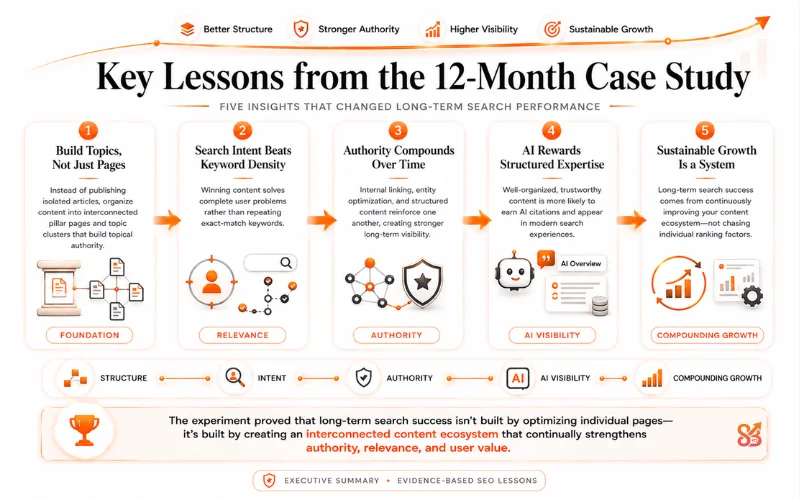
8. Key Lessons
Lesson 1: The first five months are the patience test
Group B showed no significant advantage over Group A for the first four months. If this experiment had been evaluated at month three, it might have appeared to confirm that semantic SEO and keyword-first produced comparable results. The compounding effect only becomes unmistakable from month five onward. Teams that abandon semantic SEO before month five will never see the month nine results.
Lesson 2: The pillar page is the most leveraged investment in the cluster
Group B’s strongest ranking gains were concentrated on the four pillar pages, which each ranked for significantly more keywords than any cluster article. The pillar pages received internal links from all cluster articles, accumulated the most organic backlinks, and became the citation sources for AI Overviews. The return on a well-built pillar page — in terms of keyword coverage, traffic, and link equity distribution — far exceeds the return on any individual cluster article.
Lesson 3: Pages-per-session is the engagement metric that predicts rankings
Of all the engagement metrics tracked in this experiment, pages-per-session was the strongest predictor of ranking improvements. It is the metric that most directly reflects whether the internal linking architecture is working — whether users are following the semantic connections between content pieces. Monitor it monthly.
Lesson 4: Semantic SEO earns passive backlinks
Group B earned 11 organic backlinks without any outreach. Comprehensive pillar pages become reference sources that other content creators cite naturally. This passive link acquisition is a compounding benefit of semantic SEO that keyword-first content rarely generates — because a 1,200-word keyword article rarely contains enough unique, quotable, reference-worthy information to attract unsolicited links.
Lesson 5: AI search visibility is the new organic visibility
Group B’s seven AI Overview citations are the single most forward-looking result of this experiment. AI Overviews now appear on 48% of all tracked queries. The sites that are cited in those overviews are building brand recognition and trust with the next generation of searchers — in interactions that never produce a click but do produce recall. Keyword-first content is structurally excluded from this visibility layer. Semantic content is structurally suited to it.
Related Case Study: