
Search has fundamentally changed. As of late 2025, the presence of an AI overview on Google reduces the click-through rate for the number-one ranking page by 58%. That means for every 100 clicks you used to get, Google now keeps 58 of them.
ChatGPT alone has 900 million weekly users and handles roughly 12% of Google search volume. AI traffic to websites has grown 9.7 times in the past year. If that trajectory continues — and there is every reason to believe it will — brands that fail to adapt will see their organic visibility slowly erode.
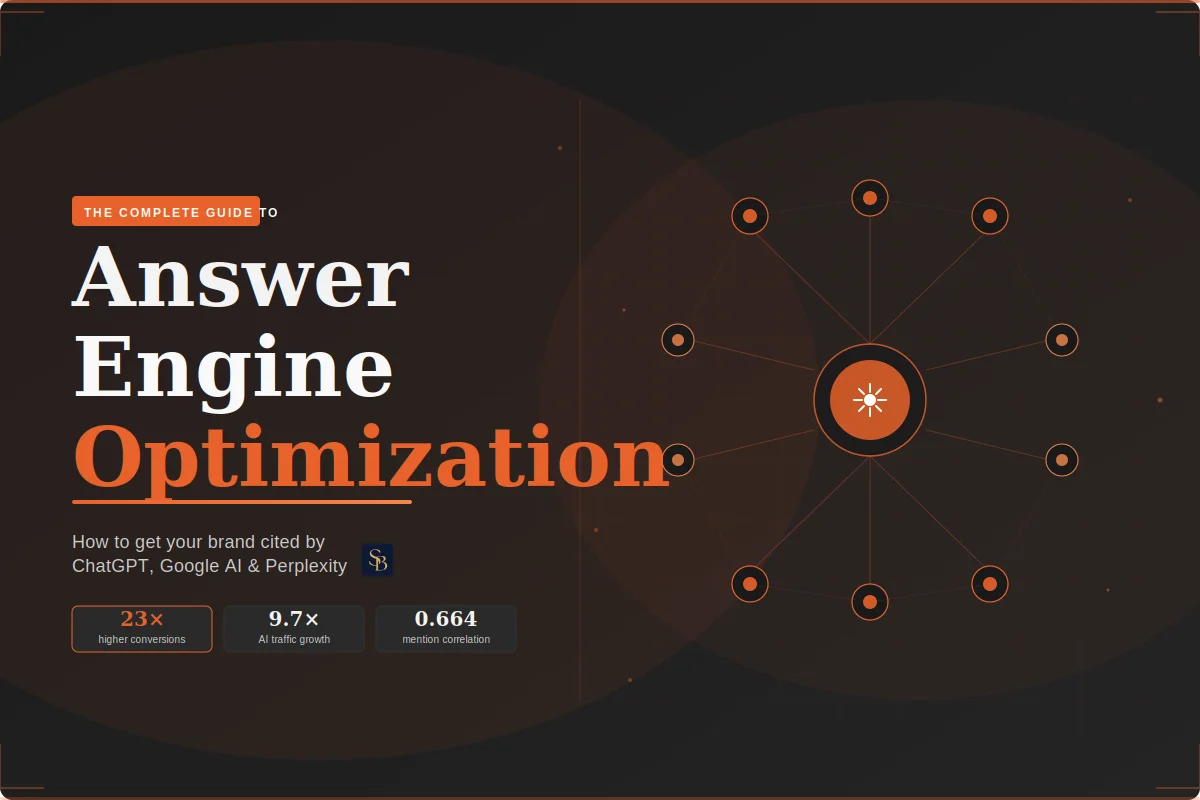
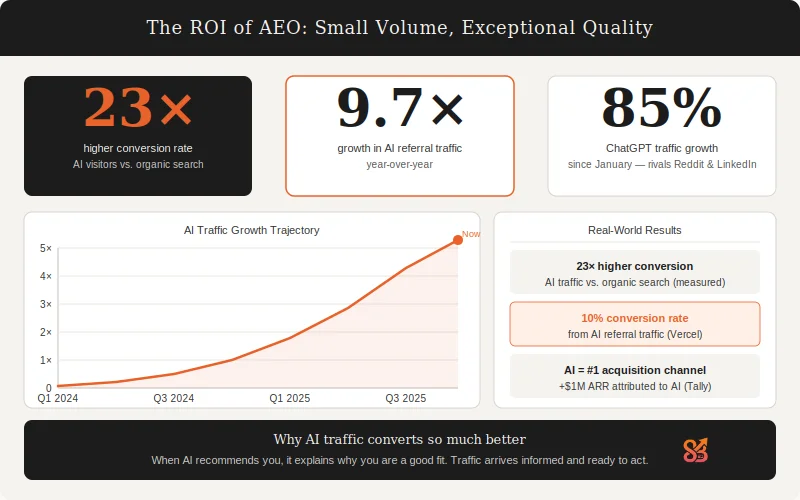
But here is the opportunity most businesses are missing: in one measured period, AI search accounted for just 0.5% of total traffic — yet it drove 12.1% of signups. That is a 23× higher conversion rate than organic search.
This guide explains what Answer Engine Optimization is, how each major AI platform works, and gives you an actionable framework to earn citations, mentions, and brand visibility across the AI search landscape.
What Is Answer Engine Optimization (AEO)?
Answer Engine Optimization — also called Generative Engine Optimization (GEO) or Large Language Model Optimization (LLMO) — is the practice of making your content visible and useful to AI systems that deliver direct answers. That includes Google AI Overviews, ChatGPT, Perplexity, Gemini, Copilot, and any platform where AI generates a response and decides who to cite.
AEO vs. Traditional SEO: What Actually Changes
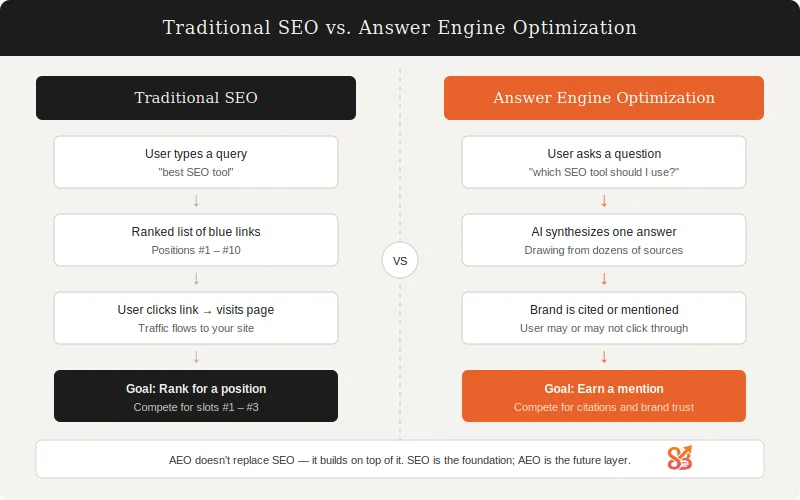
In traditional SEO, you optimize web pages to rank higher in a list of results. Users see your blue link, click it, and land on your site. You compete for positions.
In AEO, there is no list. The AI reads from dozens of sources, synthesizes an answer, and decides who to mention or cite. You are not competing for a position — you are competing for a mention.
AEO does not replace SEO. It builds on top of it. Think of SEO as the foundation and AEO as future-proofing your online presence. Quality content, authority, and technical health still matter — but the strategy must evolve.
How AI Search Engines Actually Work
Two Sources of Information
AI search engines draw on two fundamentally different sources:
- Training data — a static snapshot of the internet (books, websites, PDFs, YouTube transcripts) that the model was trained on. This gives AI its general knowledge but is updated only every several months. A product you launched last week is not in it yet.
- Real-time retrieval (RAG — Retrieval Augmented Generation) — when a question is too specific or too fresh for training data, the AI searches the web in real time, pulls back relevant pages, and generates an answer from what it finds.
This means there are two ways to influence what AI says about your brand: (1) be mentioned so widely that your brand is baked into training data, and (2) make sure your content shows up when AI searches the web in real time. The second path is largely traditional SEO.
Query Fan-Out: Why AI Search Is a One-to-Many System
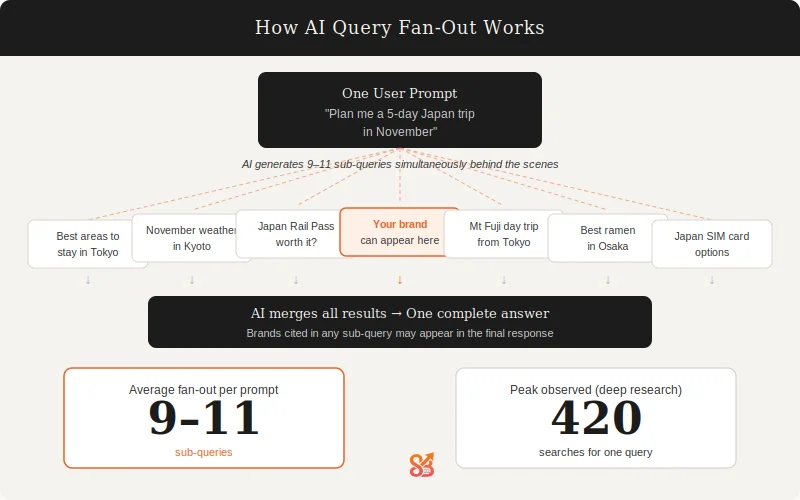
Traditional search was one query → one set of results. AI search flips the model: one prompt expands into many sub-queries simultaneously. For example, the prompt “Plan me a 5-day trip to Japan in November” fans out into dozens of questions: best neighborhoods to stay in Tokyo, November weather in Kyoto, is the Japan Rail Pass worth it, and so on — all running in parallel.
Key Stat: Research shows the average prompt triggers 9–11 fan-out queries, with some reaching as high as 28. ChatGPT’s deep research mode ran 420 searches for a single query about buying a red phone case.
The implication for content strategy is significant. In traditional SEO, you could optimize one page for one keyword. In AI search, you need to be relevant across an entire topic — because if your content on a subject only covers the basics, AI will find someone else’s more comprehensive page.
How AI Decides Who to Cite
AI citations are probabilistic, not fixed. Ask the same question five times and you might be cited three times, your competitor twice. There is no fixed position to rank for. This is why the concept of AI visibility — a probability distribution — is more useful than “AI rankings.”
That said, patterns emerge in what gets cited more often:
- Consensus matters. If multiple sources on the web say the same thing about your brand, AI is more likely to repeat it.
- Freshness matters. AI-cited content tends to be about 25% fresher than what ranks in traditional search results.
- Authority still matters. 76% of AI overview citations come from pages already in Google’s top 10 — though this number has been declining as AI expands its sources.
How Each AI Platform Differs (And Why It Matters)
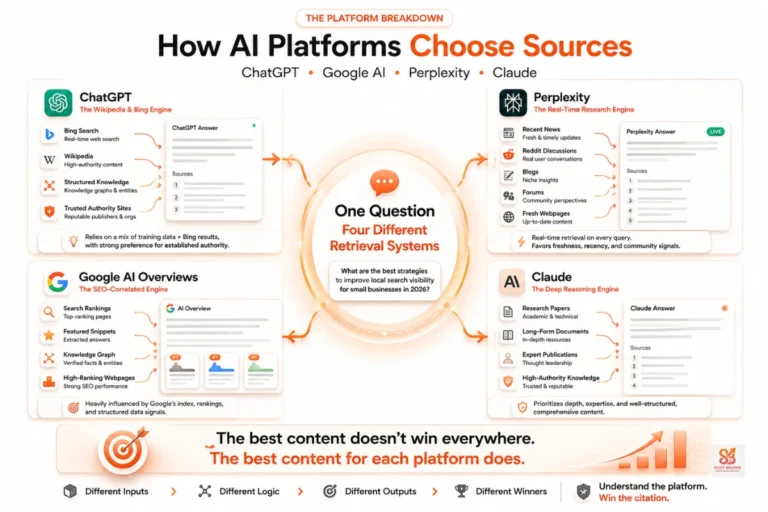
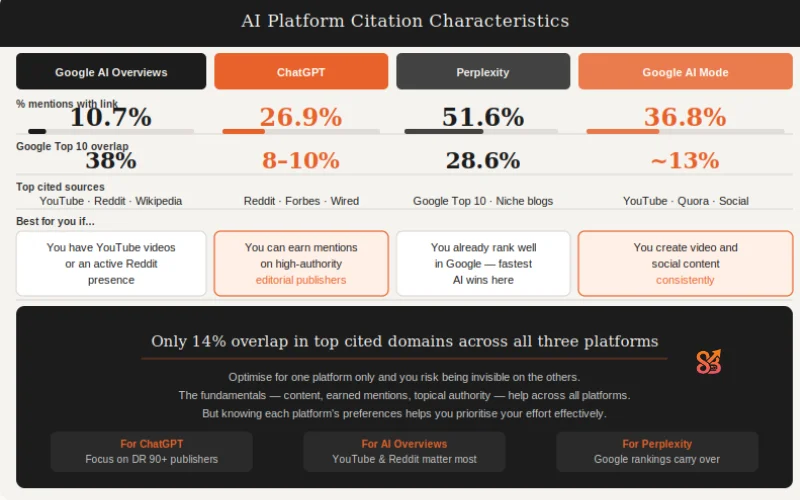
A common mistake is treating AI search as a single, uniform channel. It is not. Research examining the top 50 most-cited domains across Google AI Overviews, ChatGPT, and Perplexity found that only 7 appeared on all three platforms — a 14% overlap. Optimizing for one platform while ignoring the others means being potentially invisible to most AI traffic.
Google AI Overviews
- Favors authoritative, established sites — especially in health, finance, and encyclopedic content.
- YouTube accounts for about 5.6% of all AI Overview citations. The platform is rapidly expanding its use of video in AI responses.
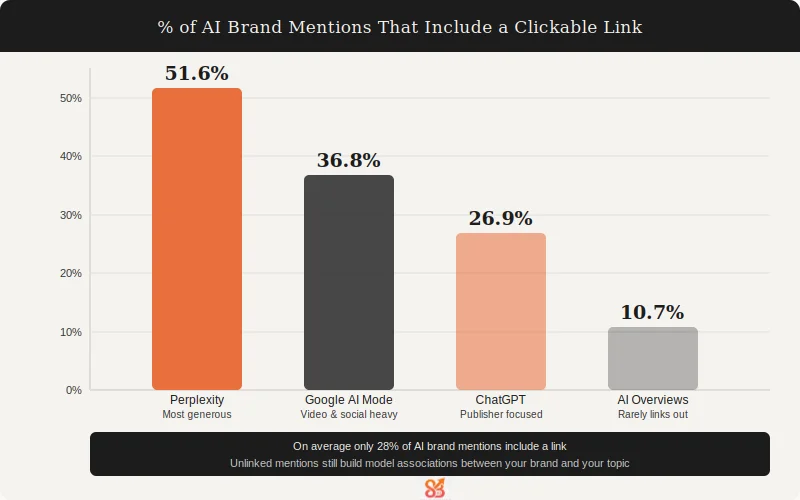
- Only 10.7% of brand mentions in AI Overviews include a clickable link.
ChatGPT
- Leans heavily toward publishers and media. Top cited domains include Reddit, Wikipedia, Forbes, Business Insider, and Wired.
- The median domain rating of ChatGPT’s top-cited pages is 90 — making publisher mentions more valuable than your own site’s Google ranking for this platform.
- Overlaps with Google’s top 10 only 8–10% of the time.
Perplexity
- Most aligned with traditional Google search — 28.6% of Perplexity citations come from pages ranking in Google’s top 10.
- If you are already ranking well in Google, Perplexity is where you will see the most immediate AI visibility gains.
- Most generous with links: 51.6% of brand mentions in Perplexity include a clickable citation.
Google AI Mode
- Despite being a Google product, AI Mode shares only 13.7% citation overlap with AI Overviews — even though their answers are 86% semantically similar.
- Top cited domain is YouTube by a wide margin. Also cites Quora 3.5× more than AI Overviews and pulls heavily from social platforms like Facebook and Instagram.
The Three Types of AI Visibility
Most people think AI visibility is binary — you either get a link or you do not. In reality, it falls into three categories:
- Cited and linked — AI includes a clickable link to your page. Best for direct traffic and easiest to measure.
- Mentioned but not linked — AI names your brand without a link. No direct traffic, but real brand exposure at scale. Users who see your name will often search for it directly.
- Not visible at all — AI does not mention or link to you. This is the gap you are trying to close.
On average, only about 28% of AI brand mentions include a link. That means roughly 7 out of 10 times your brand comes up in an AI response, there is no link attached.
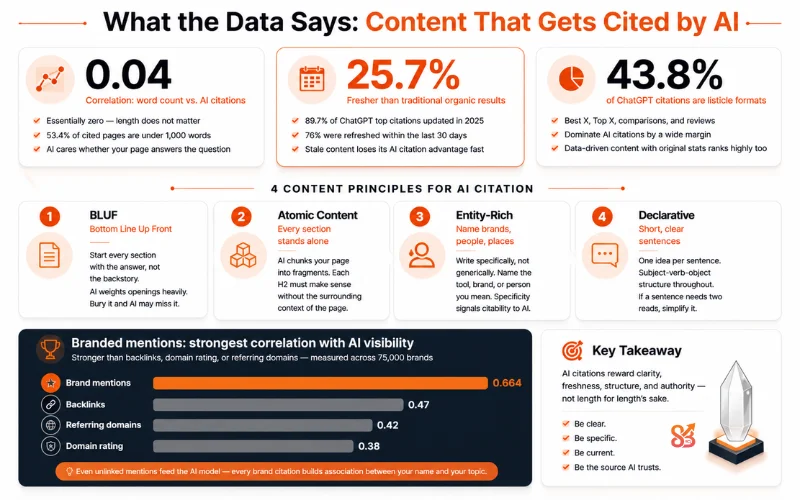
But unlinked mentions are not worthless. In a study of 75,000 brands, branded web mentions had the strongest correlation with AI visibility — a 0.664 correlation with showing up in AI Overviews. That is stronger than backlinks, domain rating, or any other traditional SEO metric. Every mention, whether linked or not, feeds the model’s associations between your brand and a topic.
AEO Strategy: How to Find Your Gaps
Step 1: Map Your Branded Entities
Your brand gets referred to differently by different people. Before auditing your visibility, map out:
- Your main brand name
- Sub-brands and product names
- Proprietary features or metrics
- Personal brands associated with your company
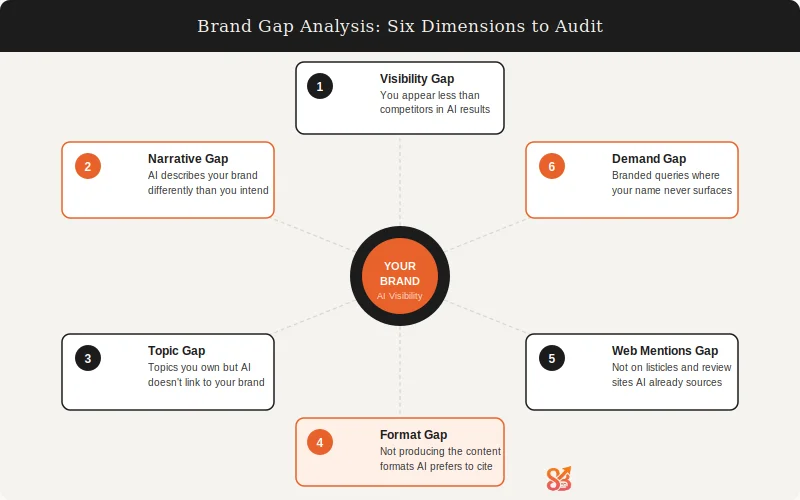
Step 2: Run Your Brand Gap Analysis Across Six Dimensions
Look at your brand’s visibility across these six gap types:
- Visibility gap — you appear less often than competitors in search or AI results.
- Narrative gap — AI or media describes your brand differently from how you want to be positioned.
- Topic gap — topics you should be associated with but are not (e.g., you are a project management tool but AI never mentions you for remote team collaboration).
- Format gap — AI tends to cite guides, videos, reviews, and comparison pages. If you are not producing these formats, that is a gap.
- Web mentions gap — external sources that mention competitors but not you.
- Demand gap — branded queries where your name never surfaces alongside relevant searches.
Keyword and Prompt Research for AEO
Not all keywords deserve the same treatment in an AI-first world. Before committing to a keyword, apply what we call the BID formula:
- B — Business Potential: Does ranking for this keyword actually help your business? A keyword like “what is espresso” has volume but almost no buyer intent. “Best espresso machine under $500” does.
- I — Intent: Google the keyword and check what is ranking. If all top results are e-commerce pages and you want to rank a blog post, the intent mismatch will work against you.
- D — Difficulty: Check the domain rating and backlinks of top-ranking pages. If every result is a high-DR authority site, look for opportunities where low-DR sites appear in the top 10.
The AI Filter: One More Question Before You Commit
Even if a keyword passes BID, ask: can AI fully satisfy the user for this query? AI Overviews appear on about 21% of all keywords — but for informational queries it is much higher: 58% for question queries, 46% for queries with seven or more words, and 99.9% of AI Overview-triggered keywords are informational in intent.
If the AI Overview fully answers the question, targeting that keyword for organic traffic may not be worth the investment. However, these queries are still worth targeting for AEO — not to earn a click, but to get your brand mentioned inside the AI response itself.
Where AI Has Not Taken Over: Tool Queries
There is an entire category of searches AI cannot yet satisfy: queries where someone needs to actually use something. Search for “backlink checker,””mortgage calculator,” or “word counter” and you will find no AI Overview. AI cannot replace a working tool.
Targeting keywords with modifiers like calculator, checker, generator, tool, template, finder, planner, and maker is a practical way to find queries where the organic click is still intact.
Creating Content That Gets Cited
What the Data Says About Content for AI
Analysis of over 174,000 pages cited in AI Overviews reveals three clear patterns:
- Length does not matter. The correlation between word count and getting cited is just 0.04 — essentially zero. Over 53% of cited pages are under 1,000 words. AI does not care how long your page is. It cares whether it answers the question.
- Freshness matters enormously. Content cited by AI is on average 25.7% fresher than what ranks in traditional organic results. For ChatGPT specifically, 89.7% of its top-cited pages were updated in 2025, and 76% were refreshed within the last 30 days.
- Format matters. 43.8% of all pages cited by ChatGPT are listicles — best X, top X, comparisons, reviews. Data-driven content with original statistics and comparison pages (X vs. Y) also perform disproportionately well.
Four Content Principles That Help Both Humans and AI
- BLUF (Bottom Line Up Front): Start every section with the answer, not the backstory. Both human readers and LLMs weigh the beginning and end of a passage more heavily than the middle. If your key point is buried three paragraphs in, both audiences miss it.
- Atomic Content: Every section should stand on its own. AI systems chunk your content into pieces when processing it. If every section is self-contained, the meaning survives no matter where the chunks fall.
- Entity-Rich Writing: AI understands text by mapping entities and their relationships. Instead of “this tool helps with SEO,” write “[Tool Name] helps you find keywords with low difficulty and high traffic potential.” The more specific and concrete, the more useful your content is when AI is answering a specific question.
- Declarative Sentences: Use short sentences with clear subject-verb-object structure. One idea per sentence. If a sentence takes two reads to understand, simplify it.
Refreshing Sleeper Pages for AI Visibility
Pages that used to rank well but have slowly declined already have the backlinks and authority — they just need a refresh. Because freshness is such a strong signal for AI citations, updating these pages can be one of the fastest paths to gaining AI visibility.
Identify candidates by sorting your top pages by traffic decline. Look for pages with meaningful backlinks (the authority is there) combined with a clear traffic drop (a sign the content has gone stale). Then make meaningful updates — new statistics, updated examples, current information — rather than simply changing the publish date.
Earning Mentions and Citations From Other Sites
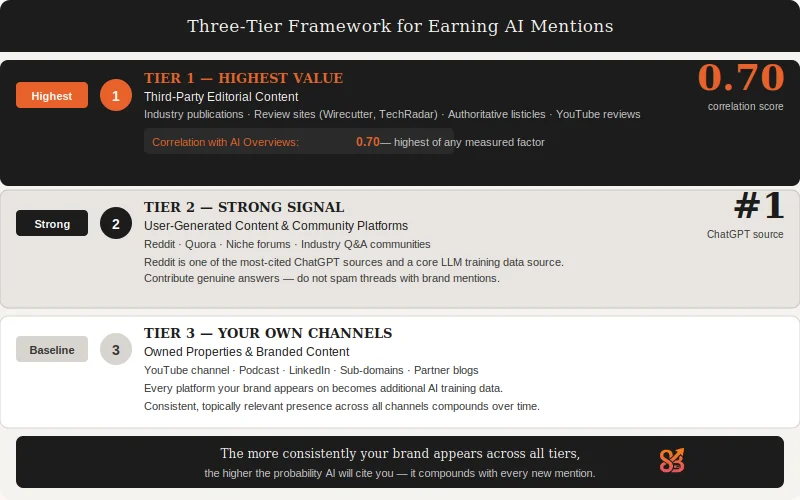
A significant portion of AEO happens off your own site. Getting mentioned on the pages AI already pulls from is at least as important as optimizing your own content. Getting mentioned on highly linked pages has a 0.7 correlation with appearing in Google’s AI Overviews — higher than the general branded mentions correlation.
Tier 1: Third-Party Editorial Content
Industry publications, review sites (like Wirecutter or TechRadar), listicles and comparison posts on authoritative blogs, and YouTube reviews from creators in your space are the most valuable mention sources. These are exactly the pages AI loves to cite — 43.8% of ChatGPT citations are already listicles and comparison pages.
To find the right pages, look at which sites AI is already citing for topics related to your brand, then identify which pages mention competitors but not you. Use search operators like “title:best [category] -[your brand]” to surface listicles in your niche where you are absent, then prioritize by referring domains.
Tier 2: User-Generated Content and Community Platforms
Reddit is one of the most frequently cited sources by ChatGPT and one of the foundational training sources for large language models. Quora and niche forums also carry weight.
The right approach is not to spam threads with your brand. Find threads where people are asking questions your product genuinely answers and contribute a real, useful response. Find high-ranking Reddit threads in your niche by filtering the site’s organic rankings for your niche terms — then participate in the conversations already happening.
Tier 3: Your Own Channels
Your YouTube channel, podcast, and LinkedIn content are all indexed and can show up as sources AI pulls from. The more places your brand appears in a positive, topically relevant way, the more training examples AI has to learn from.
YouTube Optimization for AI Visibility
YouTube is the most cited domain in Google’s AI Overviews, and YouTube mentions have a 0.737 correlation with ChatGPT visibility — the strongest correlation of any single factor studied. One major AI model was trained on over a million hours of YouTube transcripts, meaning YouTube is not just a platform AI cites; it is one AI learns from.
Target Search Hits, Not Viral Hits
A viral hit spikes and dies when the algorithm exhausts the interested audience. A search hit generates consistent traffic from both Google and YouTube search month after month — and is exactly the kind of video AI is likely to pull from.
Find these topics by identifying keywords where YouTube videos are already ranking in the top three of Google’s results in your niche. If Google trusts a YouTube video enough to rank it prominently, AI Overviews are likely to surface it too.
The Video Ranking Checklist
- Title: Include the target keyword directly. Save creativity for the thumbnail. The title handles the keyword; the thumbnail sells the click.
- Description: Write a real summary of the video. Include your target keyword in the first two lines. Google, AI, and viewers all read it.
- Timestamps: Turn your video into chapters. Individual chapters can rank in Google for specific sub-queries, giving you free extra visibility for about two minutes of work.
- Say the keyword: Google understands audio. If your video is about the best protein powder for recovery, actually say those words in the video.
- Match format to intent: If tutorials dominate results for your keyword, make a tutorial. Match what is already working for that query’s intent.
Technical AEO: Making Sure AI Can Find You
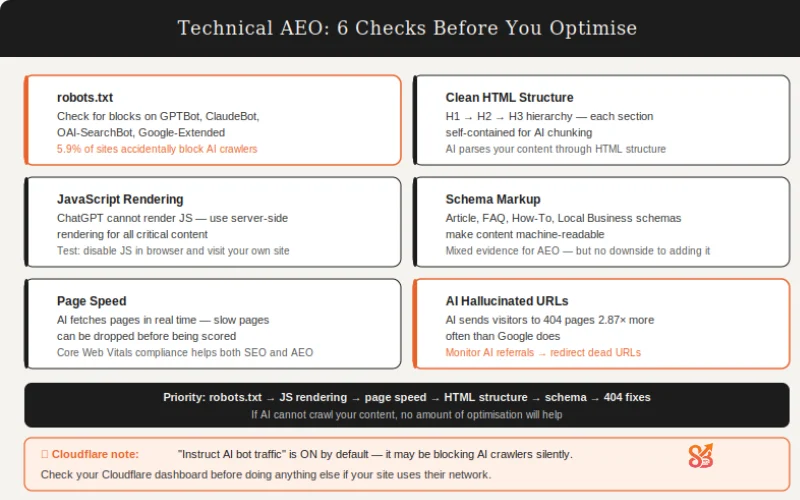
Around 5.9% of 140 million websites are blocking GPTBot — OpenAI’s crawler. That is millions of sites that are invisible to ChatGPT. Before worrying about content strategy, confirm AI can actually access your site.
Six Technical Checks
- Robots.txt: Check for disallow rules blocking GPTBot (OpenAI), OAI-SearchBot (OpenAI), ClaudeBot (Anthropic), and Google-Extended. Note: Cloudflare has a setting called “Instruct AI bot traffic with robots.txt” that is now enabled by default — it may be blocking AI crawlers without your knowledge.
- JavaScript rendering: ChatGPT’s crawler does not render JavaScript. If your content relies on JS to load (common with React or Angular single-page apps), ChatGPT sees an empty shell. Server-side rendering solves this. Test by disabling JavaScript in your browser and visiting your own site.
- Page speed: When AI systems retrieve information in real time, they fetch, parse, and chunk pages on the fly. Slow pages can get dropped before they are even scored.
- Clean HTML structure: AI systems parse content by following HTML structure. Logical headings (H1 → H2 → H3), organized sections, and focused paragraphs make it easier to extract the right information.
- Schema markup: Evidence that schema directly improves AI citations is mixed, but implementing article schema, FAQ page, how-to, and local business markup makes content easier for any system to understand and does not hurt.
- AI hallucinated URLs: AI assistants send visitors to 404 pages 2.87× more often than Google search does. ChatGPT is the biggest offender, with roughly 1% of its clicked URLs leading to dead pages. Monitor AI referrals that return 404 status and set up redirects to relevant pages.
Measuring AI Visibility: Three Tracking Methods
1. AI Referral Traffic
Track visits from ChatGPT, Perplexity, Claude, Gemini, and Copilot in your analytics. A key caveat: not all AI platforms pass referral data correctly. ChatGPT’s source links pass referral data but in-content links on paid accounts use a no-referral attribute. Perplexity tracks on the web but not on its desktop app. Grok passes no referral data at all. Treat AI referral traffic as a directional indicator — almost certainly an undercount.
2. AI Bot Activity on Your Site
AI bots visit your pages far more often than humans do. The pages they hit most frequently are likely your strongest citation candidates. Two types matter: training bots (like GPTBot and Google-Extended) that consume your content for model training, and search/citation bots (like ChatGPT-User) that fetch your pages in real time when a user asks a question.
3. Self-Reported Attribution
Much of AI’s impact never shows up in analytics. Someone asks ChatGPT for a recommendation, hears your brand name, then goes directly to their browser and types your URL — that registers as direct traffic. Or they Google your brand name after hearing it from AI — that registers as branded organic.
The only way to capture this is to ask. Add a “How did you hear about us?” question to your signup flow, checkout process, or post-purchase survey. Include options for AI assistant and AI search. This self-reported data, while imperfect, is the most direct way to connect AI visibility to actual business results — and without it, you may be significantly underestimating AI’s contribution to your growth.
Is AEO Worth It? The ROI Case
Raw traffic numbers from AI are still small. AI referral traffic accounts for about 0.25% of a site’s total traffic on average. Google still sends about 210× more traffic than the top AI platforms combined.
But here is what those numbers miss. AI visitors convert at dramatically higher rates. In one measurement period, AI visitors converted at 23× the rate of organic search visitors. One platform saw 10% conversion rates from AI traffic. Another company attributed a $1 million ARR increase directly to AI being its largest acquisition channel.
The reason is structural. When AI recommends your product, it explains to the user why you are a good fit before they arrive. The traffic arrives pre-qualified. They are not browsing. They are ready to act.
And the trajectory of the channel itself is significant. AI traffic has grown 9.7× in the past year. ChatGPT alone has grown 85% since January and now sends more traffic than Reddit or LinkedIn. The absolute volume is still modest, but the direction is unmistakable.
Your AEO Action Plan: Where to Start
This Week
- Check your robots.txt. This takes five minutes and is the most common technical blocker. Confirm GPTBot, OAI-SearchBot, ClaudeBot, and Google-Extended are not disallowed.
- Set up AI analytics. Create an AI traffic channel group in Google Analytics 4, or use a web analytics tool with a built-in AI search channel. Add a “How did you hear about us?” question to your signup or checkout flow.
- Update your five most important pages. Make meaningful updates — new statistics, updated examples, current information. Content cited by AI is 25.7% fresher than what ranks organically.
- Run your brand gap analysis. Know where you stand across the six gap dimensions before you start optimizing.
- Identify your top 10 mention targets. Find the editorial pages, listicles, and comparison posts in your niche where getting mentioned would have the biggest impact on AI visibility.
Ongoing
- Monthly: Review AI share of voice, cited domains, topic coverage, and mention sentiment.
- Quarterly: Run a deeper competitive audit to identify where competitors have gained and where your gaps have shifted.
Final Thoughts
AEO is not a replacement for SEO. It is a new layer on top of it. The brands that build that layer now — while AI search is still early — will have a compounding advantage as the channel grows.
The good news is that most businesses have not started yet. The content, authority, and technical foundation you have already built through SEO gives you a head start. The question is whether you will use it.
Start with the five actions above. Check your robots.txt, set up your analytics, refresh your most important pages, run your brand gap analysis, and identify your top mention targets. Everything else in this guide builds from there.