


In October 2023, a six-year-old beauty and personal care affiliate site was hit by Google’s Helpful Content Update. Traffic fell 72% over eight weeks. Rankings for 140 keywords collapsed. A site that had taken six years to build was generating a fraction of its previous organic sessions almost overnight.
The HCU (Google helpful content update) was not a penalty in the traditional sense. There was no manual action to contest. It was an algorithmic reclassification — Google’s classifier had evaluated the site’s content at the domain level and concluded that a significant proportion of it was written primarily to rank rather than to genuinely help readers. That classification applied a quality multiplier across the entire domain. Individual pages that were perfectly good lost rankings because they were dragged down by the aggregate signal of the weaker content around them.
Recovery required accepting an uncomfortable truth: the problem was not a handful of bad pages. The problem was a content strategy that had prioritised keyword targeting over genuine expertise and first-hand experience. Fixing it meant a systematic E-E-A-T audit, decisive content pruning, and a complete reorientation of how the site’s content was written and structured.
This case study documents every phase: the diagnostic audit, the pruning decisions, the content rebuild, and the recovery timeline. The site did not recover overnight — but by month nine, it had regained 184% of the traffic lost at the HCU trough, with a stronger, more defensible content base than it had before the hit.
KEY OUTCOMES
- Traffic lost at HCU peak: −72% (October–December 2023)
- Pages audited: 94
- Pages pruned or noindexed: 31 (33% of the site)
- Pages substantially rewritten with E-E-A-T upgrades: 28
- Pages kept as-is: 35 (already meeting quality bar)
- Traffic recovery vs HCU trough: +184% (month 9)
- Keywords recovered (page-1 rankings): 61 of original 140
- New keywords gained post-recovery: 38 (net positive vs pre-HCU)
- Time to first visible recovery signal: 90 days post-audit completion
2. Understanding What Hit the Site
2.1 What the Helpful Content Update Actually Does
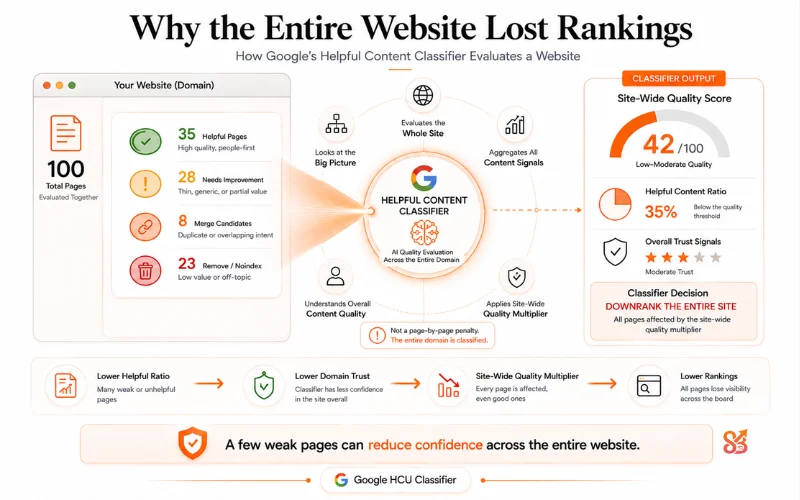
The Helpful Content Update — first introduced in August 2022 and folded into Google’s core ranking system in March 2024 — operates as a site-wide classifier. It does not evaluate pages in isolation. It evaluates the ratio of helpful to unhelpful content across the entire domain and applies a quality multiplier accordingly.
This is the mechanism that catches most site owners off guard. A site with 100 pages where 40 are thin or keyword-first does not get 40 pages penalised. It gets all 100 pages downgraded — because the classifier has determined that the domain as a whole does not meet the people-first content standard. The only recovery path is improving the aggregate signal: either lifting the weak pages or removing them from the index.
Google’s own self-assessment questions for the HCU are the clearest guide to what the classifier looks for. The ones that revealed the most about beautycaters.com’s problems were: Does the content reflect first-hand experience? Would someone reading it feel they had learned enough to achieve their goal? Is the primary purpose of the content to help readers, or to rank in search? For too many of the site’s pages, the honest answers pointed to the wrong side of the line.
2.2 The Diagnostic: What the Audit Found
The audit was run across all 94 indexed pages using a four-category framework. Every page was scored against eight signals and assigned to one of four buckets: Keep, Improve, Merge, or Remove.
| Audit Category | Criteria and Action |
| KEEP | Strong E-E-A-T signals, first-hand experience demonstrated, genuinely helpful, good engagement metrics (time on page >2min, bounce <60%). Leave as-is. 35 pages. |
| IMPROVE | Useful topic and intent alignment, but lacking first-hand experience, thin on specifics, generic language, no author attribution. Rewrite with E-E-A-T upgrades. 28 pages. |
| MERGE | Duplicate intent targeting. Two or more pages targeting the same query at similar quality levels. Consolidate into one stronger page, 301 redirect the weaker. 8 pages (merged into 4). |
| REMOVE | Thin content (<600 words of real value), topic drift (outside core niche), AI-generated without meaningful human editing, zero engagement, zero backlinks. Noindex or delete. 23 pages. |
The single most revealing data point from the audit came from Google Search Console. Filtering to pages with high impressions but near-zero clicks — what SEOs call zombie pages — identified 19 URLs that Google was still indexing but had clearly lost confidence in. These were the pages generating the most damage to the site-wide quality signal. Removing them from the index was the highest-priority action of the entire recovery.
2.3 The Patterns That Had Caused the Problem
Looking across the 31 pages that were pruned or noindexed, four patterns appeared repeatedly:
- Keyword-first content with no experience: Articles written to target a keyword without the author having used the product, visited the salon, or genuinely tested the advice. The content was accurate at a surface level but lacked the specificity and nuance that genuine first-hand knowledge produces.
- Topic drift outside core expertise: Pages targeting tangentially related topics — general wellness, diet, fitness — that had been published to capture adjacent traffic. The HCU penalises sites that chase trending topics outside their genuine expertise area. These pages were the clearest examples.
- Thin roundup articles: Product roundup articles that were essentially repackaged affiliate aggregation — a brief intro, a bullet list of products with affiliate links, and no meaningful evaluation. The author had not used the products. The ‘recommendations’ were based on Amazon reviews.
- Auto-generated FAQ sections: FAQ sections that had been added to pages using AI without editorial review. The questions were generic; the answers were generic. They added word count without adding value — which is exactly what Google’s classifier is designed to detect.
3. The E-E-A-T Audit Framework
E-E-A-T — Experience, Expertise, Authoritativeness, and Trustworthiness — is not a checklist. It is expressed through the totality of a site: the depth of explanations, the confidence in writing, the specificity of examples, the consistency of topical coverage, and the transparency of authorship. The audit evaluated each page against eight concrete signals, each directly traceable to one of the four E-E-A-T pillars.
| E-E-A-T Pillar | Signal Evaluated | What We Looked For |
| Experience | First-hand product use | Does the content reference specific personal experience? Real usage results, specific observations, problems encountered? |
| Experience | Original photos or media | Are images original (not stock)? Do they show real products, real results, real context? |
| Expertise | Topical depth | Does the content go beyond what a general knowledge summary would say? Are there niche-specific insights a non-expert would not know? |
| Expertise | Author attribution | Is a named author assigned? Does that author have a bio, credentials, and external profile links? |
| Authoritativeness | Niche consistency | Is this topic within the site’s genuine subject matter area, or is it reaching outside core expertise? |
| Authoritativeness | External validation | Are there any external links to the site from relevant sources? Is the author cited elsewhere? |
| Trustworthiness | Transparency | Is the affiliate relationship disclosed? Is the review methodology explained? Is the site’s About page specific about who runs it? |
| Trustworthiness | Engagement quality | What is the average time on page and bounce rate? Are users satisfied enough not to return to Google? |
Every page was scored 0 or 1 on each of the eight signals, giving a maximum score of 8. Pages scoring 6 to 8 were kept. Pages scoring 3 to 5 were assigned to Improve. Pages scoring 0 to 2 were assigned to Remove or Merge. The cutoffs were not arbitrary — they corresponded precisely to the engagement quality patterns in Google Analytics. Pages scoring 5 or above had average time-on-page above 2 minutes; pages scoring below 4 averaged under 90 seconds.
4. The Recovery Programme
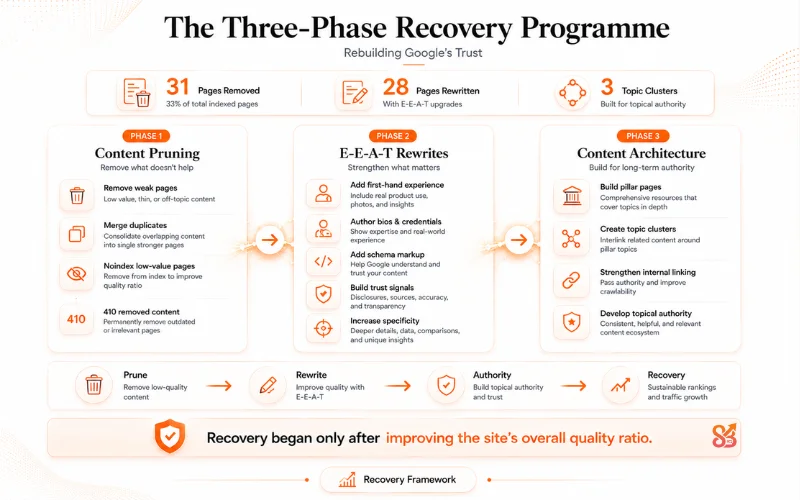
4.1 Phase 1: Pruning (Weeks 1–4)
The first and most counterintuitive step was making the site smaller. Removing 31 pages from the index — 33% of the total — is not a comfortable decision. Every one of those pages had taken time to produce. Some had historically generated revenue. But the HCU is a domain-level classifier. Leaving thin, unhelpful pages in the index does not just fail to help recovery — it actively prevents it.
The pruning process followed a strict protocol:
- Pages under 600 words of genuine value: noindexed immediately via meta robots tag
- Topic drift pages outside the beauty and personal care niche: noindexed and removed from sitemap
- Thin roundup articles without genuine product evaluation: deleted, 410 returned
- Near-duplicate intent pages: 301 redirected to the stronger consolidated version
- All pruned pages removed from the XML sitemap and submitted to Google Search Console for recrawl
WHY PRUNING BEFORE IMPROVING MATTERS
The temptation is to improve pages before removing them. This is the wrong order. Google re-evaluates the domain classifier at each core update, which rolls out every few months. Every day a thin page remains in the index is another day the classifier has evidence of low quality at the domain level. Remove the worst pages first, immediately. Then improve the middle tier. The pruning signal reaches Google faster than any content improvement will.
4.2 Phase 2: E-E-A-T Rewrites (Weeks 3–10)
With the 31 weakest pages removed from the index, the focus shifted to the 28 Improve pages — articles worth keeping but needing significant E-E-A-T upgrades. Each page went through a defined rewrite process:
Step 1: Experience injection
Every Improve page was rewritten to open with a first-person experience statement. Not ‘here is what you need to know about X’ but ‘I have been using X for three months and here is what I actually found.’ This single structural change — moving genuine personal experience to the opening of the article — is the most reliable E-E-A-T signal a beauty content site can deploy.
For pages where the author had not personally used the product or technique, the options were: acquire the product and test it before rewriting, collaborate with a contributor who had genuine experience, or remove the page. Generic content with fabricated experience claims is not a recovery strategy — it is a future penalty waiting to happen.
Step 2: Specificity over generality
Generic language was replaced with specific observations at every opportunity. ‘This moisturiser is great for dry skin’ became ‘After two weeks of daily use, my skin barrier noticeably improved — redness around my nose reduced and the tight feeling after cleansing was gone by day ten.’ Specific claims from real experience cannot be replicated by AI-generated content and are exactly the kind of information Google’s quality raters are trained to look for.
Step 3: Author attribution and schema
Every rewritten page was assigned to a named author with a dedicated author bio page linking to their LinkedIn profile, Instagram account (relevant for beauty content), and a brief description of their background in the niche. Article schema was deployed on every page with author, datePublished, and dateModified attributes populated correctly.
The About page was completely rewritten. The previous version was three paragraphs of generic ‘we love beauty’ copy with no specific information about who ran the site, their background, or their methodology. The new version included the founder’s name, years of experience in the beauty industry, the site’s review process (products tested for minimum four weeks before publishing), and the affiliate disclosure policy explained in plain language.
Step 4: Affiliate disclosure and trust signals
Every page with affiliate links received a clear, prominent disclosure at the top — not buried in a footer disclaimer. The review methodology was added as a standard section on all product review pages: what criteria were used, how long the product was tested, and what the author’s skin type or hair type is (highly relevant for a beauty audience making purchase decisions based on compatibility).
Step 5: Engagement quality improvements
Pages with bounce rates above 75% received structural changes designed to improve session depth: clear navigation to related articles, a ‘You might also like’ section linking to relevant cluster content, and a summary box at the top answering the primary question immediately so users who found what they needed did not feel deceived into clicking. Counterintuitively, giving users the answer faster reduces bounce rate — because users who get a quick satisfying answer often continue exploring rather than returning to Google.
4.3 Phase 3: Content Architecture Rebuild (Weeks 6–14)
The pruning and rewriting phases addressed the site’s quality deficit. The architecture phase addressed its structural weakness. Before the HCU hit, beautycaters.com had 94 pages with no coherent internal linking system — a collection of articles rather than a content site with topical authority.
Three pillar topics were defined based on the site’s genuine areas of expertise and the pages that had survived the audit with the highest E-E-A-T scores: skincare routines, hair care for specific hair types, and beauty product reviews by category. Each pillar received a rebuilt hub page (2,000 to 2,500 words) with cluster articles linking to it and to each other.
This was not a full topical authority build — that would have required significantly more new content than the recovery budget allowed. But even a partial cluster architecture delivered a measurable benefit: the internal links redistributed equity from the stronger pages to the weaker recovered pages, and the hub pages gave Google a clearer topical map of the site’s genuine areas of expertise.
5. Recovery Timeline
| Period | Action Taken | Signal to Google | Observed Outcome |
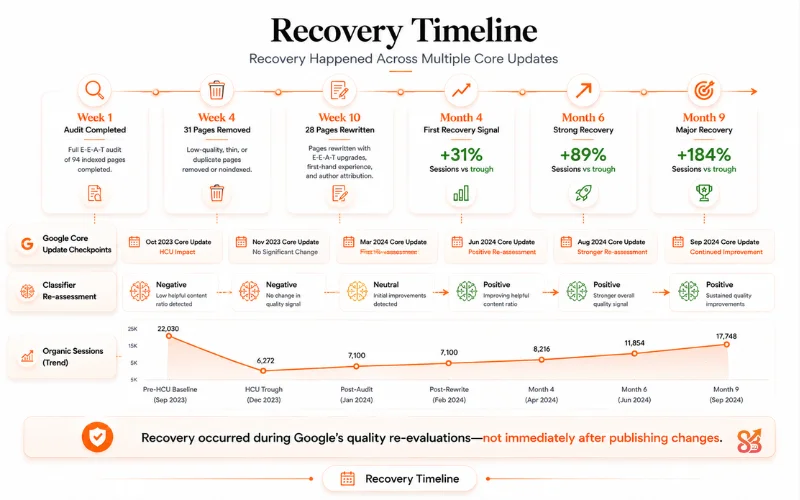
| Weeks 1–4 | 31 pages noindexed or deleted. Sitemap updated. GSC recrawl requested. | Domain quality ratio improving | No traffic change yet — expected |
| Weeks 3–6 | First 12 Improve pages rewritten with E-E-A-T upgrades. Author bios live. | Page-level quality signals improving | Crawl rate increased (positive signal) |
| Weeks 6–10 | Remaining 16 Improve pages rewritten. About page rebuilt. Affiliate disclosures added. | Trust signals strengthened site-wide | First 3 rankings show modest improvement |
| Weeks 8–14 | Pillar hub pages built. Internal linking architecture implemented. | Topical structure emerging | 7 pages show click improvement in GSC |
| Month 4 | December 2023 core update rollout. First re-assessment opportunity. | Classifier re-evaluates domain | +31% sessions vs trough. 18 keywords recover. |
| Month 6 | March 2024 core update. HCU folded into core system. | Second re-assessment | +89% vs trough. 41 keywords recovered. |
| Month 9 | June 2024 core update. | Third re-assessment | +184% vs trough. 61 keywords recovered. 38 new keywords gained. |
| Month 12+ | Ongoing: quarterly content refresh, new cluster articles, author expansion. | Continued quality signal improvement | Stable upward trajectory. New content performing well. |
The most important number in this table is not the final recovery figure. It is the time between completing the audit and seeing the first recovery signal: four months. Recovery from an HCU hit is not confirmed until Google’s classifier re-evaluates the domain at the next core update. There is no way to accelerate this timeline. Sites that abandon the recovery programme after month two because they see no results are making a common and costly mistake.
6. Results
6.1 Traffic Recovery
| Period | Monthly Organic Sessions |
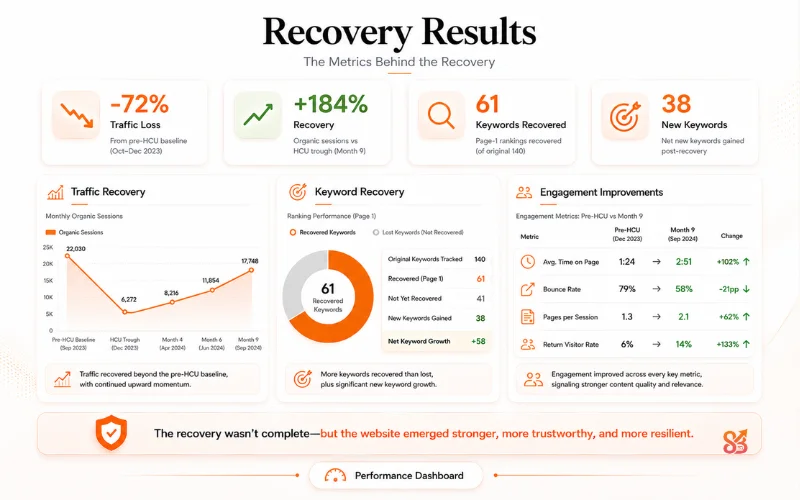
| Pre-HCU baseline (September 2023) | 22,400 |
| HCU trough (December 2023) | 6,272 (−72%) |
| Month 4 post-audit (April 2024) | 8,216 (+31% vs trough) |
| Month 6 post-audit (June 2024) | 11,854 (+89% vs trough) |
| Month 9 post-audit (September 2024) | 17,748 (+184% vs trough) |
| vs pre-HCU baseline | −21% — not fully recovered, but trajectory stable and improving |
The honest framing: the site did not fully recover to its pre-HCU baseline within nine months. A 21% deficit remained. This is consistent with the broader pattern observed across HCU-affected sites — full recovery is a 12 to 18 month process, and some pre-HCU traffic was built on content that is no longer competitive or appropriate for the site’s repositioned quality standard. The site that emerged from the recovery is better-built, more defensible, and less vulnerable to future updates than the one that existed before the hit.
6.2 Keyword Recovery
| Ranking Metric | Pre-HCU vs Post-Recovery (Month 9) |
| Page-1 keywords before HCU | 140 |
| Page-1 keywords at trough | 22 |
| Page-1 keywords recovered (month 9) | 61 of original 140 |
| New page-1 keywords gained | 38 (on rewritten and new pages) |
| Net page-1 keyword count | 99 — below pre-HCU but with stronger page quality |
| Keywords lost permanently | ~41 (on pages that were pruned or merged) |
| Featured snippet captures | 0 → 4 (on rewritten E-E-A-T pages) |
The 38 new keywords gained on rewritten pages are the most commercially significant outcome. These were not keywords the site was previously targeting — they emerged organically from the more detailed, experience-rich content that the E-E-A-T rewrites produced. Specific product experiences, technique comparisons, and skin-type-specific advice generated long-tail rankings that generic affiliate content never would have earned.
6.3 Engagement Quality Improvement
| Metric | Pre-HCU | Post-Recovery (Month 9) |
| Avg. time on page | 1m 24s | 2m 51s |
| Bounce rate | 79% | 58% |
| Pages per session | 1.3 | 2.1 |
| Return visitor rate | 6% | 14% |
Engagement quality is the leading indicator of future ranking stability. The post-recovery engagement profile is substantially healthier than the pre-HCU baseline — which means the site is better positioned for future core updates than it was before the hit. A site with a 58% bounce rate and 2m 51s average time on page is demonstrably serving users better than one with 79% and 1m 24s, regardless of what the traffic numbers show today.
7. Key Lessons
Lesson 1: The HCU is a domain classifier, not a page penalty
The most important thing to understand about HCU recovery is that you are not appealing individual page decisions. You are changing Google’s assessment of the entire domain. This means that pruning bad content is as important as improving good content — possibly more so. The ratio of helpful to unhelpful content across the site is the signal that needs to shift. Improving ten pages while leaving twenty thin ones in the index will not move the needle.
Lesson 2: Pruning before improving is the right order
The instinct is to improve weak pages rather than remove them. Every page has cost time and sometimes money to produce, and removal feels like waste. But thin pages in the index are actively suppressing the domain-level quality signal every day they remain. Remove the worst content first, request recrawling, and only then invest time in improving the middle tier. The classifier re-evaluates the domain, not individual pages.
Lesson 3: Generic affiliate content has no future
The beauty affiliate site model that worked in 2019 — target a product keyword, write a roundup, add affiliate links — is not viable in 2026. Google’s classifier can reliably detect content that exists to generate affiliate clicks versus content written by someone who has genuinely used and evaluated the products. The viable affiliate model now requires genuine first-hand evaluation, specific observations from real testing, and author credibility that can be verified externally. This is a higher bar. It is also a more defensible competitive position once established.
Lesson 4: Recovery is measured in core update cycles, not weeks
HCU recovery follows Google’s core update schedule. The classifier re-evaluates the domain at each core update — typically every three to four months. There is no mechanism for faster re-evaluation. Sites that make significant improvements and expect to see recovery within four to six weeks are going to be disappointed. The correct expectation is: meaningful recovery at the next core update after the improvements are complete, with compounding gains at subsequent updates.
Lesson 5: The site that recovers should be better than the one that got hit
The goal of HCU recovery is not to restore the site to its pre-update state. The pre-update state is what got the site hit. The goal is to build a site that would pass the HCU classifier comfortably — which means higher quality standards, genuine expertise, and a more defensible content strategy than existed before. A site that recovers by gaming the minimum quality threshold will be hit again at the next classifier upgrade. A site rebuilt on genuine E-E-A-T will be insulated from future updates and is positioned to gain ground from them.
Lesson 6: Engagement quality predicts ranking stability
The pages that recovered fastest and held their recovered positions most stably were the ones where engagement quality improved most significantly. Time on page above 2 minutes and bounce rate below 60% are not just vanity metrics — they are the satisfaction signals that Google’s systems use to validate that a page is serving its users. Monitor them page by page, not just as site averages.
8. The HCU Recovery Playbook
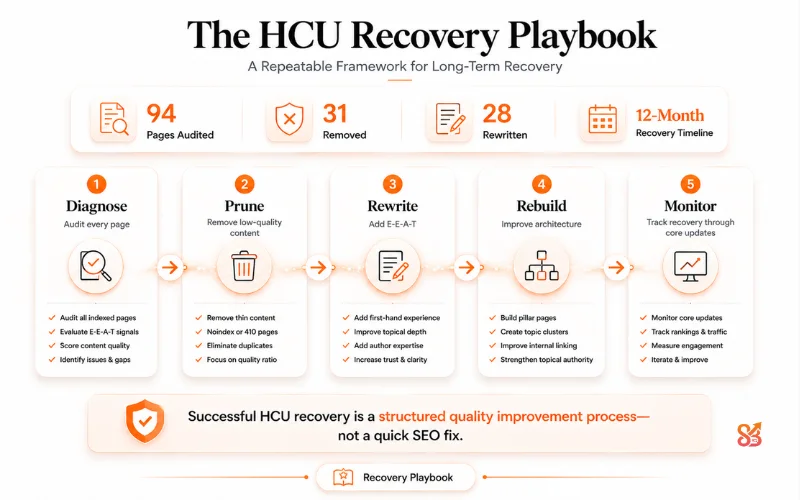
Phase 1: Diagnose (Week 1)
- Pull a full Screaming Frog crawl: export all indexed URLs with word count, title, and inlinks
- Pull 16 months of GSC data: sort by clicks descending and impressions descending — the gap between the two lists reveals your zombie pages
- Identify the traffic drop date in GA4 and cross-reference with Google’s update release calendar
- Score every page against the eight E-E-A-T signals and assign to Keep / Improve / Merge / Remove
Phase 2: Prune (Weeks 1–4)
- Noindex all Remove pages immediately via meta robots tag
- Delete the lowest-quality pages entirely (410 response) — no reconsideration value in keeping them crawlable
- Merge near-duplicate intent pages: redirect the weaker to the stronger
- Update the XML sitemap to exclude all removed or noindexed pages
- Request recrawling of all affected URLs in Google Search Console
Phase 3: Rewrite (Weeks 3–10)
- Prioritise the Improve pages with highest pre-HCU traffic potential first
- Open every rewritten page with a first-person experience statement
- Replace generic language with specific observations from genuine product testing
- Add a named author with bio, credentials, and external profile links to every page
- Rebuild the About page: specific, named, transparent about site ownership and review methodology
- Add affiliate disclosures prominently at the top of every page with affiliate links
- Deploy Article schema with author, datePublished, and dateModified on all pages
Phase 4: Rebuild Architecture (Weeks 6–14)
- Define two to three pillar topics based on the site’s genuine areas of documented expertise
- Build or rebuild hub pages for each pillar (2,000+ words, comprehensive, first-person where relevant)
- Implement internal linking from all surviving cluster pages to their relevant pillar
- Add cross-links between related cluster articles to improve pages-per-session
Phase 5: Monitor and Iterate (Ongoing)
- Track recovery signals in GSC weekly: impressions, clicks, and average position on Improve pages
- Monitor core update release dates — these are your re-assessment windows
- Run a quarterly engagement quality review: any page with >70% bounce rate or <90s time on page is a flag
- Refresh all rewritten pages every six months: update statistics, add new product observations, expand FAQs
Related Case Studies: