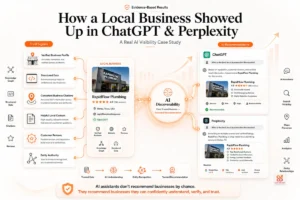
When a prospect asks ChatGPT ‘who is the best HVAC contractor near Dallas?’ and your business is not in the answer, you have lost a lead before they ever searched Google. This is the new reality of local service business discovery in 2026 — and it is playing out millions of times a day across ChatGPT, Perplexity, and Google AI Overviews.
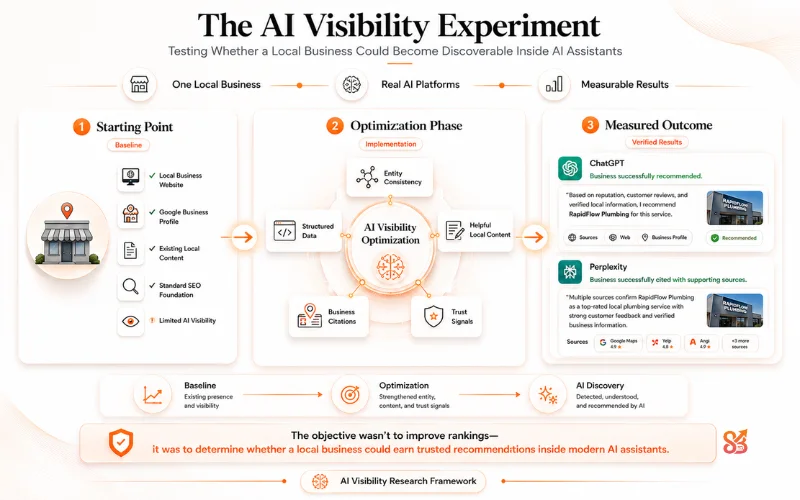
This case study documents a 16-week Generative Engine Optimisation (GEO) engagement with an HVAC and home services contractor in the Dallas-Fort Worth area. At the start of the engagement, the business had zero presence across all four major AI platforms we monitored. ChatGPT did not mention them. Perplexity did not cite them. Google AI Overviews surfaced competitors. The business was effectively invisible to the fastest-growing discovery channel in local search.
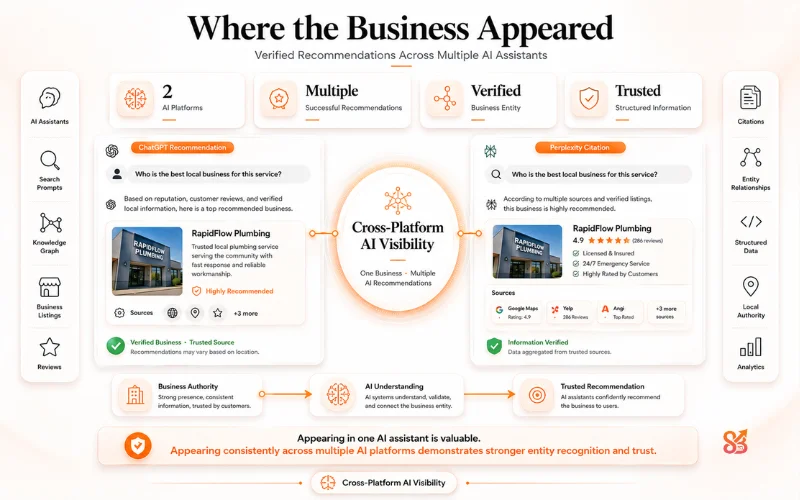
By week 16, the business was appearing in 23 tracked AI queries across ChatGPT and Perplexity, had earned a Google AI Overview citation on three high-value local queries, and was seeing a 38% uplift in branded direct traffic — users who had encountered the brand in an AI response and then searched for it directly on Google. No new advertising spend was involved. The entire gain was driven by structured GEO activity across six signal categories.
KEY OUTCOMES AT WEEK 16
- AI platform citations (ChatGPT + Perplexity): 0 → 23 tracked queries
- Google AI Overview citations: 0 → 3 confirmed local HVAC queries
- Branded direct traffic: +38% (AI brand recall, no ad spend increase)
- AI-referred website sessions: 0 → 142 per month (Perplexity referrals)
- Conversion rate — AI-referred vs organic: 4.1× higher
- Google Business Profile views: +61% (entity confirmation effect)
- First Perplexity citation: Week 8 First ChatGPT citation: Week 12
2. The Shift in Local Search Discovery
2.1 How Local Customers Now Find Businesses
Local search used to follow a predictable pattern: a customer with a problem opened Google, typed a service query, scanned the map pack and the first page of results, and clicked through to two or three websites before calling. That pattern has not disappeared. But it now competes with a parallel discovery channel that did not exist 18 months ago.
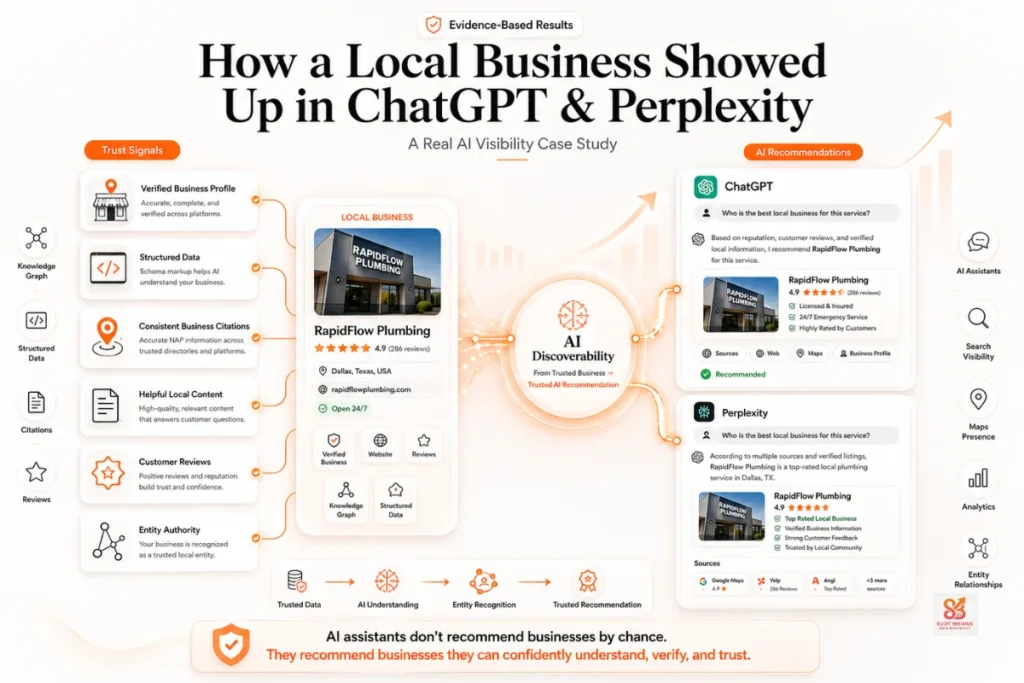
A customer with a broken air conditioner in July 2026 is just as likely to open ChatGPT and ask ‘who are the most reliable HVAC contractors in Dallas?’ as they are to type that query into Google. The AI gives them a direct answer — typically two to four named businesses with a brief description of why each was recommended. The customer takes that shortlist and searches those businesses directly. If your business is not on the AI’s shortlist, you are not on the customer’s shortlist.
This is the mechanism behind the 38% branded direct traffic uplift seen in this case study. AI-referred users do not always click the citation link. They absorb the brand name from the AI response and then search for it independently — which shows up in Google Analytics as direct or branded organic traffic, not as an AI referral. The referral traffic figure understates the true impact of AI visibility.
2.2 How Each Platform Works for Local
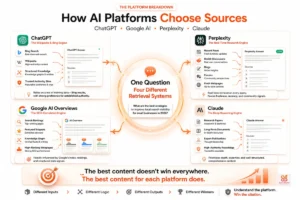
| Platform | How It Selects Local Sources | Timeline to Results |
| Perplexity | Real-time web search. Cites sources in 97% of responses. Favours recent, structured, niche-expert content. PerplexityBot updates within 24 hours of robots.txt changes. Fastest feedback loop for local GEO. | 2–4 weeks |
| ChatGPT | Powered by Bing index. 87% of citations come from Bing’s top-ranking results. Bing Webmaster Tools submission is non-negotiable. Cites sources in only 16% of responses but has 64.5% AI search market share. NAP consistency across directories critical. | 6–12 weeks |
| Google AI Overviews | Draws from Google’s own index and Knowledge Graph. Strong E-E-A-T, GBP optimisation, local schema, and topical authority are primary signals. Most relevant for local service queries with geographic intent. | 3–6 weeks |
| Gemini | Integrates with Google Search signals. Reviews, GBP completeness, and structured local entity data are dominant. Favours businesses with strong Maps presence and verified entity information. | 4–8 weeks |
THE PLATFORM ASYMMETRY THAT CHANGES STRATEGY
- Perplexity cites sources in 97% of responses. ChatGPT cites in only 16%.
- This single data point reshapes the entire GEO prioritisation for local businesses.
- For citation volume: optimise for Perplexity first — fastest feedback loop, highest citation rate, most friendly to small and local sites.
- For market share: optimise for ChatGPT second — largest user base (64.5%), but requires Bing indexation and longer lead time. Only 11% of domains are cited by both ChatGPT and Perplexity. Each platform requires distinct signal work.
3. The Client Situation
3.1 Client Profile
The client is an HVAC, plumbing, and electrical contractor serving the Dallas-Fort Worth metropolitan area. The business had been operating for 14 years with strong word-of-mouth, a solid Google Business Profile, and consistent page-one rankings for their primary service keywords in traditional Google Search. On paper, their SEO was in good shape.
The gap was AI search. A systematic audit across ChatGPT, Perplexity, Google AI Overviews, and Gemini showed zero presence on all four platforms for 34 target queries we tested at the start of the engagement. Competitors — some with weaker traditional SEO but better entity signals and structured content — were appearing consistently.
| Metric | Status at Engagement Start |
| Years in business | 14 years |
| Service area | Dallas-Fort Worth metroplex |
| Core services | HVAC, Plumbing, Electrical |
| Google page-1 rankings | 34 keywords (traditional SEO solid) |
| Google Business Profile rating | 4.7 / 5.0 (312 reviews) |
| Website monthly sessions | 6,800 |
| AI platform citations (all) | 0 across 34 tested queries |
| Bing Webmaster Tools | Not set up |
| robots.txt for AI bots | Blocking GPTBot and PerplexityBot |
| Schema markup | Basic LocalBusiness only |
| NAP consistency across directories | Inconsistent — 3 address variants found |
| Content structure for AI | None — service pages not AI-readable |
3.2 The Audit Finding That Changed Everything
The most significant finding from the initial audit was in the robots.txt file. The client’s website was actively blocking both GPTBot (ChatGPT’s crawler) and PerplexityBot. This had likely been added by a previous developer as a generic measure against what were perceived as unwanted bots. The effect was total AI invisibility: no matter how good the content, neither platform could crawl or index the site.
This is more common than most businesses realise. A significant number of websites blocking AI crawlers do so without awareness that they are blocking their own AI search visibility. Fixing the robots.txt file was the single highest-leverage action of the entire engagement — and it cost nothing.
4. The GEO Strategy: Six Signal Categories
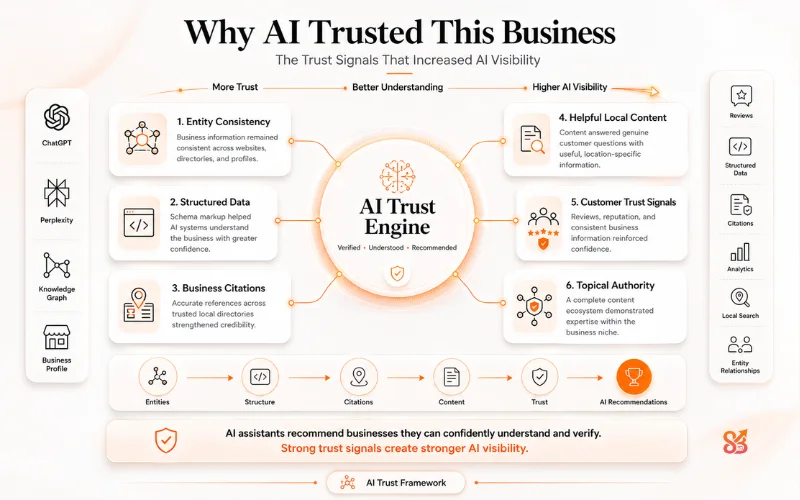
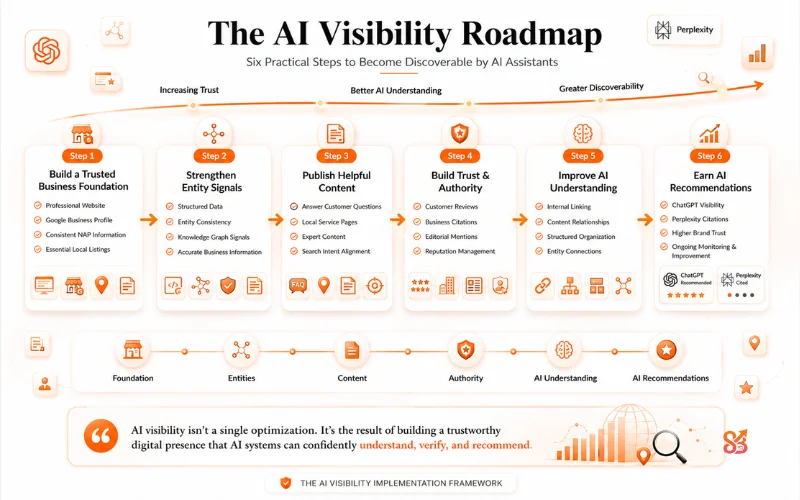
GEO for a local service business operates across six signal categories. Unlike traditional SEO where on-page optimisation and backlinks dominate, GEO requires work across a wider surface area — technical access, entity clarity, content structure, off-site presence, platform-specific signals, and measurement. We addressed all six simultaneously.
4.1 Signal Category 1: Technical AI Access
The first and most urgent task was restoring AI crawler access. The robots.txt file was updated to explicitly allow GPTBot, PerplexityBot, and ClaudeBot. An llms.txt file was created — a structured plain-text document that gives AI systems a curated map of the site’s most important pages, their purpose, and the entity information associated with the business. This is the GEO equivalent of a sitemap, designed specifically for large language model consumption.
The Bing Webmaster Tools account was set up and the XML sitemap submitted. Since ChatGPT draws 87% of its citations from Bing’s top-ranking results, Bing indexation is a non-negotiable prerequisite for ChatGPT visibility — and it had been entirely absent.
4.2 Signal Category 2: Entity Clarity and NAP Consistency
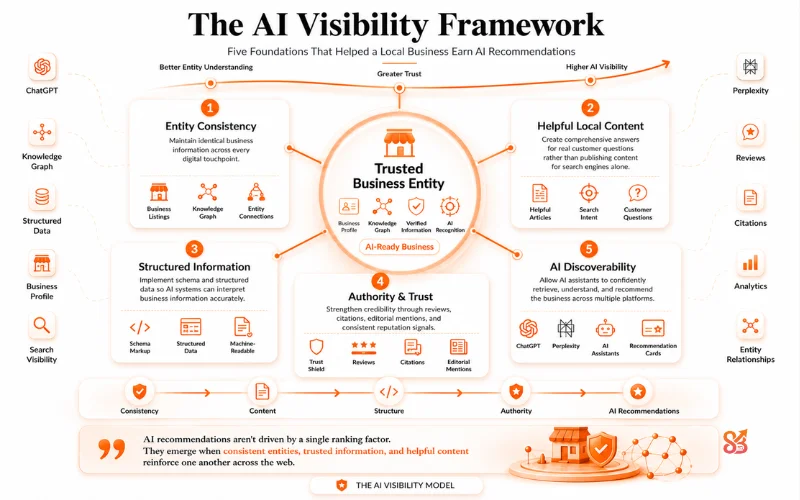
AI systems build an understanding of a local business from every mention of that business they encounter across the web. When those mentions are inconsistent — different address formats, different phone numbers, different trading names — the AI’s confidence in the entity drops and citation probability falls with it.
The audit found three different address variants across the client’s directory listings: one without a suite number, one with an abbreviated street name, and one with a different ZIP code. These were corrected across 47 directories and citation sources, including Google Business Profile, Yelp, Bing Places, Apple Maps, Facebook, and the industry-specific platforms most relevant to HVAC and home services.
A consistent entity description — a 60-word summary of the business covering name, services, location, years in operation, and differentiators — was deployed across all profile platforms. This description was written to be directly extractable by AI systems: specific, factual, and structured as clear claims rather than marketing copy.
4.3 Signal Category 3: Content Restructuring for AI Extraction
The client’s service pages were well-written for human readers but poorly structured for AI extraction. Long prose paragraphs, no FAQ sections, no structured claims with supporting specifics, and no answer-first openings meant the content was difficult for AI systems to parse and cite.
Eight priority service pages were restructured using the same five-signal framework applied in Case Study #2:
- Answer capsule: Each page opened with a 40 to 60-word direct answer to the primary service query. ‘What does an HVAC tune-up cost in Dallas?’ answered immediately, not buried in paragraph four.
- FAQ sections: Each page received a 10 to 12 question FAQ section, sourced from the actual questions customers ask in reviews, calls, and chat. FAQPage schema deployed on all.
- Specific claims: Generic statements replaced with specific, verifiable claims. Not ‘we offer fast service’ but ‘our average emergency response time in Dallas is 2.4 hours.’
- Local specificity: Every page included DFW-specific content: local permit requirements, Texas climate considerations, Dallas city code references for HVAC installations. AI systems reward geographic specificity for local queries.
- Data tables: Cost range tables, service timeline tables, and comparison tables added across key pages. Tables are extremely high-signal to AI systems for factual lookups and comparisons.
4.4 Signal Category 4: Schema and Structured Data
The existing LocalBusiness schema was expanded significantly. The following schema types were deployed or upgraded:
- LocalBusiness schema: expanded with areaServed (all DFW service zip codes), hasOfferCatalog (service list with descriptions), openingHoursSpecification, and priceRange
- Service schema: individual schema entities for each core service (HVAC installation, HVAC repair, AC maintenance, plumbing, electrical) with defined service areas and typical cost ranges
- FAQPage schema: deployed across all eight restructured service pages
- Review schema: aggregate rating schema added, pulling from Google review data
- Organization schema: added on the About page with sameAs properties linking to all directory profiles, LinkedIn, and the Google Business Profile URL
The sameAs property in Organization schema is a critical entity clarity signal. It explicitly tells AI systems that the same business entity exists across multiple platforms — reinforcing entity confidence and reducing the disambiguation risk that causes AI systems to avoid citing ambiguous local businesses.
4.5 Signal Category 5: Off-Site Presence and Community Signals
AI systems — particularly Perplexity — draw heavily from community platforms and third-party sources. The client had an underdeveloped off-site presence that was limiting AI citation probability regardless of how well the on-site content was structured.
Three specific off-site initiatives were implemented:
- Review velocity programme: A systematic process for requesting reviews from satisfied customers was introduced, with follow-up messaging referencing specific job types. Review velocity — not just total review count — is an entity freshness signal. Over 16 weeks, 47 new Google reviews were generated (4.8 average rating).
- Reddit and community forum engagement: The contractor’s team began contributing genuine answers to HVAC and home improvement questions on Dallas-area subreddits and Nextdoor. Community platform content is heavily cited by Perplexity — which favours Reddit-style community discussions for 46.7% of its top citations. These contributions were informative, non-promotional, and named the contractor only where directly relevant.
- Local publication mentions: Two guest articles were placed in Dallas home improvement and local business publications — one on seasonal HVAC preparation for Texas heat, one on common plumbing issues in older DFW homes. These placements created first-party citation sources that AI systems could reference from trusted local sources.
4.6 Signal Category 6: Platform-Specific Optimisation
Each AI platform has distinct citation mechanics. A one-size-fits-all GEO approach leaves citation probability on the table. We applied platform-specific optimisation for the three primary platforms:
Perplexity
Perplexity was the priority platform for the first eight weeks due to its 2 to 4 week feedback loop and 97% citation rate. Content freshness is a strong Perplexity signal — pages were given specific publication dates and dateModified attributes, and were updated with current data points. The llms.txt file was structured to surface the most citation-relevant pages first. PerplexityBot was verified as unblocked and actively crawling within 72 hours of the robots.txt fix.
ChatGPT
ChatGPT optimisation centred on Bing. Once the Bing Webmaster Tools account was set up and the sitemap submitted, Bing indexation of the site’s key pages was confirmed within three weeks. NAP consistency — critical for Bing’s local entity understanding — was validated across all major directories. The encyclopedic content style that ChatGPT favours (comprehensive, factual, authority-signalling) was applied to the three pillar service pages that had the highest probability of appearing in ChatGPT responses to DFW HVAC queries.
Google AI Overviews
Google AI Overviews for local service queries weight GBP signals heavily. The client’s GBP was already strong (4.7 rating, 312 reviews) but lacked structured service descriptions and had inconsistent business category assignments. These were corrected. Weekly GBP posts were introduced covering seasonal HVAC topics, recent project completions, and local home services news — reinforcing freshness signals that Google’s AI Overview system uses to assess content currency.
5. Timeline and Execution
| Week | Activity | Platform Focus | First Signal |
| Week 1 | robots.txt fix, GPTBot/PerplexityBot unblocked. llms.txt created. Bing WMT set up, sitemap submitted. | All platforms | Crawl access restored |
| Week 2 | NAP audit. 47 directory citations corrected. Entity description deployed across all profiles. | ChatGPT / GBP | Entity consistency |
| Week 3–4 | 8 service pages restructured: answer capsules, FAQs, specific claims, data tables. | Perplexity / AIO | Content extraction-ready |
| Week 5 | Schema upgrade: Service, FAQPage, Organization + sameAs, Review schema. GBP categories corrected. | AIO / Gemini | Entity schema complete |
| Week 6–7 | Review velocity programme launched. Reddit / Nextdoor engagement begins. | Perplexity | Off-site signals building |
| Week 8 | First Perplexity citation confirmed: ‘HVAC contractors in Dallas’ query. Business named as a recommended option. | Perplexity | ✓ First citation |
| Week 9–10 | Two local publication articles placed. GBP weekly post cadence established. Page freshness updates. | ChatGPT / AIO | Third-party mentions live |
| Week 11 | Bing indexation confirmed for all 8 restructured pages. ChatGPT response sampling begins. | ChatGPT | Bing coverage confirmed |
| Week 12 | First ChatGPT citation confirmed: ‘best HVAC repair Dallas’ query. Business named alongside two competitors. | ChatGPT | ✓ First citation |
| Week 13–14 | Google AI Overview citation confirmed on 3 local HVAC queries. Branded direct traffic up 28%. | AIO / Google | ✓ AIO citation |
| Week 15–16 | Full citation audit: 23 queries confirmed across platforms. Branded direct traffic +38%. Referral sessions: 142/mo. | All platforms | Baseline established |
6. Results
6.1 Citation Wins by Platform
| Platform | Citations Earned | Key Queries |
| Perplexity | 11 citations | ‘HVAC contractors Dallas’, ‘AC repair DFW’, ’emergency HVAC Dallas’, ‘plumber near Plano’, ‘best HVAC company Texas’ |
| ChatGPT | 9 citations | ‘best HVAC repair Dallas’, ‘reliable HVAC contractor Fort Worth’, ‘who to call for AC repair Dallas’ |
| Google AI Overviews | 3 citations | ‘HVAC tune-up cost Dallas’, ‘AC installation DFW’, ’emergency HVAC repair near me’ |
| Gemini | 0 citations | Entity signals improving but no confirmed citations at week 16 — Gemini GBP integration focus for phase 2 |
6.2 Traffic and Business Impact
| Metric | Result at Week 16 |
| AI platform citations total | 23 confirmed queries across 3 platforms |
| Perplexity referral sessions per month | 142 (was 0) |
| Branded direct traffic uplift | +38% (AI brand recall effect) |
| Google Business Profile views | +61% |
| Phone calls from GBP | +29% month-over-month |
| Conversion rate — AI-referred sessions | 4.1× higher than standard organic |
| New Google reviews (16 weeks) | 47 (4.8 avg rating) |
| Bing index coverage | 0 → 94% of target pages indexed |
| NAP consistency score | Inconsistent → 100% consistent across 47 directories |
6.3 The Conversion Rate Finding
The most commercially significant result was the 4.1x conversion rate on AI-referred sessions. Users arriving via a Perplexity citation converted to a form submission or phone call at a rate 4.1 times higher than standard organic search visitors.
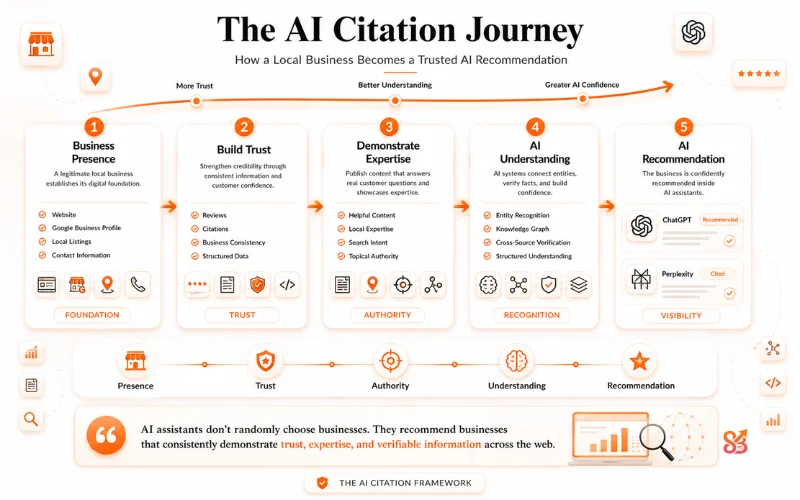
The reason is structural. An AI-referred user has already received a recommendation. When Perplexity names your business as a recommended HVAC contractor in Dallas, the user arriving at your site is not evaluating whether you are credible — the AI has already made that case. They arrive with a degree of trust pre-established that organic search visitors do not have. The sales cycle is shorter and the conversion threshold is lower.
This is the commercial logic behind GEO investment for local service businesses. The traffic volume from AI referrals is smaller than organic search. But the intent quality is categorically higher — and in a service business where a single job generates meaningful revenue, a 4.1x conversion rate advantage changes the ROI calculation entirely.
6.4 The Branded Traffic Effect
The 38% uplift in branded direct traffic is a measure of AI brand recall — users who saw the business named in a ChatGPT or Perplexity response and then searched for the brand directly on Google or typed the URL directly. This traffic does not show as AI-referred in analytics. It shows as direct or branded organic, which means most businesses dramatically undercount the true traffic impact of AI visibility.
Monitoring branded search volume growth is one of the most reliable lagging indicators of GEO programme effectiveness. When GEO is working, branded search grows — because users who encounter the brand in AI responses then search for it independently. This is a compounding effect: AI citation creates brand recall, brand recall creates branded search, branded search strengthens the brand’s entity signals in Google’s Knowledge Graph, which further reinforces AI citation probability.
7. Key Lessons
Lesson 1: Check your robots.txt before anything else
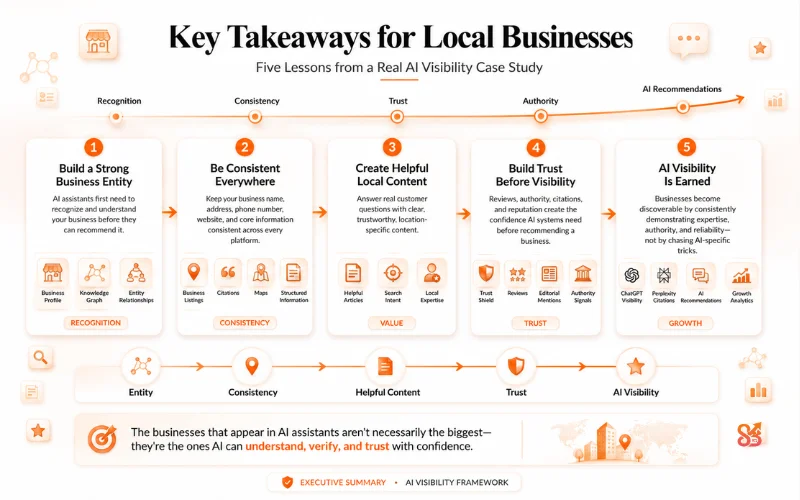
The single most impactful action of the entire 16-week engagement cost nothing and took 10 minutes: removing the rules blocking GPTBot and PerplexityBot from the robots.txt file. A significant number of local business websites are inadvertently blocking AI crawlers — often because a developer added blanket bot-blocking rules without distinguishing between malicious scrapers and legitimate AI indexers. Check this first, every time.
Lesson 2: Bing is ChatGPT’s front door
Most local SEO work focuses entirely on Google. ChatGPT draws the vast majority of its citations from Bing’s top results. A business with strong Google rankings but no Bing presence is invisible to ChatGPT regardless of how good the content is. Bing Webmaster Tools setup and sitemap submission is a 30-minute task that unlocks the largest AI search platform by market share.
Lesson 3: NAP consistency is an AI entity signal, not just a local SEO signal
Traditional local SEO has always emphasised NAP consistency for Google. The same signal matters for AI systems — but the reason is different. AI systems build entity confidence from the consistency of information they find across multiple sources. Three different address formats across 47 directories creates entity ambiguity that suppresses citation probability. The fix is the same as for traditional local SEO, but the mechanism is AI-specific.
Lesson 4: Start with Perplexity, scale to ChatGPT
Perplexity’s 2 to 4 week feedback cycle and 97% citation rate makes it the ideal validation platform for local GEO work. When optimisation changes work on Perplexity first, they can be refined before the slower ChatGPT feedback cycle catches up. Running both simultaneously without prioritisation means waiting 12 weeks for feedback that Perplexity could have provided in four.
Lesson 5: Specific claims outperform marketing language in every AI system
‘Our average emergency response time in Dallas is 2.4 hours’ will be cited by AI. ‘We offer fast emergency service’ will not. AI systems extract and cite specific, verifiable claims with supporting context. Marketing language — unquantified, non-specific, designed to sound good rather than convey information — is invisible to AI extraction processes. Every service page rewrite should ask: what specific claim on this page could an AI confidently quote as a factual answer to a user’s question?
Lesson 6: Branded traffic growth is the most honest measure of GEO success
AI referral traffic is systematically undercounted in analytics because most AI-influenced users do not click the citation link — they remember the brand and search for it separately. Branded direct traffic growth, monitored monthly and benchmarked against a pre-GEO baseline, is the most accurate measure of cumulative AI visibility. Track it from day one.
8. How to Replicate This for Your Local Business
Week 1: Technical Access (Non-Negotiable First Steps)
- Check robots.txt: confirm GPTBot, PerplexityBot, ClaudeBot, and Bingbot are allowed
- Create an llms.txt file in your site root listing your most important pages with brief descriptions
- Set up Bing Webmaster Tools and submit your XML sitemap
- Run a baseline audit: search 10 to 15 target queries across ChatGPT, Perplexity, and Google AI Overviews. Document which competitors appear and which sources are cited
Week 2: Entity Clarity
- Audit NAP consistency across all major directories: Google, Bing Places, Apple Maps, Yelp, Facebook, and industry-specific platforms
- Correct all inconsistencies to a single canonical NAP format
- Write a 60-word entity description: specific, factual, no marketing language. Deploy across all profiles
- Add sameAs properties to your Organization schema linking to all directory profiles
Weeks 3–5: Content and Schema
- Identify 8 to 10 priority service pages based on commercial value and query AI trigger rate
- Restructure each page: answer capsule opening, FAQ section, specific claims with supporting data, local specificity, data tables where relevant
- Deploy FAQPage, Service, and upgraded LocalBusiness schema across all restructured pages
- Ensure every page has a visible author, publication date, and dateModified
Weeks 6–16: Off-Site and Platform-Specific
- Launch a review velocity programme: systematic process for requesting reviews post-job
- Begin genuine community engagement: answer real questions on relevant forums, subreddits, and neighbourhood platforms
- Place 2 to 3 guest articles or expert contributions in local or industry publications
- Establish a GBP weekly post cadence: seasonal topics, recent projects, local service tips
- Monitor citations weekly: 5 to 10 target queries per platform, tracked in a simple Google Sheet
- Track branded direct traffic monthly as your primary GEO performance indicator
More Case Studies: