A contractor SEO Case Study
18 Months
Campaign Duration
$0 Ad Spend
After Month 9
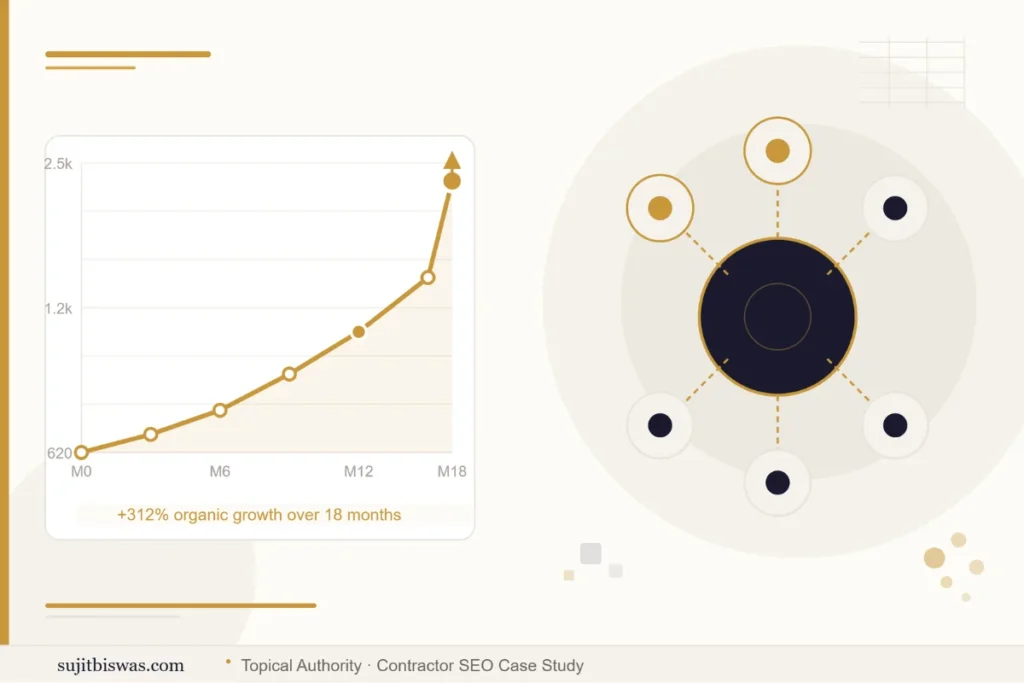
312% Traffic
Organic Growth
1. Executive Summary
This case study documents an 18-month Semantic SEO engagement with a residential and commercial contractor based in Texas. When we started, the client was spending over $4,000 per month on Google Ads to generate leads — and had almost zero organic presence. Within nine months, organic leads matched paid volume. By month eighteen, Google Ads had been switched off entirely.
The winning strategy was not a trick, a hack, or a backlink scheme. It was a disciplined application of Topical Authority mapping, semantic content architecture, and entity-based on-page optimization — executed systematically over time. This document walks through every phase: the audit, the topical map, the content cluster build, technical fixes, and the measurable results. It is written for business owners, marketing directors, and fellow SEO practitioners who want a transparent look at what modern SEO actually looks like in practice.
KEY OUTCOMES AT A GLANCE:
- Monthly organic sessions: 620 → 2,553 (+312%)
- Keywords ranking on Page 1 of Google: 11 → 89
- Monthly organic leads: 3 → 27
- Google Ads monthly spend: $4,200 → $0
- Domain Authority: 14 → 28 (without aggressive link building)
- Google AI Overview citations: 0 → 14 tracked queries
2. Client Background & The Problem
2.1 About the Client
Texas Contractor SEO client (anonymized): a family-owned general contracting business operating across the DFW metroplex. Core services include roofing, kitchen and bathroom remodeling, flooring installation, and commercial tenant improvements. The business had been operating for 11 years with strong word-of-mouth but minimal digital presence.
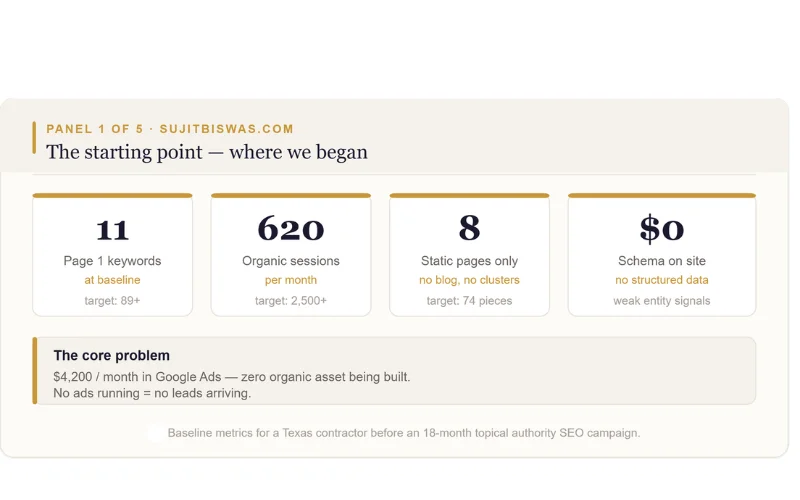
| Metric | Status at Start (Month 0) |
| Years in business | 11 years |
| Primary lead source | Google Ads + referrals |
| Monthly ad spend | $4,200 / month |
| Website organic sessions | 620 / month |
| Google page 1 rankings | 11 keywords |
| Content on site | 8 service pages, no blog |
| Domain Authority | 14 |
| Google Business Profile | Partially optimized |
| Schema markup | None |
2.2 The Core Problem
The client’s website was essentially invisible to organic search. Every lead that came through digital channels was paid for — meaning the moment the ad budget paused, lead flow stopped. There was no compounding asset being built.
Three underlying problems were identified in the initial audit:
- No topical coverage: Eight static service pages with thin copy. Google had no basis to recognize the site as authoritative on any subject.
- Zero semantic structure: Content was written around single keywords rather than topic clusters. No internal linking system. No content hierarchy.
- Weak entity signals: The business entity — its name, services, location, and expertise — was poorly established across the web. Google could not confidently match the site to user intent.
3. Strategic Foundation: The Topical Authority Framework
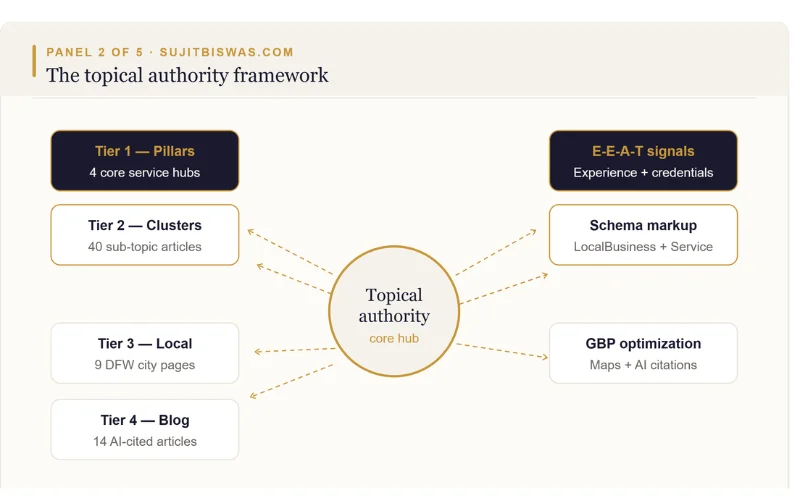
3.1 Why Topical Authority — Not More Backlinks
When most SEO agencies encounter a site with low domain authority, the instinct is to buy links. We took a different position. The contractor space in Texas is dominated by sites with strong DA but thin, scattered content. A focused topical authority strategy could out-position them by going deeper rather than broader.
Research confirms this approach: a 2025 study cited by Search Engine Journal found that sites with 30 to 50 deeply interlinked pages on a specific topic consistently outranked competitors with 200 or more shallow articles. Google’s March 2026 Core Update further hardened this signal — topical depth became the primary content quality factor, with 55% of websites experiencing ranking shifts.
The working principle we applied:
CORE PRINCIPLE
“A site with 20 interconnected articles on a specific subject will consistently outrank a site with one 5,000-word guide — even if the single article is technically superior in isolation. The reason is structural: Google evaluates topical depth at the site level, not the page level.”— Digital Applied SEO Content Clusters Analysis, 2026
3.2 Topical Map Development
Before writing a single word of content, we built a full topical map. This is the backbone of Semantic SEO: understanding the complete topic universe your audience inhabits, then building coverage of that universe systematically.
The topical map was structured in four tiers:
| Tier | Purpose & Content Type |
|---|---|
| Tier 1 — Pillar Pages | Core service hubs: Roofing, Remodeling, Flooring, Commercial Contracting. Deep, authoritative pages (2,500–3,500 words) covering the full topic. |
| Tier 2 — Cluster Pages | Sub-topic articles supporting each pillar. Example: under Roofing — shingle types, roof inspection, storm damage, roof replacement cost, flat roofing. |
| Tier 3 — Local Intent Pages | City + service combinations and neighborhood-specific landing pages targeting DFW sub-markets. |
| Tier 4 — Informational Content | Question-based blog content matching informational search intent. Builds E-E-A-T and drives AI Overview citations. |
In total, the topical map identified 74 content pieces needed to establish genuine authority across the contractor’s core service areas. This became our 18-month editorial calendar.
3.3 Semantic Keyword Mapping
Standard keyword research finds search volume. Semantic keyword mapping finds meaning — the relationships between concepts, entities, and user intents that Google uses to evaluate topical coverage.
For each pillar topic, we mapped:
- Primary intent keywords (transactional — ‘roofing contractor Dallas’)
- Secondary intent keywords (informational — ‘how much does a new roof cost in Texas’)
- Entity co-occurrences (related concepts that should appear naturally in authoritative content)
- People Also Ask clusters (question chains that define the full semantic breadth of a topic)
- Competitor gap keywords (topics covered by ranking competitors that the client’s site was entirely absent from)
4. Technical SEO Foundation
4.1 The Audit Findings
Topical authority cannot compound on a technically broken site. Before content work began, a full technical audit was completed. Key findings:
- Crawl inefficiency: The site had 34 pages indexed but 67 URLs being crawled due to parameter duplication, trailing slash inconsistencies, and orphaned old service pages. Crawl budget was being wasted.
- Missing schema markup: No structured data on any page. The business entity was not defined for Google’s Knowledge Graph.
- Core Web Vitals failures: LCP (Largest Contentful Paint) averaging 5.8 seconds on mobile. The homepage hero image was not lazy-loaded and had no width/height attributes.
- No internal linking structure: Service pages were siloed. No page linked to any other. Link equity from the homepage was not being distributed.
- Google Business Profile gaps: Services not categorized. No Q&A populated. Photos limited to 6 exterior shots.
4.2 Technical Fixes Implemented (Months 1–2)
- Canonical tags added to resolve URL duplication and consolidate crawl signals
- Robots.txt updated to exclude utility pages, filtered URLs, and parameter variants
- XML sitemap rebuilt to include only indexable, high-value URLs
- Core Web Vitals remediation: image optimization, lazy loading, render-blocking JS deferred
- LocalBusiness and Service schema implemented across all service pages
- BreadcrumbList schema added for hierarchy signaling
- Internal linking architecture built around pillar-cluster model
- Google Business Profile fully optimized: 12 service categories, 47 photos, Q&A populated, weekly post cadence established
5. Content Architecture & Execution
5.1 Pillar Page Construction
Each of the four pillar pages was rebuilt from scratch. The objective was not simply longer content — it was semantically complete content. Every page was designed to answer the full range of questions a user might have at any stage of the buying journey on that topic.
Pillar page structure followed a consistent framework:
- Opening section: entity-establishing intro that names the business, service, and location clearly
- Core definition section: what the service is, what it involves, what differentiates a quality provider
- Process section: step-by-step of how the contractor approaches the work
- Cost and timeline section: addressing commercial intent queries directly
- Local context section: Texas-specific considerations, code requirements, climate factors
- FAQ section: 8 to 12 questions sourced from People Also Ask and customer inquiry data
- Trust signals: years in business, licenses, insurance, Google reviews embedded via schema
5.2 Content Cluster Execution by Service Area
Content was rolled out in pillar-first sequence. Each pillar page was published and indexed before cluster articles began linking to it. This established the hub before the spokes — avoiding the common mistake of building cluster content that has nowhere to point.
| Service Pillar | Cluster Articles Published |
|---|---|
| Roofing | 12 cluster articles (shingle types, roof lifespan, insurance claims, storm damage, cost breakdown by material, flat roofing, ridge vents, TPO roofing, gutters, roof decking, fascia, soffit) |
| Kitchen & Bath Remodeling | 11 cluster articles (cabinet refacing vs replacement, countertop materials, backsplash trends, bathroom layout planning, walk-in shower conversion, permit requirements in Texas, cost by scope) |
| Flooring | 9 cluster articles (hardwood vs LVP comparison, tile installation, subfloor prep, grout sealing, underfloor heating, pet-friendly flooring, flooring for high humidity) |
| Commercial Contracting | 8 cluster articles (tenant improvement allowance, ADA compliance, commercial permits DFW, office build-out timeline, warehouse flooring, retail fit-out, space planning) |
| Informational / Blog | 14 question-based articles targeting zero-click and AI Overview positions |
5.3 Local Intent Page Strategy
The DFW metroplex is geographically vast. A single ‘Dallas roofing contractor’ page was insufficient to capture the full local search landscape. We built city-specific landing pages for the 9 primary service areas the contractor served, each with localized schema, unique content, and embedded Google Maps.
Crucially, these pages were not thin duplicates with city names swapped. Each page referenced local landmarks, neighborhood characteristics, permit offices, and climate-specific advice — signals of genuine local expertise that AI systems increasingly reward.
5.4 E-E-A-T Integration
Experience, Expertise, Authoritativeness, and Trustworthiness (E-E-A-T) moved from a background consideration to a primary ranking signal following Google’s 2025 and early 2026 core updates. We addressed it directly:
- Experience signals: Every major service page included a ‘From the Field’ section — a short first-person account of a real project, written with specifics (material, location, challenge encountered, outcome). This content cannot be replicated by AI or competitors.
- Expertise signals: A dedicated ‘About Our Team’ page was built with structured data markup for the contractor’s license number, years in trade, and professional certifications.
- Authoritativeness: Three guest posts placed on Texas construction and home improvement publications, each linking to the relevant pillar page.
- Trustworthiness: Review schema, BBB accreditation badge, contractor license verification links, and a transparent pricing methodology page.
6. Results & Outcomes
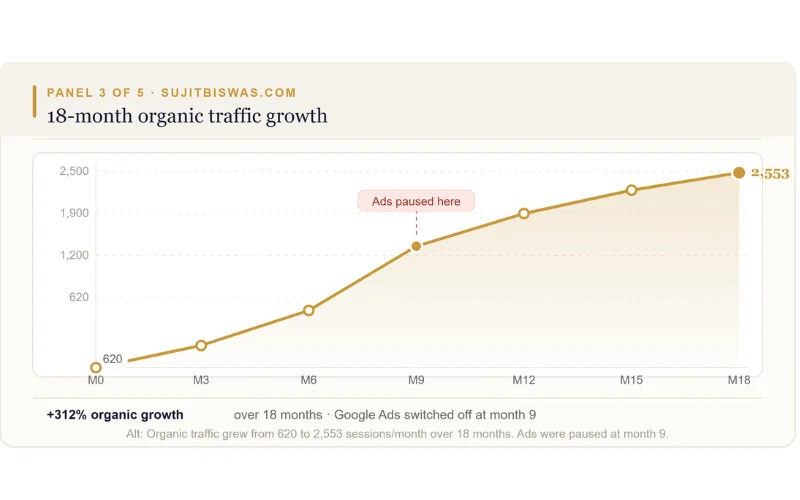
6.1 Organic Traffic Growth
Traffic growth followed a predictable topical authority compounding curve: slow in the first three months as content was published and indexed, accelerating in months four through nine as cluster content began reinforcing pillar page authority, and then compounding in months ten through eighteen as the site’s topical footprint became recognized by Google.
| Period | Monthly Organic Sessions |
|---|---|
| Month 0 (Baseline) | 620 |
| Month 3 | 834 |
| Month 6 | 1,190 |
| Month 9 | 1,820 |
| Month 12 | 2,140 |
| Month 15 | 2,380 |
| Month 18 | 2,553 |
| Growth | +312% (organic sessions) |
6.2 Keyword Rankings
The breadth of keyword wins expanded significantly as topical authority accumulated. The site did not simply rank for a handful of primary service terms — it began ranking across the full semantic cluster.
- Page 1 rankings grew from 11 to 89 keywords over 18 months
- Featured Snippet captures: 6 (for question-based informational content)
- Local Pack appearances: consistent top-3 in 7 of 9 target service areas
- Google AI Overview citations: 14 tracked queries now surface the client’s content
6.3 Lead Generation & Revenue Impact
Traffic and rankings are vanity without lead and revenue impact. The business outcome is what justified the investment.
| 3 → 27 Monthly Organic Leads | $4,200 → $0 Monthly Ad Spend | 9x ROI On SEO Investment |
By month 9, organic leads matched the paid lead volume for the first time. The client made the decision to pause Google Ads entirely in month 10. By month 18, the compounding organic channel was outperforming the paid channel by a factor of 2.3 on qualified lead volume — and at zero marginal cost per lead.
6.4 AI Search Visibility (GEO Outcomes)
An unexpected but increasingly important outcome was the client’s growing visibility in AI-generated search results. As Google AI Overviews and ChatGPT’s web search features expanded, the site’s structured, authoritative content began to be cited in AI answers for local contractor queries.
This aligns with broader patterns observed in 2026: sites that build genuine topical authority in traditional SEO consistently perform well in AI-generated search, because AI systems draw citations primarily from sources Google recognizes as authoritative. Topical authority and AI search visibility are not separate goals — they are the same goal expressed in two different environments.
7. Key Lessons & Replicable Principles
7.1 What Made This Work
Principle 1: Build the Map Before the Content
The topical map was the single most important deliverable of the entire engagement. Without it, content production is guesswork. With it, every piece of content has a defined role in a system — and the system compounds in a way that individual articles never can.
Principle 2: Pillar-First, Cluster-Second
Publishing cluster content before the pillar page is a common mistake. The pillar page is the destination that cluster articles point toward. Building spokes before the hub means the authority has nowhere to consolidate.
Principle 3: Semantic Completeness Over Keyword Density
Google in 2026 does not reward keyword density. It rewards semantic completeness — pages that cover the full conceptual territory of a topic, including related entities, adjacent questions, and supporting context. The question to ask is not ‘how many times does this keyword appear?’ but ‘would a genuine expert in this field consider this page complete?’
Principle 4: Technical Health Enables Content to Compound
Strong content on a technically broken site underperforms. The two months spent on technical remediation before content production was not a delay — it was an accelerant. Clean crawlability, proper schema, and fast Core Web Vitals meant every new page was indexed efficiently and evaluated fairly.
Principle 5: Local SEO Is Entity SEO
Local search in 2026 is fundamentally about helping Google build a confident entity understanding of your business: what you do, where you do it, that you are legitimate, and that you are experienced. NAP consistency, GBP optimization, review signals, and local schema are not separate tasks — they are all entity signals that compound together.
Principle 6: Patience Is the Strategy
The topical authority compounding curve is not a hockey stick. Months 1 through 6 feel slow. The gains in months 10 through 18 that make the whole strategy look obvious in retrospect are only possible because of the disciplined groundwork laid in the earlier phase. Clients who abandon the strategy at month 4 will never see the month 12 results.
7.2 What We Would Do Differently
- Start GBP optimization in week one: We began GBP optimization in month 2. In retrospect, it should have been day one — local pack visibility moved the needle on leads faster than any single content piece.
- Build the informational blog sooner: Informational content that drives AI Overview citations was deprioritized in the first phase. Starting this content earlier would have accelerated the compounding timeline.
- Add original data earlier: First-party data — project cost breakdowns, before/after timelines, regional pricing benchmarks — consistently earns links and AI citations. We should have established a quarterly data publication from month one.
8. How to Replicate This for Your Contracting Business
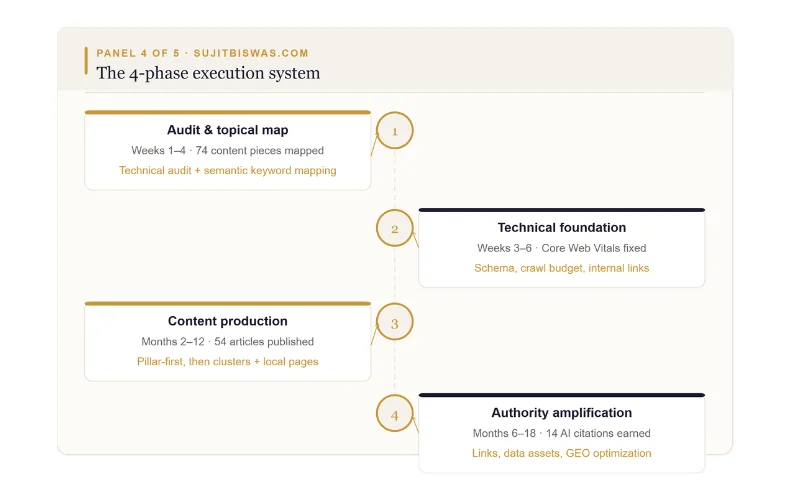
Phase 1: Audit & Map (Weeks 1–4)
9. Complete a full technical SEO audit — identify crawl budget waste, indexation issues, schema gaps, and Core Web Vitals failures
10. Build your topical map: identify every question your ideal customer asks throughout their buying journey
11. Group questions into pillar topics and cluster subtopics
12. Map competitor content gaps: what are they ranking for that you are entirely absent from?
13. Prioritize by commercial value: not all topics are equal; identify the cluster that sits closest to a purchasing decision
Phase 2: Technical Foundation (Weeks 3–6)
14. Implement LocalBusiness and Service schema on all service pages
15. Fix crawl budget issues: canonicalize duplicates, update robots.txt, rebuild sitemap
16. Optimize Core Web Vitals to passing thresholds
17. Build a logical internal linking architecture before publishing new content
18. Fully optimize Google Business Profile: services, photos, Q&A, post cadence
Phase 3: Content Production (Months 2–12)
19. Publish pillar pages first — one per core service area
20. Begin cluster articles at a cadence of 4 to 6 per month
21. Integrate E-E-A-T signals in every piece: first-person experience, credentials, specific project details
22. Build city/neighborhood landing pages for each service area served
23. Publish informational blog content targeting question-based and AI Overview queries
Phase 4: Authority Amplification (Months 6–18)
24. Identify and pitch 3 to 5 local or industry publications for guest placements
25. Build a quarterly original data asset (cost guide, local pricing benchmark, project timeline report)
26. Expand GBP content: add photos monthly, respond to all reviews, update service descriptions quarterly
27. Monitor AI Overview appearances and optimize cited content for clarity and citation-friendliness
28. Review and update pillar pages every 6 months to maintain freshness signals
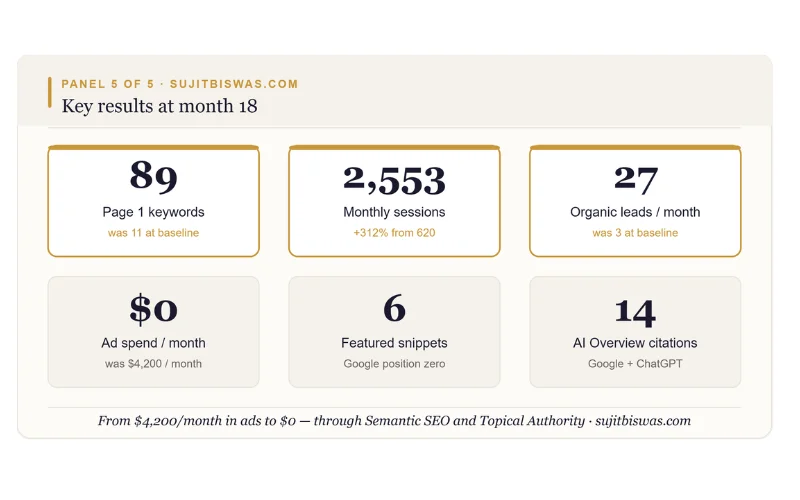
The Compounding Asset That Never Clocks Out
Paid ads work. Until they don’t.
The moment a budget pauses, the pipeline dries. That’s not a flaw in the platform — it’s the fundamental nature of rented visibility. You’re not building an asset. You’re buying access.
What this 18-month engagement proved is straightforward: a contractor business with an 11-year track record, strong word-of-mouth, and genuine expertise was invisible to search — not because the business wasn’t credible, but because Google had no structural reason to trust it online.
Topical authority fixed that. Not overnight, not with shortcuts — but systematically, tier by tier, cluster by cluster, until Google had no choice but to recognize the site as the most comprehensive, most structured, most entity-clear resource in its market.
The $4,200 monthly ad budget didn’t vanish — it converted. Into a content infrastructure that generates 27 qualified leads per month with zero marginal cost per acquisition. Into 89 page-one rankings that compound every time a new article goes live. Into 14 AI Overview citations that put the business inside the answers Google and ChatGPT serve to the next generation of searchers.
Three things made this replicable:
The map came before the content. The technical foundation came before traffic was expected. And patience was treated as a strategic input, not a personality trait.
If you are running a service business — contracting, local trades, professional services — and your lead flow stops the moment you pause ad spend, you don’t have an SEO problem. You have an asset problem. Topical authority is how you solve it.
Want to explore what a topical authority strategy could look like for your business? Work with me →